Capitalism Under Fire III

I probably should’ve started here. Any discussion of capitalism assumes people understand the role of capital. This may be a false assumption. Ask your friends or others to define or describe capital. You might get a blank stare, or something like, “Oh, that’s stocks and bonds.” Can you define or describe it?

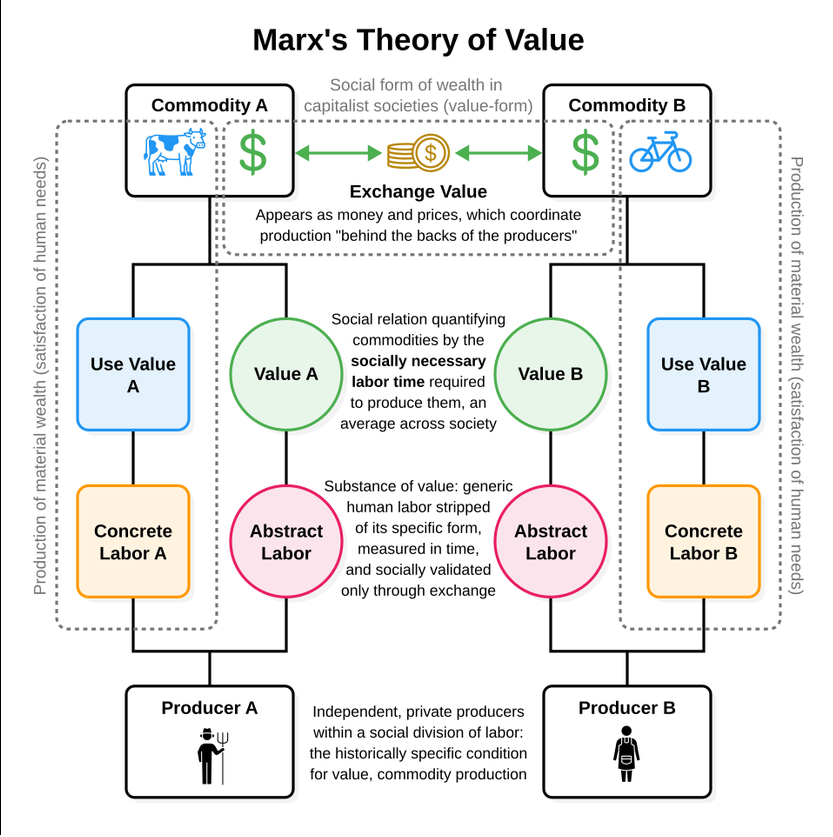
Apparently, this lack of awareness is widespread. I asked AI whether many Americans could describe economic capital. The answer is that very few can. On the other hand, surveys show that at least 17% can define socialism, and many more have some idea of it. This knowledge includes Karl Marx’s concepts like his convoluted labor theory of value:
However, capital, unlike Marx, isn’t hard to understand. The easiest way to understand capital is to think of it as foregone consumption. Eons ago, our hunter-gatherer forebears would forage for grains and fruit over distance. At some point, they brought some back closer to the cave. Maybe some dropped on the ground, and new plants grew. Someone noticed and, rather than eating everything on later forays, planted some of the seeds instead. When the crop ripened, the planter saved some of the harvest for the next crop, again foregoing consumption; in agriculture, we called the saved amount seed corn. In economics, we call it capital.

If you want similar crops in the future, you save a similar amount of seed, but to grow more, you need more seed, more capital. Growing the tribe’s economy requires ever-expanding seedcorn-capital.

Of course, risk is ever-present. Rats may eat your saved seeds. A flood may wash away the crop. Drought or locusts may loom. Thieves and hostile governments, both foreign and domestic, are ever present. So capital is also a bet on the future. It stands to reason that the most successful farmers can take the biggest risks. Through their knowledge and resources, they have the best chance of overcoming the risks.

Properly assessing the risk-reward ratio is often key to moving forward. The old saying, “nothing ventured, nothing gained,” is true for people and societies. Refusing to take a chance guarantees you won’t make progress.

Continue reading →
Capitalism Under Fire I

It is widely reported that Socialism is more popular than ever in the U.S. and is gaining on Capitalism as our preferred economic system. This shift is most prominent among young people, many of whom claim that Capitalism just hasn’t delivered for them. Because of Capitalism’s failures, we are in the middle of an affordability crisis.

While this may make some sense on the surface, a closer look is warranted. Affordability is just another way of saying prices are too high and rising. In other words, Inflation. Economist Milton Friedman famously stated that “inflation is always and everywhere a monetary phenomenon,” arguing it results from the money supply growing faster than economic output—too much money chasing too few goods.

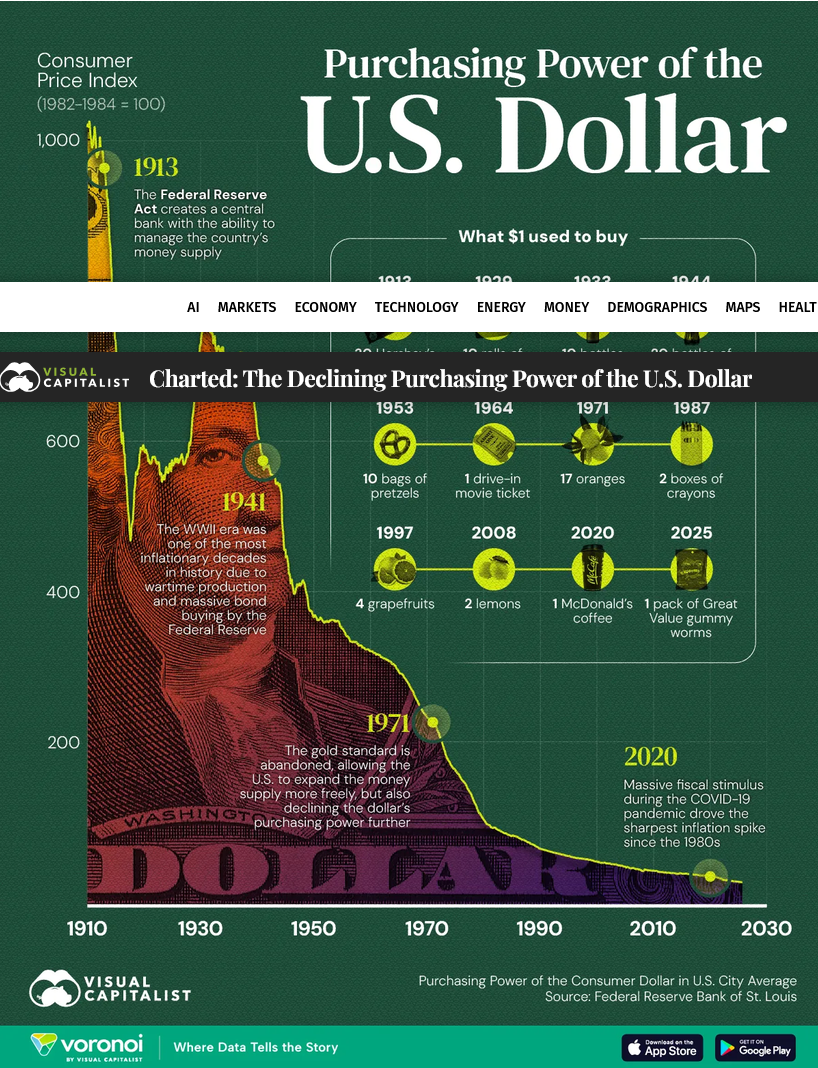
Capitalism means the least government interference in the economy. Private enterprise has no control over the money supply. Only the Government, through the Federal Reserve (FED), has that power. The FED is a 1913 progressive creation with a poor record on Inflation:

Except for wars, sustained rising prices were virtually unknown before the FED. In fact, during the Gilded Age, a period with little government interference but amazing growth, prices consistently fell, increasing real wages. Inflation, then, is a government phenomenon. Blaming Capitalism is misplaced. Looking to the Government for solutions flies in he face of experience.

This situation led me to look more closely at the other prevalent criticisms of Capitalism. The first thing you find is this: Adam Smith and his followers, moving away from the government-controlled mercantilist and feudal systems then in existence, never used the term Capitalism. Instead, they used free markets or free enterprise. Smith himself called it a “system of natural liberty.” French socialist Louis Blanc used the word capitalisme around 1850 to mean “the appropriation of capital by some to the exclusion of others.” He obviously meant it as a pejorative.

Maybe this explains why the media and academia use Capitalism rather than free market or free enterprise when referring to an economic system relying on markets to direct investment and set prices?

The Gallup poll shows Socialism’s favorability rising to 43% vs. Capitalism at 53%, while Free Enterprise in the same poll sits at 77%. Yet Capitalism and Free Enterprise are considered synonyms in every dictionary, meaning essentially the same.

Curious, I asked AI what the major failures of Capitalism were touted. They centered on five general n deficiencies. Unequal distribution of Wealth, market failures, prioritizing demand over morality, environmental degradation, and labor exploitation make for quite an indictment.  

Since we aren’t gods and aren’t perfect, a reasonable inquiry into this bill of particulars should ask: compared to what? Has any other system done a better job in these areas?

Continue reading →

Delusions

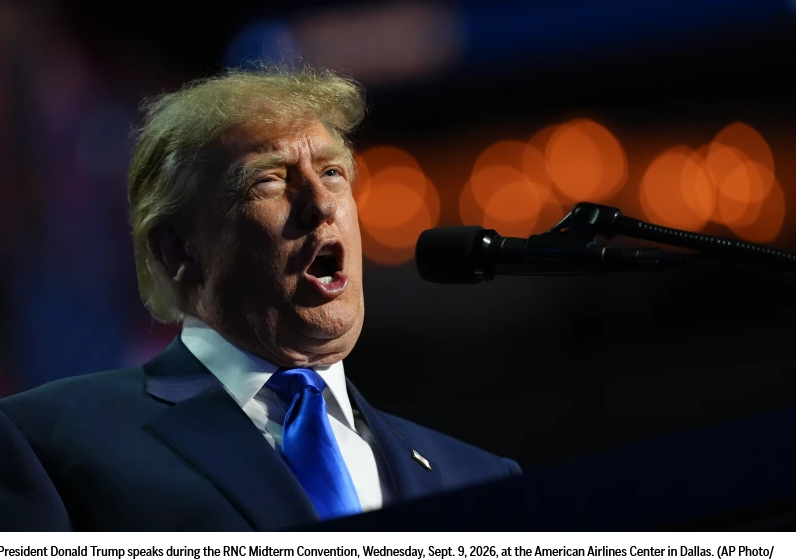
“If the Republicans win the House of Representatives and the United States Senate, both of them,” President Donald Trump said at his midterm convention, “I will issue a dividend to every adult citizen in the United States of America for $5,000.” As the New York Times (NYT) tells us, in 2020, Democrats in Georgia pointed to $2,000 coronavirus relief checks if their party took control of the Senate. Politicians always promise more cash or other monetary benefits if you’ll vote their way:

The Socialist Party of America (DSA), which exerts more and more influence on the Democratic Party, promises either lots of free stuff or more cash in your pocket through things like greatly expanding the minimum wage. All these promises come against the backdrop of “The Affordability Crisis.”

The crisis is just a way of saying prices are rising faster than our ability to pay them. Both parties point to putting more dollars in everyone’s pockets as the answer. But does this make sense? Say ten people are in line to buy one of the ten parcels of necessities needed to survive. Each has $100; the necessities, to no one’s surprise, cost $100. Now President Trump, or Mayor Mandami, comes along and gives each $50. Everyone has more money in their pockets, but now the price of necessities has risen to $150. Unless supply increases, this is the only outcome.

Donald’s or Zohan’s largesse runs aground because of the Law of Supply and Demand. It still rules, as it has through the ages. Simply put, if Demand exceeds supply, prices will rise. Increasing Demand without more supply keeps prices rising.

Increasing supply to meet or exceed Demand stops inflation. However, this solution requires capital investment. Planting more acreage, building a factory, drilling wells, ships to bring in imported goods, or opening a mine- whatever is needed to increase supply demands capital.

Capital is forgone consumption, or put another way, savings, and the positive returns on them. If you lend at interest or invest directly in assets that grow in value, you have more capital, but you also face the risk of loss. Not every well finds oil, gas, or even water.

Continue reading →

Mental Health Exercise

With the Strait of Hormuz under the control of the Iranian Regime, and Rockets and drones raining down on our friends, without a visible objective or strategy on our part, I’ve said all I can. I lost track of where the Trump administration wanted to go with its attack when it ruled out cooperation with the Kurds. Others had a similar response.

Wall Street Journal columnist Holman Jenkins Jr, a member of that paper’s editorial board, put it this way: “The moment that gave me pause was when the administration backed away from unleashing Iran’s Kurdish rebels. Yes, if U.S. goals were limited, a certain delicacy was appropriate here. But if the U.S. means to impose maximal stress on Iran’s ruling group, if the goal is to push the Regime to the wall, then throw everything at it, including the Kurds—at least everything short of a presumably unacceptable U.S. ground invasion.”

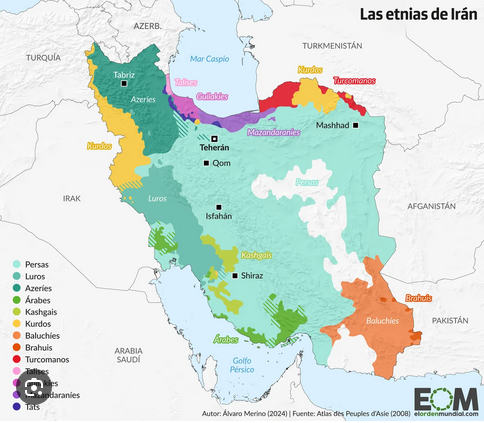
Why not? Not only could the Kurds provide an area for the Iranian opposition to gather, arm, train, and organize, but it would also give Iran’s Azerbaijanis (AZERIAS), to the north and east of the Kurdish areas, freedom from a regime repressing them. Bordering Azerbaijan, where their ethnic brothers and sisters reside, it would allow that nation to support their brethren. Azerbaijan is friendly with Israel, and is now being attacked with drones from Iran. Together, the Kurds and Azerbaijanis constitute over 25% of Iran’s present population. A good start to any revolt.

As I’ve said, maybe our administration, the Israelis, or both have something great up their sleeves. Given Trump’s performance on tariffs, confused aims are understandable, but this muddle is uncharacteristic of Israel. Maybe there is a winning master plan proving me happily foolish, but for now, I have to move on to something else for my mental health.

Continue reading →

Head-scratchers

Confusion rules. Has there been a time when, other than wars or economic reversals, everything was so up in the air? In just the last couple of weeks, we’ve had a meltdown over frozen Greenland, a fleet racing to the Middle East for possible military action against Iran, and the appointment of a Federal Reserve chairman philosophically at odds with the President, who appointed him. All with worldwide implications. What can we make of all this?

We’ve gone from giving the U.S. Greenland or else, to we’ll work things out—no big deal. Wait, wasn’t our need to possess Greenland a necessity for national defense? As I pointed out in the last post, we already had access to everything in Greenland that we would ever need. We antagonized our allies for no discernible end. Will Trump return to his demands again down the road?

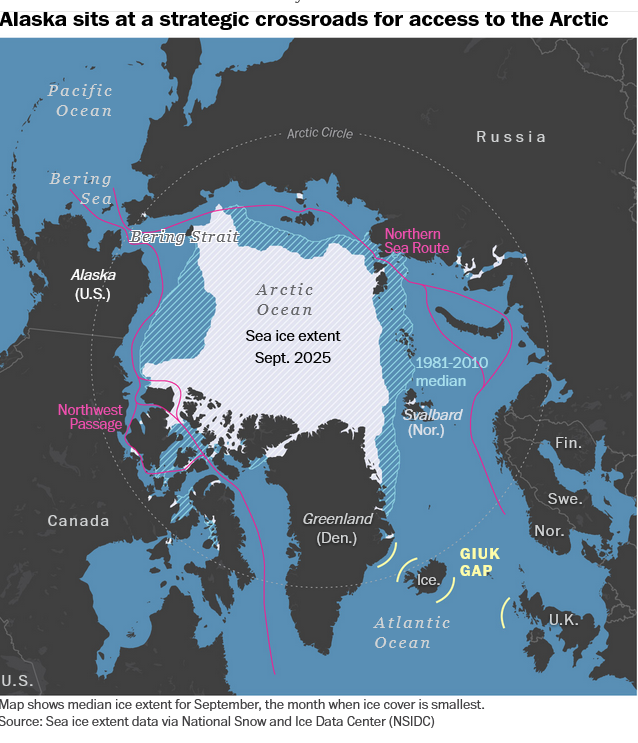
The administration is correct in acknowledging the Arctic’s rapidly increasing importance. Still, as others and I pointed out, China has more to fear from us regarding the new Arctic trade routes than we do from it. This map makes it obvious where the choke point for both routes lies, and it isn’t Greenland. It is already part of the U.S., our state of Alaska:

As you can see, both new shorter routes run through the Bering Strait, which Alaska dominates. A reasonably strong Alaska military position could close the strait to China’s trade, and China would have to pay hell to regain passage there, even if they could. After all, China would have to move its forces a great distance under to attack, only to find a well-positioned enemy. If we take the proper military steps in Alaska, we, not China, possess the leverage in the Arctic.

Given this strategic fact, Trump’s campaign to grab Greenland was about his legacy, rather than national defense. We’ll determine the cost of his vanity later.

Continue reading →