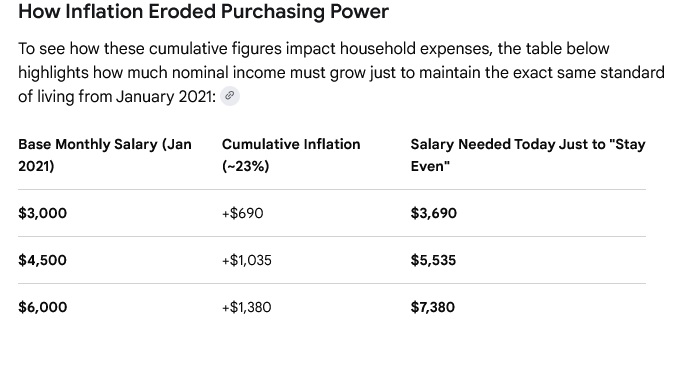
While we wait for the midterm election results, I’ve been struck by how the election has largely focused on one issue: “affordability.” Everyone knows prices have risen sharply, starting in the Biden administration. Since January 2021, prices have risen 28.32% cumulatively. Wages during the same period rose only 22.7%, at best. No wonder people feel they’re falling behind at month’s end:
What we’re not hearing is how we first arrest the rise and then bring prices down from either major party. “I feel yor pain,” worked for Clinton; we need more now.
I’ve pointed out that the Law of Supply and Demand tells us that when demand exceeds supply, prices rise because too many dollars chase too few goods and services. The Federal Reserve (FED) can tighten the money supply until demand falls. FED Chairman Paul Volcker did that to stop the Great Inflation of the 1970s, but it caused a painful recession, with unemployment hitting almost 11%. Cutting demand in this way can feel worse to many than the inflation.
It wasn’t until we eased supply constraints by lowering capital taxes and deregulating key areas that supply met demand, real growth followed, and inflation was tamed. I’ve written about all this before, but have our two major parties seen the light?
Subsidizing everything from groceries to healthcare only increases demand. Price controls on basics such as rent distort supply. Yet that seems to be the bedrock of Democratic policies.
Republican policies are nothing if not contradictory. Cutting taxes on capital and cutting regulations will encourage supply growth, but tariffs disrupt supply. Constant tariff changes create confusion and stop business planning. If someone, like farmers, is really suffering from retaliation, send them money. Sounds like the Democrats.
The one area both seem to agree on is ending the Iran War. There’s no doubt the conflict has added to inflation, with a sharp rise in petroleum-based products and natural gas. However, neither has a plan to obtain an acceptable peace.
Beyond knocking off much of Iran’s leadership and destroying a lot of its military assets, the administration in the beginning lacked a coherent plan for what came next. The resulting standoff, with two major trade routes in constant jeopardy, keeps prices high.
Now we hear the administration is planning heavy attacks after the midterms. Another carrier group is on the way, possibly to add more firepower. It is fair to ask: to what purpose?
Operation Epic Fury in February showed a serious absence of planning. Without any land component, regime change wasn’t in the cards. As I assumed at the time, arming and training an uprising within the Islamic Republic was a mandatory piece.
Continue reading
