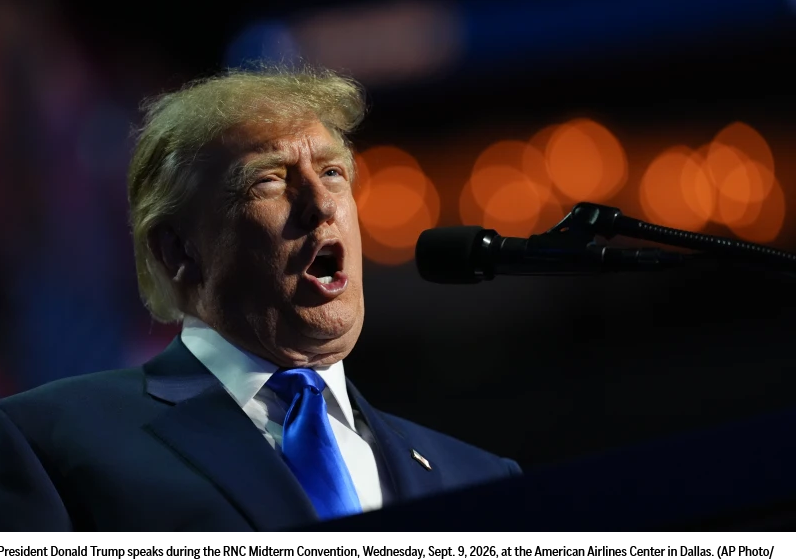
“If the Republicans win the House of Representatives and the United States Senate, both of them,” President Donald Trump said at his midterm convention, “I will issue a dividend to every adult citizen in the United States of America for $5,000.” As the New York Times (NYT) tells us, in 2020, Democrats in Georgia pointed to $2,000 coronavirus relief checks if their party took control of the Senate. Politicians always promise more cash or other monetary benefits if you’ll vote their way:
The Socialist Party of America (DSA), which exerts more and more influence on the Democratic Party, promises either lots of free stuff or more cash in your pocket through things like greatly expanding the minimum wage. All these promises come against the backdrop of “The Affordability Crisis.”
The crisis is just a way of saying prices are rising faster than our ability to pay them. Both parties point to putting more dollars in everyone’s pockets as the answer. But does this make sense? Say ten people are in line to buy one of the ten parcels of necessities needed to survive. Each has $100; the necessities, to no one’s surprise, cost $100. Now President Trump, or Mayor Mandami, comes along and gives each $50. Everyone has more money in their pockets, but now the price of necessities has risen to $150. Unless supply increases, this is the only outcome.
Donald’s or Zohan’s largesse runs aground because of the Law of Supply and Demand. It still rules, as it has through the ages. Simply put, if Demand exceeds supply, prices will rise. Increasing Demand without more supply keeps prices rising.
Increasing supply to meet or exceed Demand stops inflation. However, this solution requires capital investment. Planting more acreage, building a factory, drilling wells, ships to bring in imported goods, or opening a mine- whatever is needed to increase supply demands capital.
Capital is forgone consumption, or put another way, savings, and the positive returns on them. If you lend at interest or invest directly in assets that grow in value, you have more capital, but you also face the risk of loss. Not every well finds oil, gas, or even water.
If our politicians truly want to end the “Affordability Crisis,” they need to increase the capital attracted to and available to the problem areas. Conversely, reducing people’s investable capital leaves less to solve the problems. Less capital also makes us more risk-averse, but risk is usually where the big payoffs reside.
Well, if people, meaning private industry, won’t or can’t invest, the Government must step in. This idea has gained currency on both sides of the political aisle. Government Grocery stores, golden shares, ownership shares, or profit participation will painlessly get us out of the mess.
There are a few things wrong with these assumptions, not the least of which is that the Government has no capital, just a call on the people’s capital through taxes. If the Government takes more capital from the people, it reduces the investable capital they might use to generate gains and provide more goods and services.
If the Government borrows and pays by printing money to fund its endeavors, it directly increases the amount of money chasing too few goods. The result is more inflation.
But it takes a village, according to Hillary Clinton, for people to prosper, and it’s only fair to give back to the collective a good hunk of their wealth. After all, according to Barack Obama, you didn’t build that.
This concept clashes with our people who left their old-world collectives to brave a new world, improve their lives and their offspring’s, and kept leaving “villages” as they headed west. Alexis de Tocqueville, in his Democracy in America, marveled at Americans’ ability to form new communities to support themselves and others. We didn’t need your old village; we formed our own as needed.
Well, the Government can borrow the money. So long as the interest rate is very low, we can pay off the debt out of the future gains produced by a brilliant industrial policy.
Secretary of the Treasury Scott Bessent is traveling this road by buying higher-priced, longer-term bonds and paying for them with shorter-term, lower-cost ones. Bessent claims, “I have asymmetric information. I am the house now,” He adds, “You can bet against me if you want.”
Despite his hutzpah, the 30-year Treasury bond reached its highest yield in over thirteen years. Surely he knows bond traders are among the best-informed people in the world.
In any case, why would anyone assume the Government would invest our money better than we would? In fact, history points the other way. Nations using government-directed “industrial policies” end up like the old Soviet Union, with misdirected investment that leads to bankruptcy. Even China, as it turns away from free markets toward more government control, is slowing and showing obvious strains. Cuba and Venezuela are living examples of how governments can destroy economies through mismanagement.
The profit motive of free-market investment exerts discipline. As “Public Choice Theory” points out, governments controlling investment have other motives. Patronage of those who might help keep rulers in power, rather than efficiency, might drive investment. Rulers who seek to enrich themselves, their families, and cronies are hardly unknown in history. When Government grants exemptions from tariffs, it chooses winners and losers at its whim.
Nobel laureate Milton Friedman said corporations’ social responsibility is to increase profits. When governments and favored stakeholders become involved, an enterprise serves too many masters and benefits a few. The present troubles of Germany’s largest automaker, Volkswagen, should serve as a warning. Representatives of its state of residence and unions sit on its board, robbing it of the flexibility to compete—a tragedy in the making.
Rather than increasing government interference, we ended the 1970s “Great Inflation” by shrinking the Government’s footprint, allowing flexibility and innovation, and cutting taxes, thereby increasing private capital to take the risks that increase supply. For example, when we lifted controls on oil, instead of going from the expected $40 to $100 a barrel, it fell below $10 in the early 80s.
Trump’s first term succeeded economically insofar as it reduced government impediments and cut taxes.
We know what works and what doesn’t. This fact should be especially true among those touting their education and superior knowledge. So why is it so pervasive among both our main parties that more Government is the answer?
Could it be all about power? Rather than relying on your own efforts and resources, these politicians want to reduce us to supplicants, begging for some of the fruits of our labor. It sounds like the “old regimes,” not our Republic. If you understand this motive, you may join me in being insulted by a President and others who are trying to bribe us with our own money.
 Detour on the Road