When I talk with young people, I’m struck by how, whether they’re talking about Make America Great Again (MAGA) or Democratic Socialists of America (DSA) ideas, they’re sure they’re taking Radical, Revolutionary positions. Further, these ideas will pull a moribund America out of the morass.
They’re certain about tariffs, government control of or ownership of industry and commerce, severe restrictions on immigration or law enforcement, and that those in government know best. How we get our healthcare, or are educated, is best left to government determination.
Often, both extremes of the two dominant political parties are very close in their reasoning. They attack constitutional speed bumps or procedural impediments, such as courts or the Senate’s rules. Belittling or chastising judges at the highest levels is common to both. Even the makeup of the Supreme Court is on the table: change the number of Justices, or force some into retirement.
Get rid of the Senate’s filibuster rule, or the Senate altogether. Both say that when they’re the majority, nothing should stand in the way of their desires. Subsidies to those they favor seem never-ending—we see antisemitism in both.
People engaging in unfettered commerce can create wealth disparity or run counter to national aims. Government must regulate, or even own or control, the means of production, or any other part of the economy, for the public good. Markets are inherently unfair.
This coalescing of the parties has given rise to the horseshoe theory of politics; at the extremes, the parties are actually close together. Some people might see this as a good thing; the dynamic parts of each party are coming together in a new system that will improve humanity’s future. This idea seems to give some people a sense of purpose.
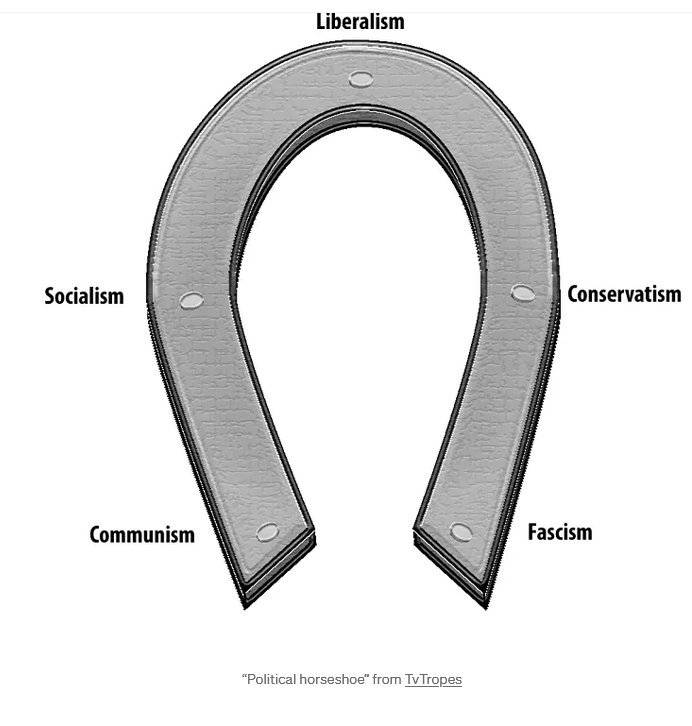
To those with more than a passing interest in history, this means a top-down government of rule by edict, avoiding imports in favor of domestic producers, the native over others, people are dealt primarily by their class, and acquiescence to government and its religious counterparts, as the font of knowledge; all this seems a throwback to another era. In fact, it could be any era before 1776. For thousands of years, agrarian-based societies worldwide were organized along these lines.
For all those years, human progress was glacial. Those in the lower classes rarely rose above subsistence, while those in the top educated class garnered most of the available goods. Those involved in commerce did so at the sufferance of the rulers.
As none of these younger people in the U.S. ever fully lived under such systems, it can’t be nostalgia, but they may long for some romanticized version. Somewhere in their education and their other sources of information, they formed conceptions at odds with reality. Unaware of their history, the bromides they espouse feel fresh and revolutionary, rather than reactionary to the modern world.
The most radical revolution able to complement and foster a rapidly changing world, breaking with the past’s near stagnation, is our own. I strongly suggest Gordon S. Wood’s Pulitzer Prize-winning “Radicalism of the American Revolution” to understand the radical break with the past our revolution wrought.
Continue reading
