What’s Radical

When I talk with young people, I’m struck by how, whether they’re talking about Make America Great Again (MAGA) or Democratic Socialists of America (DSA) ideas, they’re sure they’re taking Radical, Revolutionary positions. Further, these ideas will pull a moribund America out of the morass.

They’re certain about tariffs, government control of or ownership of industry and commerce, severe restrictions on immigration or law enforcement, and that those in government know best. How we get our healthcare, or are educated, is best left to government determination.

Often, both extremes of the two dominant political parties are very close in their reasoning. They attack constitutional speed bumps or procedural impediments, such as courts or the Senate’s rules. Belittling or chastising judges at the highest levels is common to both. Even the makeup of the Supreme Court is on the table: change the number of Justices, or force some into retirement.

Get rid of the Senate’s filibuster rule, or the Senate altogether. Both say that when they’re the majority, nothing should stand in the way of their desires. Subsidies to those they favor seem never-ending—we see antisemitism in both.

People engaging in unfettered commerce can create wealth disparity or run counter to national aims. Government must regulate, or even own or control, the means of production, or any other part of the economy, for the public good. Markets are inherently unfair.

This coalescing of the parties has given rise to the horseshoe theory of politics; at the extremes, the parties are actually close together. Some people might see this as a good thing; the dynamic parts of each party are coming together in a new system that will improve humanity’s future. This idea seems to give some people a sense of purpose.
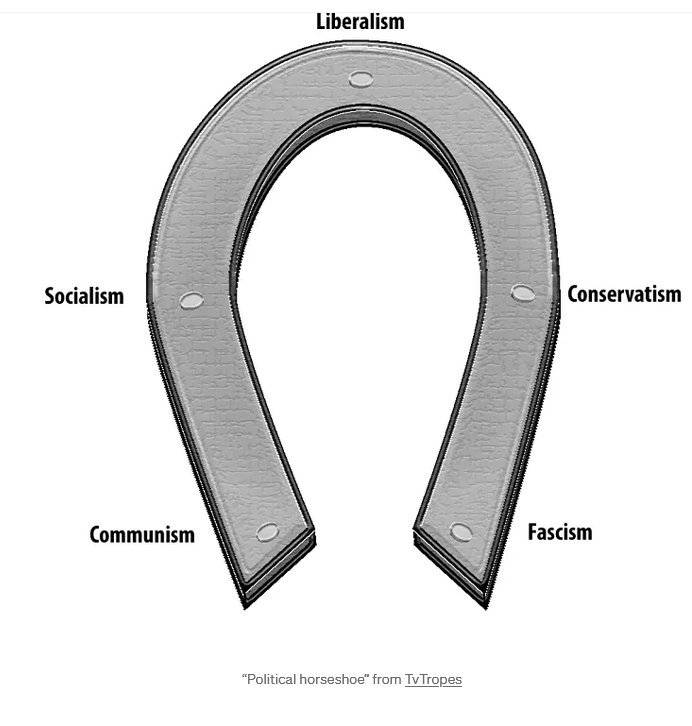
To those with more than a passing interest in history, this means a top-down government of rule by edict, avoiding imports in favor of domestic producers, the native over others, people are dealt primarily by their class, and acquiescence to government and its religious counterparts, as the font of knowledge; all this seems a throwback to another era. In fact, it could be any era before 1776. For thousands of years, agrarian-based societies worldwide were organized along these lines.

For all those years, human progress was glacial. Those in the lower classes rarely rose above subsistence, while those in the top educated class garnered most of the available goods. Those involved in commerce did so at the sufferance of the rulers.

As none of these younger people in the U.S. ever fully lived under such systems, it can’t be nostalgia, but they may long for some romanticized version. Somewhere in their education and their other sources of information, they formed conceptions at odds with reality. Unaware of their history, the bromides they espouse feel fresh and revolutionary, rather than reactionary to the modern world.

The most radical revolution able to complement and foster a rapidly changing world, breaking with the past’s near stagnation, is our own. I strongly suggest Gordon S. Wood’s Pulitzer Prize-winning “Radicalism of the American Revolution” to understand the radical break with the past our revolution wrought.

Continue reading →

AI In The Crosshairs

While we await the umpteenth peace that Trump has promised since the Iran ceasefire, it might be a good time to address the rising calls to impose controls on Artificial Intelligence (AI) and to reduce the power and wealth of the leaders of the enterprises leading the technology. After all, bringing concentrated knowledge and computing power to the masses can overturn the social order and threaten humanity.

Leaders in both parties appear to be tripping over each other, demanding that the Government take control now before it’s too late. From GOP Senator Josh Hawley to Democratic socialists, Sen. Bernie Sanders (I-Vt.) and Rep. Alexandria Ocasio-Cortez (D-N.Y.), there is pressure to go much further with government intervention.

None of this is new, as I’ve pointed out in my series, “The Long Journey to More.” At the start of the Industrial Age, the handicraftsmen known as  Luddites destroyed weaving machinery. Farm mechanization provoked a mass migration away from farm work. More recently, Computers connected to the internet caused an upheaval in how we do almost everything. The great economist Joseph Schumpeter called this process “Creative Destruction.”

Continue reading →

A Timely Address

Supreme Court Justice Clarence Thomas delivered an important address at the University of Texas and, in light of Progressivism becoming the face of the Democratic Party, a needed contrast with the Declaration of Independence. Not only are there more progressives running as Democrats, but supposedly moderate Democrats such as Joe Biden and newly elected Virginia Governor Abigail Spanberger run as moderates, yet once in office, govern as committed Progressives.

Even the Republicans exhibit progressive tendencies. Using tariffs to restructure not only the U.S. economy but the whole world’s trading system is classic top-down industrial policy. The government taking an interest in certain companies isn’t free enterprise.

Justice Thomas paints a picture of how the Declaration holds that we are endowed with rights by our maker rather than whatever elite government “experts” deem to grant us. To the Progressive, our founding documents pertain to a bygone era and are irrelevant in the modern world. The Declaration and Constitution are quaint, but ill-suited to tackle today’s problems, such as Climate Change. They only impede necessary progress.

Thomas shows us the facts point in the other direction. Limited government with protections of person and property, even if they conflict with a government seeking the “greater good,” hasn’t ushered in the great wars and famines killing millions that top-down governments have spawned. Instead, they have fostered free markets to allocate resources more effectively, spurring innovation and enabling far more people to live longer, better lives.

Our 250th birthday is a good time to compare the route offered by what Pulitzer Prize-winning historian Gordon S. Wood termed the “Most Radical Revolution in History” with the progressive, top-down path. Before the American Revolution, dictates flowed from the top downward, while obligations moved only upward almost everywhere in the world.

Continue reading →

Crisis-Real or Not

In my last post, I noted that the Democrats offered the same false diagnoses, leading them to propose policies that have failed in the past. Shortly after publishing, I learned of Paul Ehrlich’s passing. The Stanford biologist’s life encapsulates how misinformation underlies progressivism. Worse, these mostly highly educated people are aware of these falsehoods, but they work very hard to avoid the truth.

Paul Ehrlich may not be well known among today’s youth, but they may be contending with his effect. His book, “The Population Bomb,” written with his wife and published in 1968, sold millions of copies. The Author was a fixture on The Late Show.” Exposed to his frightening predictions of mass famine and the collapse of overpopulated societies, people worldwide changed their behavior, and some nations even adopted policies to restrict population growth.

Some found the idea of parenthood selfish and a threat to the planet. Many skipped the adventure of parenthood. As a result, many never became grandparents, and we have fewer cousins. Beyond individual decisions, some nations took stringent measures to curb population growth.

On the surface, his thesis seems plausible. If humans were allowed to breed like rabbits, they would soon outrun the planet’s ability to provide food and resources. The only possible outcome is a massive die-off.

This theory isn’t new. In 1798, Thomas Malthus observed that humans reproduced geometrically, while food resources grew only arithmetically, setting up a trap that could only lead to dire circumstances—his outwardly logical theory occurred during the Age of Reason and the beginnings of the Industrial Revolution.

Continue reading →