Recalling a Failed Test

A cruise ship reporting an outbreak of Hantavirus, with a loss of life, brought back memories of COVID and how we responded. Lockdowns, needless nursing home deaths, school closures, isolation, and all the rules, such as distancing and mask requirements. Not a pleasant memory.

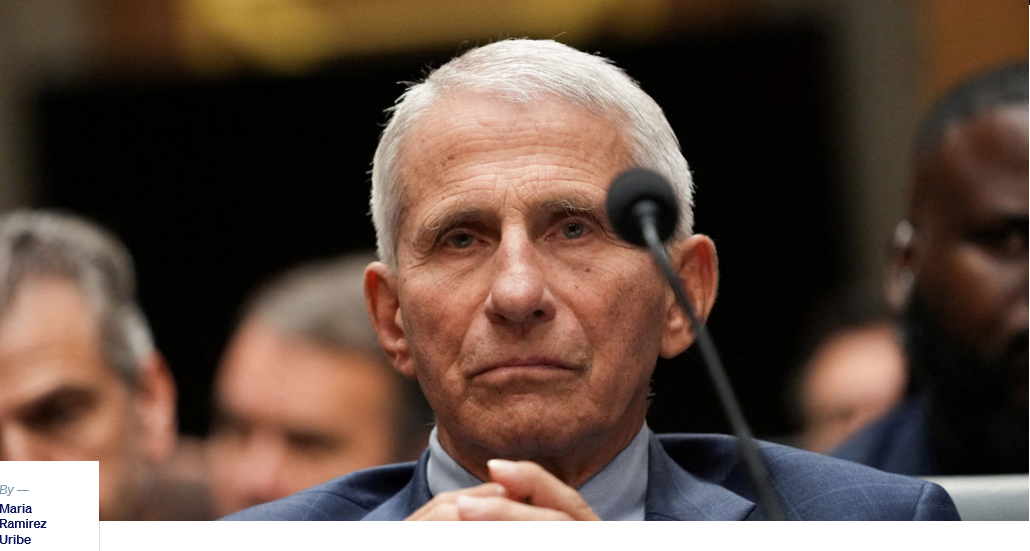
Then we have the recent Senate Homeland Security & Governmental Affairs Committee receiving testimony from a CIA whistleblower on the cover-up of the likely Wuhan Lab Covid origin. Dr. Anthony Fauci used his government position to intervene in a CIA report on the lab’s origins, which was connected to funding for the Wuhan Lab. That establishment was conducting “Change of Function” research that could have resulted in the Covid virus.

Shining a light on how misinformation and government actors led to actions we’re still suffering from, it made clear that the top-down government response failed on a massive scale. Yet, this is the type of crisis progressives claim government experts handle best.

To understand how we ended up on this Covid response road, we have to recall the history of top-down government dominance. As I’ve pointed out in “Long Journey to More”, for thousands of years, settled agricultural societies divided people into classes, with an educated ruling class at the top (up to 10%), an illiterate mass, and a smaller artisan-merchant class in between.

The masses lacked the knowledge to dispute what the government told them, and the artisan-merchant class, though often literate, was too dependent on the ruling class’s good graces to offer much dissent—human progress was glacial.

Continue reading

The Debate Isn’t About Problem Solving

As we realize the catastrophic impact of our response to the COVID-19 epidemic, it’s crucial to acknowledge the profound, long-lasting effects on our children’s education. Many will struggle to make up for the learning loss from unnecessarily closed schools. The staggering borrowing to offset income losses from a shutdown economy will burden us for years.

Those in charge, like Anthony Fauci, owe the nation an apology on many levels, from scientifically unsupported policies to the apparent coverup of the pandemic’s laboratory origins. Instead, the good doctor gets a friendly reception on his book tour. My series on COVID left no doubt about my feelings about our actions from March ’20 on. Out front of every lousy decision was Dr. Fauci. Yet, welcoming Dr. Fauci as some hero in progressive stops nationwide is commonplace.

It’s as if everything we learned about the pandemic and our awful response missed a large part of the electorate. We see similar blindness among many when it comes to the Gaza War. Brutely attacked, Israel counter-attacked against the Hamas perpetrators. In contravention of the accepted rules of war, Hamas has located its military in heavily populated areas, hospitals, schools, and Mosques. Breaking the prohibition of using civilians, especially women and children, as human shields have resulted in preventable civilian casualties; the leader of Hamas tells the world how little they value Palestinian lives by saying they’re winning world opinion with the increasing civilian deaths. Yet, the progressive left blames Israel.

Continue reading

Inflation Hurts And The Pain Will Continue

Democratic Politicians and allied media, echoing some economists like Paul Krugman, paint a rosy picture of our economy. They question why we’re less content while supposedly outperforming other nations. Catherine Rampall, the Washinton Post economics columnist, tells us, “Nearly everything Americans believe about the economy is wrong, according to a recent Harris-Guardian poll. And that’s pretty much everyone’s fault.” This narrative implies that our dissatisfaction is unfounded. But is this the whole truth? Are there no deeper economic issues that we need to address?

After a lifetime of talking to people about their finances, I have gained a profound understanding of how people assess their financial well-being. In most cases, having a growing amount left over at the end of each month tells them whether they’re just subsisting or can think of the things that make life worth living—a vacation, maybe with your family, or a better house. Whatever your dream, it always requires money. Unless you have discretionary income, you can’t fulfill it, whatever it is.

When every basic bill, from rent to utilities and insurance, elicits a gasp, even a raise can’t alleviate the feeling of being trapped. The necessities of life, like food, transportation, and clothing, become burdens, and dreams start to fade. This situation is actual for many hardworking Americans struggling to make ends meet.

While economists discuss prices and wages, the reality is far more complex. Your pay may rise, but your grandpa’s and grandma’s income may be more fixed. Where they could pay their way in the past, now they need help to meet their rising bills. You thought you had the kid’s education covered, only to find a widening gap. These stark realities are not just isolated incidents but the daily norm for more people. No wonder those telling us how well we’re doing only get blank stares.

Inflation is the source of most of our angst, but if you feel future inflation isn’t dangerous, steps to rein it aren’t topping your to-do list. Everybody seems to be waiting for the Federal Reserve to lower interest rates, which presupposes inflation is under control. How likely is this situation to be accurate in the future?

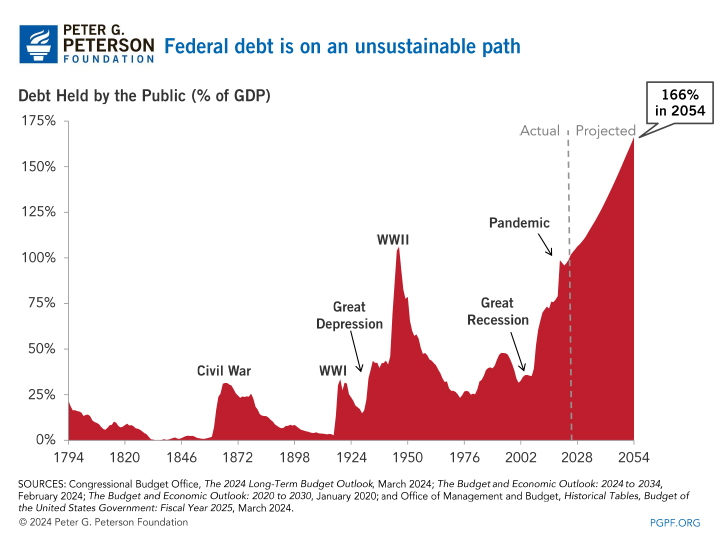
The classic definition of inflation is “too much money chasing too few goods.” We have to borrow when revenues don’t cover our government’s expenditures. If we dump ever-growing amounts of debt on the market and the Federal Reserve fails to intervene, ever-rising interest rates will be required to find buyers. Already, we pay more on our debt than on defense. In the future, the payments will crush the entire budget. This crisis is not a distant possibility but a potential economic catastrophe that we must address:

Of course, the Federal Reserve can buy the debt with money created out of thin air. This course of action is how we get runaway inflation: one way or another, overspending results in the unkindest tax inflation.

Continue reading

Getting It Right

A few recent things made me reflect on some stands I’ve taken. Indeed, there are some things I need to correct. Michelle Obama still needs to run for President. COVID-19 vaccines and the mandates associated with them never prevented the spread. Yet, I may have gotten some things right. 

I thought I and ex-congressman Jason Chaffetz, now a Fox News commentator, were the only people who thought Joe Biden wasn’t running for re-election. While I have felt this was always the plan, Chaffetz points out that Biden isn’t doing the expected. Wall Street Journal Journal columnist Dan Henninger has weighed in with conclusions mirroring my own. Maybe the Republicans will wake up and realize a fresh Democratic face running against Trump guarantees a progressive victory. Only tying President Biden to his corrupt family business well before Trump clinches the nomination can spoil the plan. My warnings on Biden’s replacement, unfortunately, look better every day.

Why else would a judge set a court date one day before Super Tuesday? Keeping the ex-president front and center till then seems inevitable. 

Henninger calls the Democrats the “Evil Party” while he labels the Republicans the “Dumb Party.” The Republicans are doing everything to live up to this moniker.

 While Florida Governor Desantis is off the campaign trail managing the state’s response to a major hurricane, Fox News and others have seen fit to feature Vivek Ramaswamy. He may have appeared on every Fox program this week except Gutfeld, but maybe I missed him there. A college professor expounded on Fox that you must be a showman to win. I guess P.T. Barnum over Lincoln is today’s norm.

Continue reading

The First Republican Debate

With the first Republican debate, one of the most critical election seasons is officially open. With so much at stake, the results were as much as I expected. As I predicted, Trump didn’t show up, and his Atlanta arrest pushed it off the news in less than 24 hours. Still, looking at the discourse might give us insight into the future.

Eight people on the stage with limited time isn’t any honest debate. Two hours with commercial breaks leaves little time for an in-depth discussion. Worse, the moderators needed to steer the conversation to Americans’ concerns. Economic issues dominate the top of what Americans care about—yet inflation and the economy command little time. 

The debate gave those with little chance of winning the nomination most of the time while failing to address the real concerns of the viewers:

The Republic National Committee and Fox need to address these failings to reduce the number on the stage and ensure the moderates direct the discussion to the top concerns. 

Even though Abortion is down the list of concerns, the lack of a coherent Republican response has damaged their results in recent elections. Democrats have done an excellent job of demonizing Republicans for a six-week or less ban on allowable abortions while masking their position on Abortion right up to birth. Pence and Haley pointed to compromise somewhere between the two extremes. 

Pence favored a ban after 15 weeks, while Haley felt the Senate would only go for a more extended period. Polls show the public rejects both extremes. I think Pence has the better argument at fifteen weeks. Most other nations have settled at or near 15 weeks. 

Continue reading