Delusions

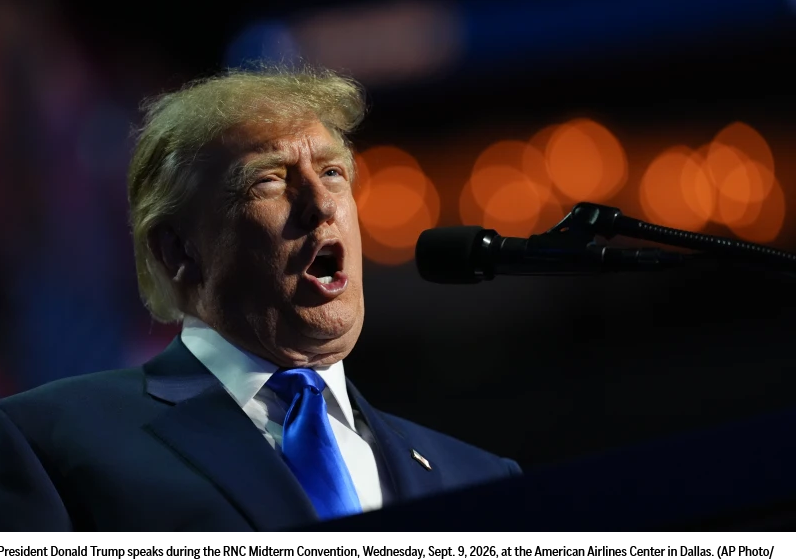
“If the Republicans win the House of Representatives and the United States Senate, both of them,” President Donald Trump said at his midterm convention, “I will issue a dividend to every adult citizen in the United States of America for $5,000.” As the New York Times (NYT) tells us, in 2020, Democrats in Georgia pointed to $2,000 coronavirus relief checks if their party took control of the Senate. Politicians always promise more cash or other monetary benefits if you’ll vote their way:
The Socialist Party of America (DSA), which exerts more and more influence on the Democratic Party, promises either lots of free stuff or more cash in your pocket through things like greatly expanding the minimum wage. All these promises come against the backdrop of “The Affordability Crisis.”

The crisis is just a way of saying prices are rising faster than our ability to pay them. Both parties point to putting more dollars in everyone’s pockets as the answer. But does this make sense? Say ten people are in line to buy one of the ten parcels of necessities needed to survive. Each has $100; the necessities, to no one’s surprise, cost $100. Now President Trump, or Mayor Mandami, comes along and gives each $50. Everyone has more money in their pockets, but now the price of necessities has risen to $150. Unless supply increases, this is the only outcome.

Donald’s or Zohan’s largesse runs aground because of the Law of Supply and Demand. It still rules, as it has through the ages. Simply put, if Demand exceeds supply, prices will rise. Increasing Demand without more supply keeps prices rising.

Increasing supply to meet or exceed Demand stops inflation. However, this solution requires capital investment. Planting more acreage, building a factory, drilling wells, ships to bring in imported goods, or opening a mine- whatever is needed to increase supply demands capital.

Capital is forgone consumption, or put another way, savings, and the positive returns on them. If you lend at interest or invest directly in assets that grow in value, you have more capital, but you also face the risk of loss. Not every well finds oil, gas, or even water.

Continue reading →
Not The Change We Need

Don’t count on things getting better. When we’ve gone through a rough patch, we wish the next election would result in greater competence, but that’s hope over experience. The last election saw a voter revolt against the worst inflation in 40 years, wide-open borders, and the Afghan fiasco, which encouraged bad actors to start two ugly wars. The relatively solid economy and the absence of major fighting during Donald Trump’s first term fostered nostalgia.

Trump promised peace, safety, and prosperity in 2024. A little over one year in, we still have rising prices, albeit at a somewhat lower rate, violence on the streets in cities like Minneapolis, and an ever-widening war in the Middle East. Maybe we didn’t want wide open borders, letting in bad people, but we want the good contributing to our nation, treated humanely, not terrified and abruptly deported.

Given where we are, how is that election working out? More importantly, will the future election bring improvement? Plagued by high prices, poorly conceived international actions that have led to more bloodshed and increased costs, civil unrest, lawfare, executive orders that ignore Congress, and corruption, a change in leadership surely will lead to a different direction.

But will it? Everything we’re complaining about today has its roots in the prior Democratic administration: high prices, almost double-digit inflation. Afghanistan, Ukraine, and Gaza weren’t examples of international stability. The Black Lives Matter riots weren’t peaceful. Forgiving billions in student loans by executive order, the courts were Trump’s second home during the 2024 campaign, and if you wanted Biden’s attention, his son had a painting for you.

Yes, you can argue that the current Trump administration is worse in all these areas, but that is just because Trump exceeded them, not because he initiated them. Just as Trump followed and expanded on the Democrats’ path, there is no reason to believe the Democrats won’t build on and exceed the present administration in these areas. A continuing game of ” Can you top this?”

Instead of a fresh approach to our myriad of problems, the Democratic leaders with the loudest voices promise more of the same. From California to New York City, Newsome to Mandani, and all Blue spots in between, we hear the same old, same old. The rich are getting richer at the expense of the rest of us, and not “paying their fair share.” Corporations, you name the place, are price-gouging, and inequality is growing by leaps and bounds.

Given these diagnoses of our problems, the solutions have a familiar ring to them. Increase taxes on those nasty billionaires and millionaires’ ill-gotten gains. In California, increasing income taxes on the “rich” isn’t enough; we have to tax their accumulated wealth. Investigate companies whose prices have moved up significantly. Stronger price controls on things like rent in New York City. Hike up the minimum wage to give everyone a raise. Close the growing gap between the haves and have-nots by increasing transfer payments.

Continue reading →

Food For Thought

It took only a few moments after the Supreme Court’s long-awaited tariff decision for President Trump to strike back by imposing an across-the-board 10% tariff. Within 24 hours, he increased it to 15%. Under Section 122 of the Trade Act of 1974, the tariffs remain in effect for the next 150 days. At that point, the tariff authority will expire unless Congress acts. Not to worry, the administration will have completed the mandatory work to continue the tariffs under yet another statute.

The same affected importers and others are likely to sue to prevent implementation. Still, given how long it took to secure a favorable decision on the original statute used to justify Trump’s torrent of tariffs, the administration will remain one step ahead of relief.

As for getting a refund for the illegal tariffs collected, Judge Kavanaugh, in his dissent, said that’s messy. Litigating the refunds could take years, according to Treasury Secretary Scott Bessent.

Nice try, Supreme Court, but the courts are just too slow to keep up with those bright administration people. Trump’s beloved tariffs will remain, while importers will grow old waiting for their refunds.

According to the administration and its media supporters, the importer’s High Court victory is just a mirage. Nothing has really changed. Trump will keep your money and keep collecting in the future.

That’s one plotline for the future of the Trump tariff regime, but there might be another script. The stage for court challenges to the administration is the Court of International Trade (CIT). This court will hear the demands of Costco, FedEx, and many others for refunds.

Continue reading →

The Real Trump

We finally have the Supreme Court tariff decision. Even though they took too long in a faster-moving world, it is as predicted. The Court ruled that all tariffs imposed under the International Emergency Economic Powers Act (IEEPA) were illegal in a 6-to-3 decision. The majority acknowledged what the first article of our Constitution clearly states: that duties (tariffs), like all taxes, are the exclusive province of Congress.

Predictably, the President threw a hissy fit. His main ire fell on two of the justices he appointed, Neil Gorsuch and Amy Coney Barrett,, even going so far as saying their families are ashamed of them or should be. At the same time, he praised the three conservative judges who backed the tariffs, Clarence Thomas, Samuel Alito, and Brett Kavanaugh. The latter wrote the key dissenting opinion. He made three points: the statute gives unlimited tariff power, the linking tariff power to the ability to conduct foreign affairs, and refunding the money would be “messy.

All three justices claim to be Scalia originalists, meaning simply applying the original intent of the law. What is confusing about the original intent of the first article of the Constitution that gives the power of the purse, including duties, exclusively to Congress? The thinking behind this traces back through British history and law, and the framers’ intent is crystal clear. What part of “no taxation without representation” don’t they understand? The majority in Chief Justice’s opinion stated the obvious.

The contention that the President needs the power to impose a punishing tax on U.S. citizens to conduct foreign affairs would be news to the Founding Fathers. This idea is like a child demanding his way, or he’ll hurt himself. As two recent studies have shown, Americans, not foreigners, pay 90% of the tariffs.

Continue reading →

Head-scratchers

Confusion rules. Has there been a time when, other than wars or economic reversals, everything was so up in the air? In just the last couple of weeks, we’ve had a meltdown over frozen Greenland, a fleet racing to the Middle East for possible military action against Iran, and the appointment of a Federal Reserve chairman philosophically at odds with the President, who appointed him. All with worldwide implications. What can we make of all this?

We’ve gone from giving the U.S. Greenland or else, to we’ll work things out—no big deal. Wait, wasn’t our need to possess Greenland a necessity for national defense? As I pointed out in the last post, we already had access to everything in Greenland that we would ever need. We antagonized our allies for no discernible end. Will Trump return to his demands again down the road?

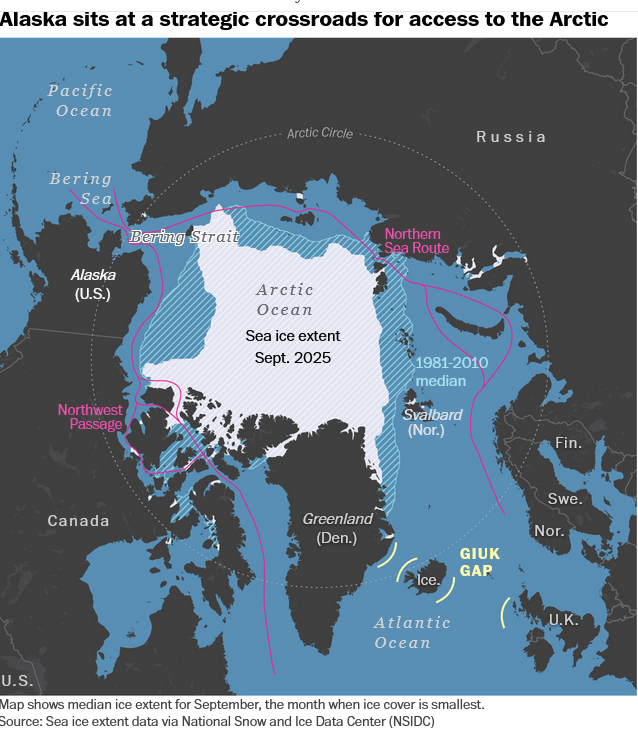
The administration is correct in acknowledging the Arctic’s rapidly increasing importance. Still, as others and I pointed out, China has more to fear from us regarding the new Arctic trade routes than we do from it. This map makes it obvious where the choke point for both routes lies, and it isn’t Greenland. It is already part of the U.S., our state of Alaska:

As you can see, both new shorter routes run through the Bering Strait, which Alaska dominates. A reasonably strong Alaska military position could close the strait to China’s trade, and China would have to pay hell to regain passage there, even if they could. After all, China would have to move its forces a great distance under to attack, only to find a well-positioned enemy. If we take the proper military steps in Alaska, we, not China, possess the leverage in the Arctic.

Given this strategic fact, Trump’s campaign to grab Greenland was about his legacy, rather than national defense. We’ll determine the cost of his vanity later.

Continue reading →