Mental Health Exercise

With the Strait of Hormuz under the control of the Iranian Regime, and Rockets and drones raining down on our friends, without a visible objective or strategy on our part, I’ve said all I can. I lost track of where the Trump administration wanted to go with its attack when it ruled out cooperation with the Kurds. Others had a similar response.

Wall Street Journal columnist Holman Jenkins Jr, a member of that paper’s editorial board, put it this way: “The moment that gave me pause was when the administration backed away from unleashing Iran’s Kurdish rebels. Yes, if U.S. goals were limited, a certain delicacy was appropriate here. But if the U.S. means to impose maximal stress on Iran’s ruling group, if the goal is to push the Regime to the wall, then throw everything at it, including the Kurds—at least everything short of a presumably unacceptable U.S. ground invasion.”

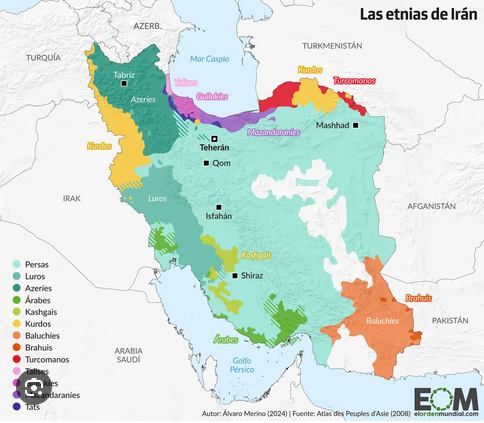
Why not? Not only could the Kurds provide an area for the Iranian opposition to gather, arm, train, and organize, but it would also give Iran’s Azerbaijanis (AZERIAS), to the north and east of the Kurdish areas, freedom from a regime repressing them. Bordering Azerbaijan, where their ethnic brothers and sisters reside, it would allow that nation to support their brethren. Azerbaijan is friendly with Israel, and is now being attacked with drones from Iran. Together, the Kurds and Azerbaijanis constitute over 25% of Iran’s present population. A good start to any revolt.

As I’ve said, maybe our administration, the Israelis, or both have something great up their sleeves. Given Trump’s performance on tariffs, confused aims are understandable, but this muddle is uncharacteristic of Israel. Maybe there is a winning master plan proving me happily foolish, but for now, I have to move on to something else for my mental health.

Continue reading

Head-scratchers

Confusion rules. Has there been a time when, other than wars or economic reversals, everything was so up in the air? In just the last couple of weeks, we’ve had a meltdown over frozen Greenland, a fleet racing to the Middle East for possible military action against Iran, and the appointment of a Federal Reserve chairman philosophically at odds with the President, who appointed him. All with worldwide implications. What can we make of all this?

We’ve gone from giving the U.S. Greenland or else, to we’ll work things out—no big deal. Wait, wasn’t our need to possess Greenland a necessity for national defense? As I pointed out in the last post, we already had access to everything in Greenland that we would ever need. We antagonized our allies for no discernible end. Will Trump return to his demands again down the road?

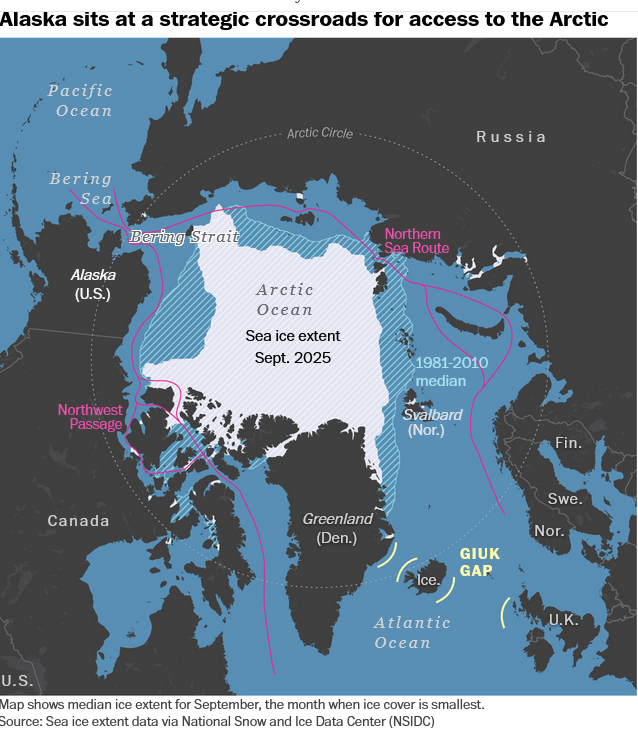
The administration is correct in acknowledging the Arctic’s rapidly increasing importance. Still, as others and I pointed out, China has more to fear from us regarding the new Arctic trade routes than we do from it. This map makes it obvious where the choke point for both routes lies, and it isn’t Greenland. It is already part of the U.S., our state of Alaska:

As you can see, both new shorter routes run through the Bering Strait, which Alaska dominates. A reasonably strong Alaska military position could close the strait to China’s trade, and China would have to pay hell to regain passage there, even if they could. After all, China would have to move its forces a great distance under to attack, only to find a well-positioned enemy. If we take the proper military steps in Alaska, we, not China, possess the leverage in the Arctic.

Given this strategic fact, Trump’s campaign to grab Greenland was about his legacy, rather than national defense. We’ll determine the cost of his vanity later.

Continue reading

Where Has Competence Gone

Years of heavier-than-usual rains, followed by dry and hot weather, left vast fuel for fires. Winter brings the dangerous and unpredictable Santa Ana winds. Thank goodness California Governor Gavin Newsome had the foresight to call an emergency legislative session to fund preparations to handle the threatening situation.

Realizing what could be coming to vulnerable areas, successful governors get out in front and ensure everything is ready and working. Even though Florida suffered from severe hurricanes, Governor Ron DeSantis and his crew minimized problems and returned things to normal quickly.

Florida set the standard of preparedness for California to follow, and with overwhelming Democratic majorities, getting the needed funds and authorizations to be ready to meet the dangers presented no problem for Governor Newsome.

Oh, wait a minute. , the emergency legislative session wasn’t to prepare for a severe fire season; it was to appropriate funds to thwart Trump from expelling illegal aliens from California. The danger Newsome foresaw wasn’t from out-of-control wildfires; it was the federal Government initially deporting the illegal alien criminal element.

The result of this lack of preparation is likely to be the worst wildfire disaster in history. Fire hydrants without water are incompressible, as is a key reservoir without any water. Does this sound like preparation?

This absence of competence isn’t due to Californians not being taxed enough to measure up. They pay a lot more than Floridians. So why does Florida do so much better in crisis? The Sunshine State may spend more wisely.

It isn’t global warming. Both states are equally affected—after all, it’s one planet. No state has invested more and taken more action in combating Global warming than California. Of course, all of it has had zero effect. The truth is that nothing California or even the United States can do will change the direction of global temperatures. It could be a simple difference in competence.

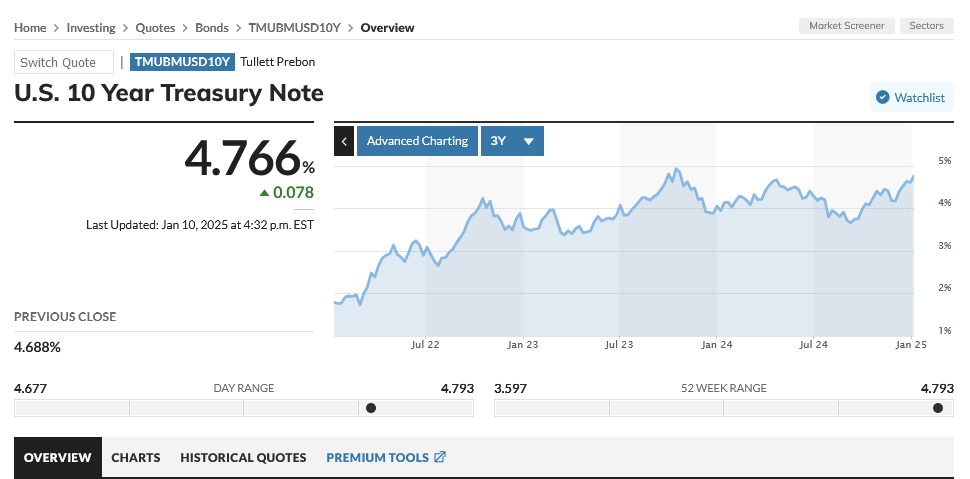
Yes, I’ve shown this chart before, but it bears watching:

While the Federal Reserve has been lowering rates, longer rates are approaching levels reached when inflation was 9%. What is it the market sees the Fed is ignoring? Could higher inflation be in our future? Could the brilliant minds at that institution be missing the signals again? Remember, a few years ago, they told us not to worry; the price rise was transitory.

Continue reading