Confusion rules. Has there been a time when, other than wars or economic reversals, everything was so up in the air? In just the last couple of weeks, we’ve had a meltdown over frozen Greenland, a fleet racing to the Middle East for possible military action against Iran, and the appointment of a Federal Reserve chairman philosophically at odds with the President, who appointed him. All with worldwide implications. What can we make of all this?
We’ve gone from giving the U.S. Greenland or else, to we’ll work things out—no big deal. Wait, wasn’t our need to possess Greenland a necessity for national defense? As I pointed out in the last post, we already had access to everything in Greenland that we would ever need. We antagonized our allies for no discernible end. Will Trump return to his demands again down the road?
The administration is correct in acknowledging the Arctic’s rapidly increasing importance. Still, as others and I pointed out, China has more to fear from us regarding the new Arctic trade routes than we do from it. This map makes it obvious where the choke point for both routes lies, and it isn’t Greenland. It is already part of the U.S., our state of Alaska:
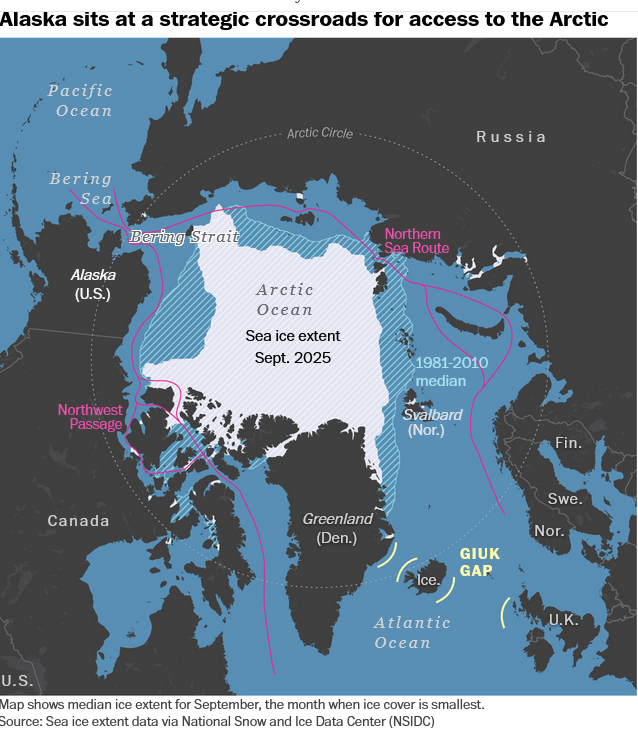
As you can see, both new shorter routes run through the Bering Strait, which Alaska dominates. A reasonably strong Alaska military position could close the strait to China’s trade, and China would have to pay hell to regain passage there, even if they could. After all, China would have to move its forces a great distance under to attack, only to find a well-positioned enemy. If we take the proper military steps in Alaska, we, not China, possess the leverage in the Arctic.
Given this strategic fact, Trump’s campaign to grab Greenland was about his legacy, rather than national defense. We’ll determine the cost of his vanity later.
When the Iranian people went into the streets to protest the collapse of their currency, Trump warned the Mullahs in charge not to harm the demonstrators. The Iranian government responded by slaughtering up to 20,000 of its own people. With naval assets deployed elsewhere, Trump had little in place to enforce his red line. Now that a carrier group has reached the area, what action, if any, will the President take?
Fearing an Iranian reaction, our allies in the area are less than enthusiastic about an American attack on Iran, with Saudi Arabia banning our use of their airspace. Yet, Trump’s honor is on the line. Given the bloodshed already, can Trump afford to back down? Will it be TACO (Trump always backs down), Trump again? Talk about a legacy killer. We’re all waiting for an answer.
Kevin Warsh is Trump’s pick to head up the Federal Reserve Board. The former board member is widely respected but seen as hawkish on inflation. The President lambasted the current chairman, Jerome Powell, for not dropping short-term interest rates to 1%. Some view the D.O.J.’s investigation of Powell for the Fed’s building cost overruns as retribution for higher rates.
So far, under Trump, inflation has remained above target, and GDP has grown strongly. Usually, these aren’t the conditions crying out for lower interest rates. Lowering the cost of borrowing theoretically makes it easier to buy, thereby increasing demand. , resulting in price pressures. Unless offset by a jump in supply, inflation continues.
The administration addresses this conundrum by pointing to its policies favoring expanded supply, less regulation, and faster investment write-offs, and apparently, Warsh has signed on to this theory. With “affordability” topping the list of 2026 election issues, they better be right.
A closer look reveals why this is anything but a sure thing. New plants and mines take time to ramp up production; in the near term, they consume a lot of inputs, adding to demand. According to the Administration, Americans will receive record tax refunds this year. adding to demand. Tariffs discourage lower-cost imports, thereby supporting higher prices.
In this climate, an attempt to force down interest rates could easily backfire, or worse, fail. Will Kevin Walsh endeavor to push for lower rates? Would the rest of the board go along? What about the Federal Reserve’s independence?
To understand all this, you have to know how the Fed operates. To lower short-term rates, it buys Treasury bills with money it creates out of thin air, raising Treasury prices and lowering rates. Again, more money chasing goods. To maintain today’s rate, the Fed has had to add to its security holdings. This action is the opposite of its stated policy to reduce its portfolio, which is currently losing money. To lower rates further, the Fed will have to add to its portfolio, not decrease it. Even then, the market may not go along.
While the Fed controls short-term rates, longer-term rates are far more responsive to market forces. As inflation reduces real returns, buyers demand more over a longer time as inflation rises. Mortgages and car loans follow the 10-year Treasury rate. Even though the Fed has lowered short-term rates, mortgage rates have hardly moved.
The only way to force lower, longer-term rates in the face of market opposition is to buy massive amounts of government debt, as it did during the Biden years, resulting in the highest inflation in 40 years.
This situation suggests a possible conflict between Trump’s demand for lower rates and the Fed’s inability or unwillingness to deliver them. Why a smart guy like Kevin Warsh would want the job beats me. Why, given its numerous past failures, do we even have a Federal Reserve Board in its present form and mission is a subject for later.
Trump’s contradictions leave the world in confusion when we need stability to make longer-range plans. We have no choice but to see how things sort out before making long-term commitments. Confusion means risk.

