A two-party system has long dominated politics in both the U.S.A. and the UK, but the UK has recently evolved into a multi-party system. Public disillusionment with the Conservatives and Labor opened the door for Reform UK and the Green Party. Could this political change cross the pond and expand US ballots?
Donald Trump’s longtime friend, Nigel Farage, heads Reform U.K. Both men share a dislike of immigration and the establishment, as well as a love of media attention. A major backer of the UK leaving the European Union, Farage left the Conservative Party over Prime Minister John Major’s signing the Maastricht Treaty, which he felt was too pro-European Union. He formed a new party in protest.
Reform UK now leads the polls at 24-27%, followed by the Conservatives at 17-20%, Labor at 17-20%, the Greens at 14-16%, and the Liberals at 12-14%. The Conservatives and Labor can no longer count on passing their programs whenever they win. Coalitions loom in the future as they are in other multi-party nations.
How did the dominant parties lose their hold? People didn’t know what they stood for. Margaret Thatcher undid much of the Labor Party’s failed socialist policies with great success. After privatizing entire industries, capitalism returned to the forefront.
Yet conservatives dumped her. One of the main reasons the old-guard conservatives acted was Thatcher’s wholehearted opposition to joining the European Union (EU). The born-to-rule class old-guard conservatives went on to join the EU. With Farage at the forefront, the Brexit vote later pulled the UK out of the EU. Conservatives failed to listen to the people.
When Liz Truss, as Prime Minister, tried to return to the classical Liberalism of Thatcher and her good friend, Ronald Reagan, the same old guard sabotaged her with a phony bond crisis. The Conservatives appeared to stand for nothing except their own power.
Like Bill Clinton in the US, Tony Blair, Labor’s leader around the turn of the century, accepted many of the Reagan-Thatcher reforms. As Clinton said, “‘The Era of Big Government is over.”
Not for long. After a time in the wilderness, Labor is back in control, but it seems lost. Going back to failed Socialist policies isn’t promising. An expensive transition to renewables has left the UK with an inadequate, costly energy sector. Yet a large part of the Party still wanted to return to socialism and continue heavy spending on renewables. Adding in a good deal of anti-semitism, this bunch broke off as the Green Party.
Today, Tony Blair offers Labor a way back, touting a radical center prescription. Boost productivity by treating business more kindly, adopting realistic energy policies, and enacting welfare reform.
Why is the proliferation of parties in the UK important to us? Many of the same problems that broke up the Tories and Labor are present in our two main parties. To many in our country, the parties aren’t even presenting a viable choice. The Republicans are devoid of ideals or a consistent policy. It has deteriorated into a cult of personality. The Republicans are for whatever Trump puts out in the middle of the night on Truth Social. If it conflicts with what he posted yesterday, no matter, everyone falls in line with the new direction.
Disagreeing with the President, especially in public, results in the end of your political career. Just ask Senator Bill Cassidy or Representative Thomas Massie. Because Trump has approximately a third of the electorate, and that’s enough to dominate the Republican primaries, Trump only has to endorse a challenger, and you’re on the outside looking in. If you’re in the executive branch, you’re out the door if you’re lucky as an ambassador to Lower Slobovia. In most cases, you’re just gone.
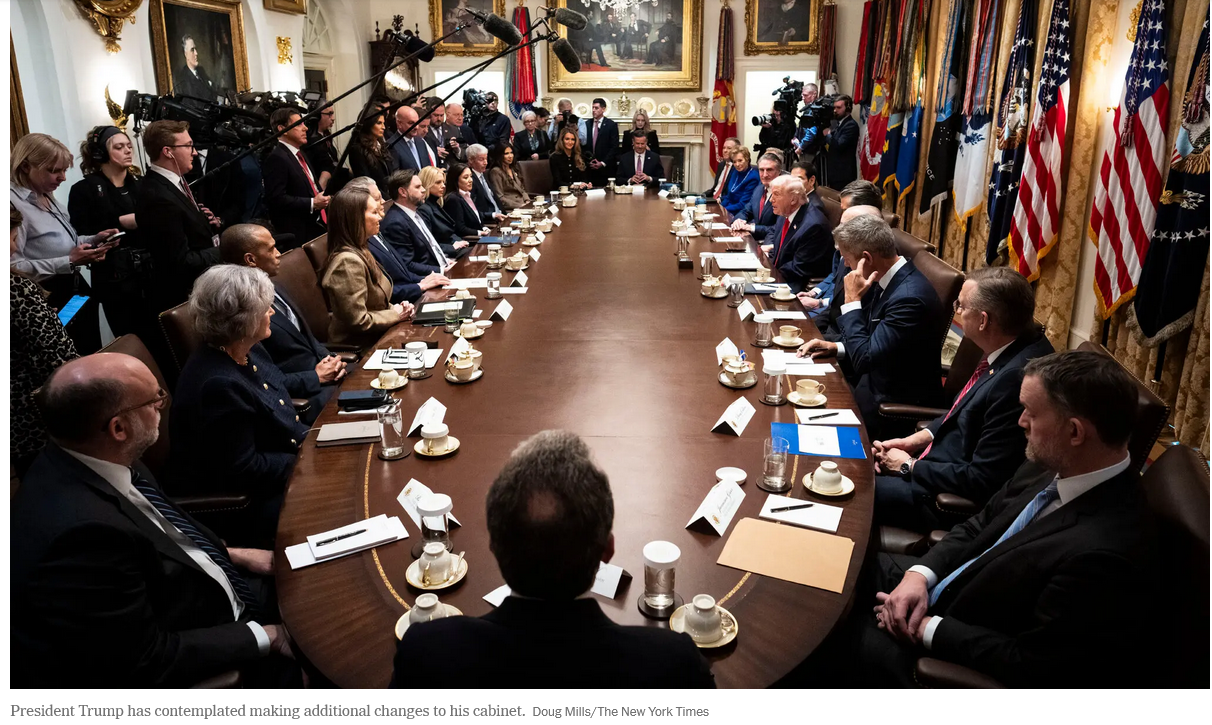
This situation reduces a Republican administration to a meeting of the US chapter of the Baghdad Bob Club:
While it’s entertaining to see all the major players in the Party dancing to Trump’s tune, and seeing how adept they are when he changes the beat, how is this sustainable? The President turns 80 soon, and in any case, he has about 2 years left in the term. From top to bottom, everyone in his administration and all his political allies have shown an amazing lack of character. Fealty to Trump is all they have to offer. How does this play in 2028 and beyond? Who’s thinking about the country?
Continue reading →
 Detour on the Road