In our neighborhood, or on our way to grade school, we couldn’t miss the stars in so many windows. We were told the blue ones showed a family member serving in the war. The gold ones meant they had lost a family member. Even at our young age, we were no strangers to crisis and loss.
Even after WWII ended, the sense of crisis and fear didn’t end. The Russians had the atomic bomb, and the Cold War was on. We all had seen pictures and movies of mushroom clouds. Our school, like the rest, brought it home with “Duck and Cover” drills. It seemed we were likely doomed:
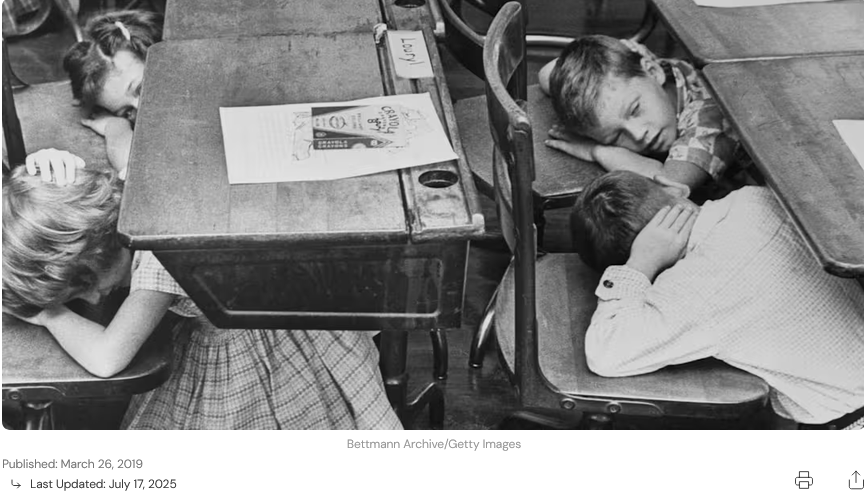
Fortunately, the Cuban Missile Crisis showed the Russians, like us, had no interest in mutual destruction. The bombs never dropped, but the memories stayed.
At summer camp, spraying areas and the cabins with DDT was a normal ritual. Mosquitoes were nasty and spread all sorts of bad things. The good news then was we had almost eradicated Malaria, one of the world’s major killers. Then came Rachael Carson’s book, “The Silent Spring,” which told us in no uncertain terms that DDT was deadly to birds and probably to humans. Exposed repeatedly, we were doomed.
Later, our fears proved overblown. DDT wasn’t going to kill us after all. The chemical that had Malaria, which cost millions of lives worldwide yearly, on the run wasn’t so bad after all. Unfortunately, millions DDT might’ve saved were lost when most of the world, including us, took Carson’s overblown warnings to heart and banned DDT. Children were at the forefront of the deaths.
It wasn’t long before we faced the distinct possibility that, because there were too many of us, we would face famine. Even those who survived would face shortages of everything. A “Population Bomb” awaited us because Stanford Biologist Paul Ehrlich showed in his 1968 book that the Earth couldn’t sustain the massive population growth since the Industrial Revolution. Ehrlich became a fixture on TV, and the fear spread worldwide. We were doomed.
Continue reading
