When I talk with young people, I’m struck by how, whether they’re talking about Make America Great Again (MAGA) or Democratic Socialists of America (DSA) ideas, they’re sure they’re taking Radical, Revolutionary positions. Further, these ideas will pull a moribund America out of the morass.
They’re certain about tariffs, government control of or ownership of industry and commerce, severe restrictions on immigration or law enforcement, and that those in government know best. How we get our healthcare, or are educated, is best left to government determination.
Often, both extremes of the two dominant political parties are very close in their reasoning. They attack constitutional speed bumps or procedural impediments, such as courts or the Senate’s rules. Belittling or chastising judges at the highest levels is common to both. Even the makeup of the Supreme Court is on the table: change the number of Justices, or force some into retirement.
Get rid of the Senate’s filibuster rule, or the Senate altogether. Both say that when they’re the majority, nothing should stand in the way of their desires. Subsidies to those they favor seem never-ending—we see antisemitism in both.
People engaging in unfettered commerce can create wealth disparity or run counter to national aims. Government must regulate, or even own or control, the means of production, or any other part of the economy, for the public good. Markets are inherently unfair.
This coalescing of the parties has given rise to the horseshoe theory of politics; at the extremes, the parties are actually close together. Some people might see this as a good thing; the dynamic parts of each party are coming together in a new system that will improve humanity’s future. This idea seems to give some people a sense of purpose.
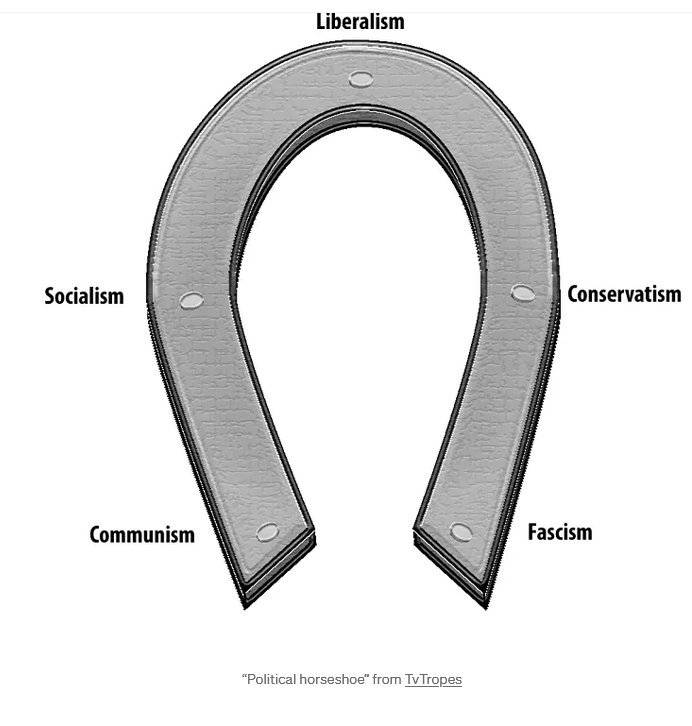
To those with more than a passing interest in history, this means a top-down government of rule by edict, avoiding imports in favor of domestic producers, the native over others, people are dealt primarily by their class, and acquiescence to government and its religious counterparts, as the font of knowledge; all this seems a throwback to another era. In fact, it could be any era before 1776. For thousands of years, agrarian-based societies worldwide were organized along these lines.
For all those years, human progress was glacial. Those in the lower classes rarely rose above subsistence, while those in the top educated class garnered most of the available goods. Those involved in commerce did so at the sufferance of the rulers.
As none of these younger people in the U.S. ever fully lived under such systems, it can’t be nostalgia, but they may long for some romanticized version. Somewhere in their education and their other sources of information, they formed conceptions at odds with reality. Unaware of their history, the bromides they espouse feel fresh and revolutionary, rather than reactionary to the modern world.
The most radical revolution able to complement and foster a rapidly changing world, breaking with the past’s near stagnation, is our own. I strongly suggest Gordon S. Wood’s Pulitzer Prize-winning “Radicalism of the American Revolution” to understand the radical break with the past our revolution wrought.
The Age of Reason, abetted by the spread of knowledge from the 15th century forward, contributed so much to our founding and the modern world. What followed 1776 was the greatest leap forward in the human condition. No country benefited more from the great advancement than the U.S.
Of course, with a sea of change, upheavals were bound to follow. Crowded cities, uneven spread of participation, but the direction was toward greater inclusion—an ever-widening pool of people able to rise by their efforts, rather than being stymied by class, sex, race, or ethnicity.
However, the adherents of a governing class never went away. Those benefiting from the old order- the highly schooled, some religious leaders, bureaucrats-Generally, those not engaged in commerce, but because of their status, could divert its fruits to their use through government action. Often they put status and power over riches. They pointed to the growing pains as reason for government intervention to set things right. Sound familiar?
These were the progressives of the Gilded Age. Instead of letting the people and free markets sort things out, they demanded that government take control. Forget the falling prices leading to record wage gains and increased longevity; those Big Company Oligarchs are gouging the working class. Nothing changes.
Robert La Follette and Teddy Roosevelt were Republicans, while William Jennings Bryan and Woodrow Wilson were Democrats, so the movement had bipartisan elements then as now.
After the rollback of government that started under the Carter administration and ran through Clinton, the stagflation engendered by too much government gave way to innovation and strong free-market growth; deregulating wide swaths of the economy, such as transportation and communications, led to better lives and even a balanced budget.
An attack from abroad on 9/11/2001, and a severe recession largely engendered by government housing market interference, led to cries from some to the government to do something. Heeding Rahm Emanuel’s famous cheer for government expansion, “never let a serious crisis go to waste,” government regulation and control expanded.
Historically, cries for the government “to do something” during a drought or locust plague were answered with actions such as tossing some virgins into a volcano. Most did little good, but it always led to more power for the rulers.
The Great Depression saw an enormous expansion of government action under the New Deal, but it failed to restore the economy. Compare that to the severe early-1920s recession, which saw little government intervention and resolved itself rather quickly.
1776 also saw the publication of Adam Smith’s “The Wealth of Nations,” a product of the same Age of Reason influences that shaped the colonists. “In Adam Smith’s political economy, the commonwealth or sovereign has a limited, specific set of duties focused on defense, justice, public works, and the dignity of the state.”
Up to the rise of the progressives in the late 19th century, we mostly adhered to Adam Smith’s advice and prospered. Since then, government has entangled us in so many regulations and obstructions; we have lost the ability to mine, smelt, or build much of anything. We may have even impaired our ability to project power or even defend ourselves.
The truly radical idea today is to return to our founding ideals. The U.S., unlike any other nation, is based on certain ideas. They are what made this nation: common ideals, rather than common history or ethnicity. How about a party that exposes this Radical idea?

