Marc Thiessen, the Washington Post columnist and Fox News contributor, went apoplectic in a recent column over a Wall Street Journal article that pointed out President Trump was warned before he started the Iran War that it wouldn’t go well. The idea that someone leaked that the then-DNI Tulsi Gabbard and others cautioned against the move, without a plan to overcome the likely closure of the Strait of Hormuz, a limited stockpile of essential munitions, and limited capabilities, is near treasonous.
Thiessen argues that this was done to undermine Trump’s courageous move to stop Iran from gaining a nuclear weapon, and to take down its terrorist Regime. This spilling of confidential information by “MAGA disloyalists” undercut the President’s ability to prevent the dangers the Iranian Regime clearly tells us are their main goals: nuclear weapons and regional domination.
Thiessen’s ire, to my mind, is misplaced. The President wasn’t alone in thinking this might be a good time to consider taking down the Regime and putting the Iranian people in power. Israel had laid waste to Iran’s air defenses, and its economic mismanagement led to high inflation and water shortages, resulting in people protesting in the streets. We had already bombed and buried much of their nuclear project. The Regime had never been weaker. I readily admit. I also thought this might be the time to move.
The problem wasn’t that we shouldn’t have considered strong action against a weakened adversary; it was the inability to come up with a workable plan. Gabbard and others would’ve failed at their jobs if they hadn’t pointed out Iran’s likely response and where we were deficient. The objective was worthy, but execution is appalling:
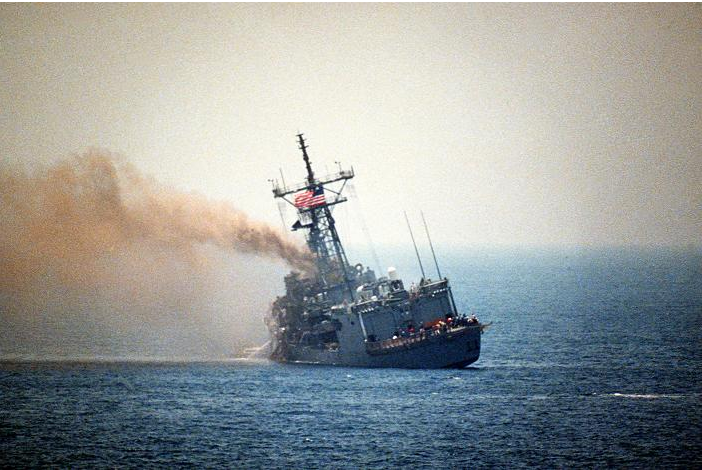
Image of the U.S.S. Stark after being struck by 2 Exocet missiles
Thiessen might be better off asking how we ended up with our only card left to play being to put maximum pressure on the Iranian people in hopes the Regime might collapse. Silly me, I thought we were supposed to have their back, not reduce them to misery. The idea that unarmed people can overthrow their armed-to-the-teeth rulers is a fantasy. Possibly 30,000 or more unarmed Iranians recently lost their lives trying.
In any case, if these sanctions could bring the Regime to its knees, why did we go to war and expend so much of our munitions? Just use sanctions.
We’ve sanctioned Cuba and Venezuela, and millions of people left those nations to survive. Those remaining mostly live at subsistence level. The exception is those in, or close to, the ruling Regime. If there are any goodies to have, they get them. The rest are expendable.
The Wall Street Journal shows there are still many ways the Regime receives money, so it could be a long time before the rulers feel the same pain as the ruled. In the face of all our efforts, the communists still rule Cuba after 67 years. Cutting a deal with the remaining gangsters, as in Venezuela, isn’t going to work with religious fanatics. In any case, that hasn’t done much for the Venezuelan people.
To say the least, the ethics of crushing people rather than helping them are questionable.
If the future of the Iran War is murky, at least how we arrived at this sad state is becoming a little clearer. At the time, I and others questioned our strategy. The only worthwhile goal of a costly war in this case is regime change. Yet, without some boots on the ground, no amount of bombing is likely to force the rulers out. Only armed people on the ground can root out these fanatics.
Aware of this necessity, we looked in vain for an uprising somewhere in Iran, clearing an area to arm and train those wanting to fight for their freedom: a military unit changing sides, or a put-upon minority providing the space. This is the kind of thing the CIA and Mossad are known for.
To date, we haven’t seen any armed dissidents. Many, including myself, thought the Kurdish area in Iran was the likeliest spot. Yet, if the Kurds were part of any plan, why did the U.S. abandon the Kurds in Syria to the mercy of the new Turkey-backed Syrian government in January, just before we attacked Iran? You don’t ask for help from a people you just betrayed.
Not only did the Trump administration bow to Turkish President Erdoğan in Syria, but it also withdrew support for Kurdish action in Iran at his insistence. There are reports that Erdoğan threatened to aid Iran directly. The large Kurdish minority in Turkey has long been mistreated and rebellious. Still, Trump’s obeisance to the Turkish strongman is a mystery.
Erdoğan is the man who dumped an agreement to help the U.S. during the Iraq War, leading to a lack of the Northern Front, which in turn led to difficulties costing the U.S. A supporter of the Muslim Brotherhood and Hamas, and antagonistic to Israel, is no great friend of ours.
Recently, Israel bombed a Syrian Airbase out of fear that Syria’s dependence on Turkey would lead to Turkish use. Likely, Israel joins many Americans in wondering what’s going on between Trump and Erdoğan. The BBC has just reported the U.S. is cutting off aid to our one comrades in arms, the Kurds.
In any case, it appears Israel had long planned to use an uprising in Iran in its planning, and most likely it was part of any plan Israel presented in going to war with Iran. If Trump dashed a major part of its proposal, that’s on him. Israel at least knew we needed to get boots on the ground and where to get them.
The ability of Iran to use its Missiles and Drones to to close the Strait of Hormuz, attack our allies, and blast our bases in the Middle East, according to the WSJ article, was made clear by our intelligence community. These weapons have dominated the war in Ukraine, so there was no reason to ignore changes on the modern battlefield.
Ultimately, President Trump chose the scenario presented by Defense Secretary Pete Hegseth, Joint Chiefs Chairman Gen. Dan Caine, and Adm. Brad Cooper, head of U.S. Central Command, which called for our overpowering Iran and forcing it to surrender. This decision was made in the face of a limited number of missile interceptors to protect our ships, bases, allies, and Ukraine.
The effectiveness of Iran’s drones added a dimension to Iran’s capabilities that should have been expected and countered. Our lack of both offensive and defensive drone capability came as a shock to many, including yours truly. We keep reading about all our new stuff in drone warfare, but where is it in this war?
I asked AI how many Drones we’d need to find and suppress Iran’s drones and missiles; Gemini said it can’t be totally accurate, but then ventured that 50 to 150 thousand of various types would be needed. Sounds like a lot, but consider Ukraine produces well over a million a year. Taiwan exported 85,000 in just the first two months of the year. Yet we hear nothing of our masses of drones making a difference in the war.
Given what we spend, how could we be so far behind in modern warfare? Our manufacturing sector is many times larger than Ukraine’s or Taiwan’s. Drone units should be operational both on land and sea. Ukraine has a dedicated Drone branch to thwart Russia on the battlefield.
It’s disturbing to find that our only experimental drone battalion, set up to bring the success Ukraine has had to our Army, has been disbanded in Europe. While it’s shocking that this was the only such unit, and given our dire drone situation, why disband the unit that knows something about drone warfare? This is part of War Secretary Pete Hegseth’s new Army Chief of Staff, Gen. Christopher LaNeve’s “back to basics” approach. “The battalion was a signature initiative of LaNeve’s predecessor, Gen. Randy George, whom Hegseth ousted in April.”
Gen. George’s drive to update the Army for the new battlefield was strongly backed by Army Secretary Driscoll, whom Hegseth just forced out.
It appears the plan is to spread drones throughout the Army rather than the Ukrainian-favored drone warfare units. This reminds me of the French sprinkling their tanks across the Army rather than in mechanized Panzer Divisions for “lightning Warfare” like the Germans. That didn’t go well for the French.
As I pointed out previously, none of the trio of Hegseth, Caine, and Cooper that told Trump the attack was doable ever went to a Service War College, so they shouldn’t be expected to know things like strategy, tactics, or military history. By the same token, why would you trust them to run your war?
At least, we’re getting the picture of how we got in this mess. It mostly confirms what I thought. What’s sad is that there seems to be no awareness at the top, which is preventing the needed corrections. This lack could set up an October Surprise where Iran’s reconstituted missile, drone, and mine capabilities, with Russian, Chinese, and North Korean help, wreak havoc on U.S. Forces and our allies, right before our midterm election.

