Capitalism Under Fire II

No monopoly lasts without government sanction. That’s just a fact. If you can think of one, I’d like to know. In competitive free markets, dominance is fleeting; look at American Online, Sears, IBM, or Microsoft.

You might ask, what about the Gilded Age Robber Barons? Didn’t Standard Oil and U.S. Steel use their dominance to gouge the public? Even then, both competed in the world market and faced plenty of competition. Instead, out of fear of competitors and to reach lower price points that expanded their markets, they lowered their product prices during the period.

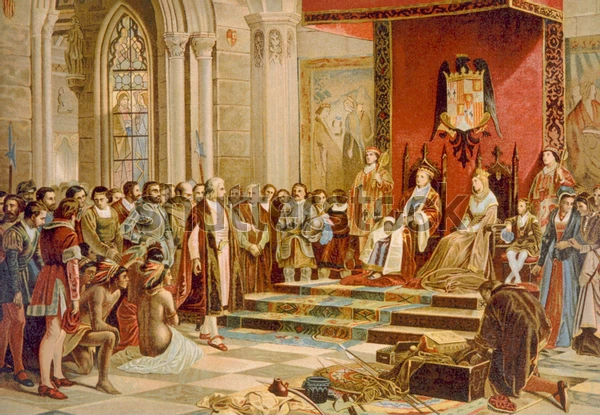
Given the thousands of years of government favoritism, patronage, monopolies, and corruption, pointing to Capitalism’s so-called moral deficiencies is laughable. If Government didn’t control so much of the economy, we wouldn’t need the vast army of lobbyists encamped in Washington. All seek some favor or try to prevent others from using Government favor against them. We now mimic a Royal Court, attracting those seeking benefits:
The recent Skydance-Warner Bros merger illustrates how far down the road to corruption we’ve come. The Government, with its power over “monopolies ” and “restraint of trade ” at various levels, seems to have extracted large sums from the Ellisons and their company, Skydance, to ensure completion of a merger they had already committed large sums to.

No one in their right mind thinks the merger could create a media monopoly or meaningfully restrain trade. At 27%, its largest share of any media sub-market, Motion Pictures is hardly a monopoly—just a large entity in a vast market. Still, the Ellisons contributed 45 million dollars to the Trump ’24 election campaign, and more to other Trump-favored endeavors.

Then many states jumped in through their attorneys general, forcing Skydance to commit huge sums for favored constituencies. Doesn’t this sound more like doing business in a banana republic than in the U.S.?

Adam Smith was, in fact, a moral philosopher; he saw greater virtue in businesses serving their customers rather than their rulers. A business that loses its customers’ confidence will go out of business, but if the Government protects it from competition, serving the public matters little. The invisible hand sorts the trustworthy from the rest.

If you order from Amazon today, you expect it to arrive on time at the agreed-upon price. Even as big as it is, it works hard to keep your trust, knowing that if it doesn’t, someone else will. Do you feel the same when you deal with the Government? How about the IRS or the motor vehicle department?

Continue reading →
What’s Radical

When I talk with young people, I’m struck by how, whether they’re talking about Make America Great Again (MAGA) or Democratic Socialists of America (DSA) ideas, they’re sure they’re taking Radical, Revolutionary positions. Further, these ideas will pull a moribund America out of the morass.

They’re certain about tariffs, government control of or ownership of industry and commerce, severe restrictions on immigration or law enforcement, and that those in government know best. How we get our healthcare, or are educated, is best left to government determination.

Often, both extremes of the two dominant political parties are very close in their reasoning. They attack constitutional speed bumps or procedural impediments, such as courts or the Senate’s rules. Belittling or chastising judges at the highest levels is common to both. Even the makeup of the Supreme Court is on the table: change the number of Justices, or force some into retirement.

Get rid of the Senate’s filibuster rule, or the Senate altogether. Both say that when they’re the majority, nothing should stand in the way of their desires. Subsidies to those they favor seem never-ending—we see antisemitism in both.

People engaging in unfettered commerce can create wealth disparity or run counter to national aims. Government must regulate, or even own or control, the means of production, or any other part of the economy, for the public good. Markets are inherently unfair.

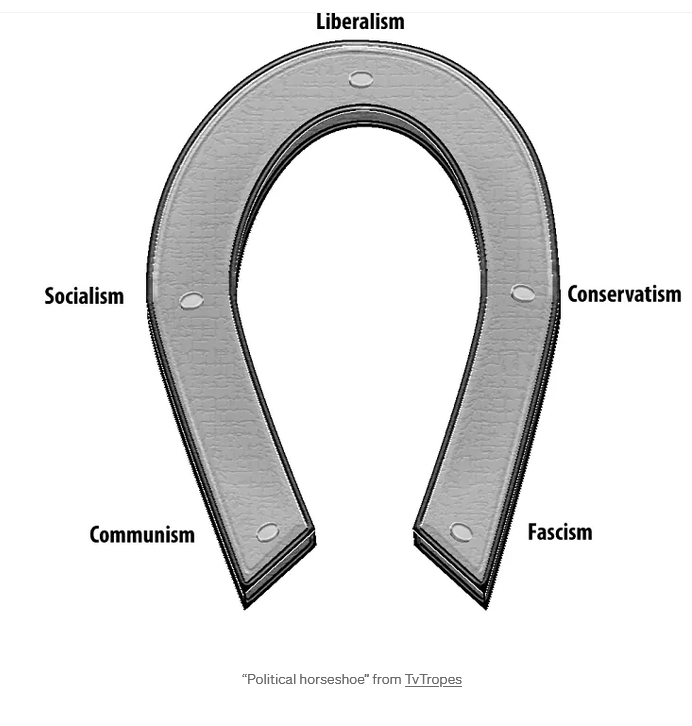
This coalescing of the parties has given rise to the horseshoe theory of politics; at the extremes, the parties are actually close together. Some people might see this as a good thing; the dynamic parts of each party are coming together in a new system that will improve humanity’s future. This idea seems to give some people a sense of purpose.

To those with more than a passing interest in history, this means a top-down government of rule by edict, avoiding imports in favor of domestic producers, the native over others, people are dealt primarily by their class, and acquiescence to government and its religious counterparts, as the font of knowledge; all this seems a throwback to another era. In fact, it could be any era before 1776. For thousands of years, agrarian-based societies worldwide were organized along these lines.

For all those years, human progress was glacial. Those in the lower classes rarely rose above subsistence, while those in the top educated class garnered most of the available goods. Those involved in commerce did so at the sufferance of the rulers.

As none of these younger people in the U.S. ever fully lived under such systems, it can’t be nostalgia, but they may long for some romanticized version. Somewhere in their education and their other sources of information, they formed conceptions at odds with reality. Unaware of their history, the bromides they espouse feel fresh and revolutionary, rather than reactionary to the modern world.

The most radical revolution able to complement and foster a rapidly changing world, breaking with the past’s near stagnation, is our own. I strongly suggest Gordon S. Wood’s Pulitzer Prize-winning “Radicalism of the American Revolution” to understand the radical break with the past our revolution wrought.

Continue reading →

AI BIAS?

I was checking factual information on some points about the similarities between the progressive reaction to today’s technological age and the progressive reaction to the Gilded Age for a recent post. A simple AI inquiry: “Did the Gilded Age see the greatest leap in living standards in history?” Google qualified the statement with “it’s debated because it also featured severe poverty and extreme wealth inequality.” The summary goes on to spell out social costs of deep inequality, crowded cities, and harsh labor:

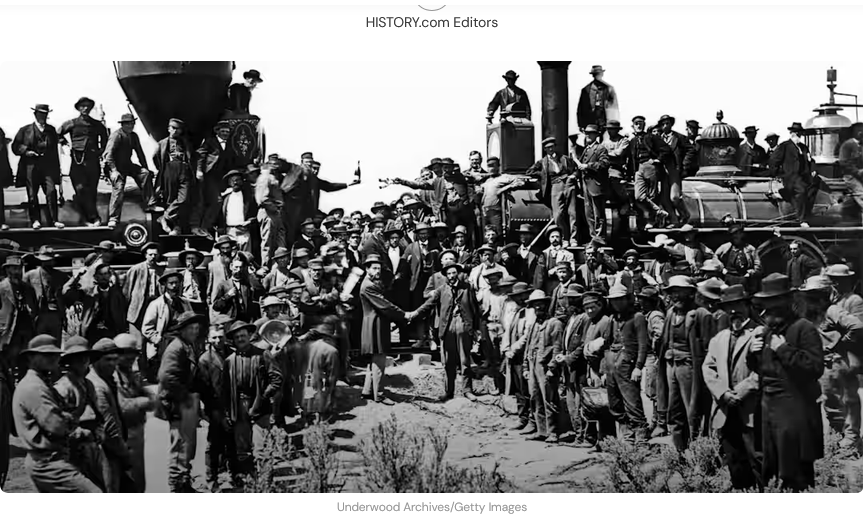
The Gilded Age is generally thought to have begun with the completion of the Transcontinental Railroad in 1869 and extended to WWI.

These qualifiers seemed strange first because I didn’t mention social conditions, just the economic advancement, and they’re at odds with the rest of the summary. In the next sentence, after it mentions the inequality and poverty, it states that real wages for nonfarm workers grew by about 53%. It goes on to confirm the Gilded Age’s Leap: with falling prices, things became more affordable to the average person, life expectancy went up, and the new technologies transformed daily life.

Adding in downbeat notes seems at odds with the rest of the findings. If things were so awful, why did millions leave farms, or come from other nations? People don’t migrate to have less. With all those people coming to our cities to take higher-paying jobs, of course there’s a housing shortage.  

Curious, I put the same statement to Microsoft’s Copilot. Its conclusion: The Gilded Age produced the fastest sustained improvement in material living conditions ever recorded for a large population,” confirmed my understanding. Yet it had to echo Google about inequality and bad labor conditions, while adding corruption and racial divisions. “Jim Crow hardened, immigration tensions rose, Native Americans suffered catastrophic losses.” But all of these problems existed before the Gilded Age. What did the Gilded Age have to do with Jim Crow? Again, these nuances are at odds with the rest of the summary.

My curiosity about AI adding extraneous and contradictory information was further piqued when I wondered about the widespread Genocide accusation leveled against Israel. In the modern world, the concept of Genocide goes back to approximately 60% to 65% (or roughly 1.5 million out of an estimated 2 to 2.5 million) of the Armenian population in the Ottoman Empire who died during the Armenian Genocide between 1915 and 1923.

Continue reading →