I probably should’ve started here. Any discussion of capitalism assumes people understand the role of capital. This may be a false assumption. Ask your friends or others to define or describe capital. You might get a blank stare, or something like, “Oh, that’s stocks and bonds.” Can you define or describe it?
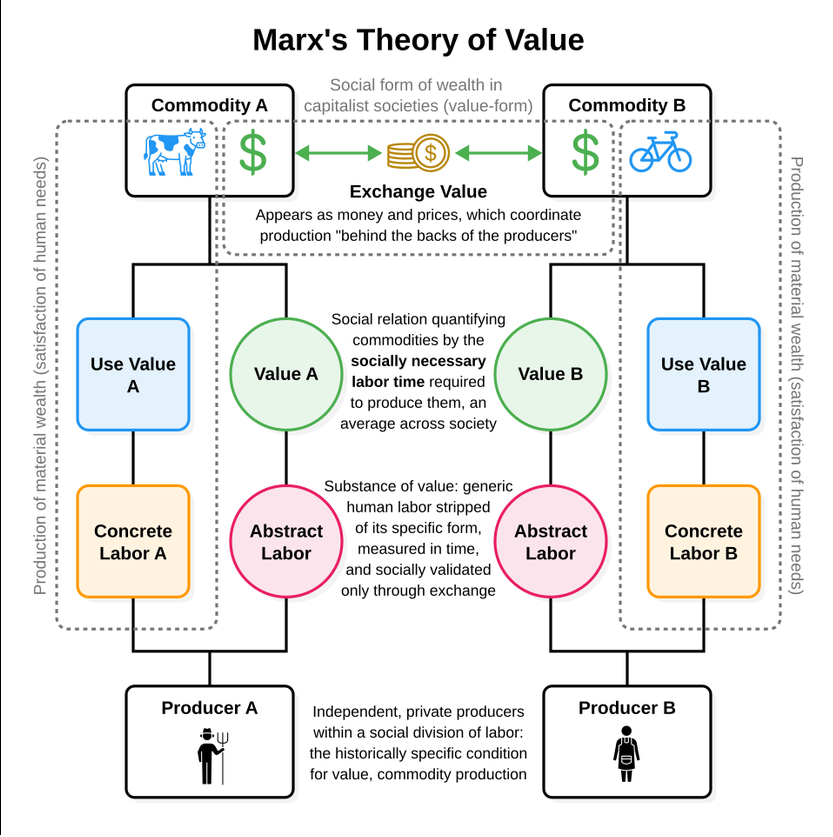
Apparently, this lack of awareness is widespread. I asked AI whether many Americans could describe economic capital. The answer is that very few can. On the other hand, surveys show that at least 17% can define socialism, and many more have some idea of it. This knowledge includes Karl Marx’s concepts like his convoluted labor theory of value:
However, capital, unlike Marx, isn’t hard to understand. The easiest way to understand capital is to think of it as foregone consumption. Eons ago, our hunter-gatherer forebears would forage for grains and fruit over distance. At some point, they brought some back closer to the cave. Maybe some dropped on the ground, and new plants grew. Someone noticed and, rather than eating everything on later forays, planted some of the seeds instead. When the crop ripened, the planter saved some of the harvest for the next crop, again foregoing consumption; in agriculture, we called the saved amount seed corn. In economics, we call it capital.
If you want similar crops in the future, you save a similar amount of seed, but to grow more, you need more seed, more capital. Growing the tribe’s economy requires ever-expanding seedcorn-capital.
Of course, risk is ever-present. Rats may eat your saved seeds. A flood may wash away the crop. Drought or locusts may loom. Thieves and hostile governments, both foreign and domestic, are ever present. So capital is also a bet on the future. It stands to reason that the most successful farmers can take the biggest risks. Through their knowledge and resources, they have the best chance of overcoming the risks.
Properly assessing the risk-reward ratio is often key to moving forward. The old saying, “nothing ventured, nothing gained,” is true for people and societies. Refusing to take a chance guarantees you won’t make progress.
Some people in our distant past didn’t consume all the seeds; they bet on the future and kept going, with ever-increasing seed capital. Humanity leaped from hunter-gatherers to settled civilizations.
We also hear about human capital. Generally, we mean a bright idea or vision. Some humans envisioned that seeds planted in the ground could really pay off. However, that bright idea goes nowhere without seed corn, capital. It only works when we combine the two for a chance at a big win.
What was true in antiquity is true today. To keep progressing, we’ll need ever-increasing amounts of capital to match our ever-increasing bright ideas. With billions of minds linked worldwide via the web, we have no shortage of ideas for progress.
Luckily, we have a capital-expanding machine. It’s called a successful business. After all expenses, what’s left is called profit. The more net profit our businesses produce, the more the capital stock grows to meet the future.
The most powerful capital is that invested in high-risk, high-payoff ventures. With most exploratory oil wells historically dry, nobody drills one without hoping for a big payoff. Oil man Harold Hamm had the bright idea that, with new technology, he could profitably extract oil and gas locked tight in rocks. Most people considered this nuts.
Using his own capital and the capital of those who believed in his ideas, he used fracking to bring oil and gas to the surface. It changed the U.S. from a huge hydrocarbon importer into the world’s largest producer and a net exporter.
Today, artificial intelligence (AI) promises to speed innovation and productivity across industries, from manufacturing to medicine. However, it needs significant risk capital to make that happen. There is no guarantee these ventures will be profitable.
So where does this high-risk capital come from? From people with enough capital to take some loss if things fail and still survive. Generally, people involved in successful businesses, from the really big but not so numerous to the numerous smaller and medium-sized, can afford to take risks in a new venture. After they cover all the bases and maintain their lives, they have more room at the top of their wealth pyramid for high-risk, high-payoff bets:
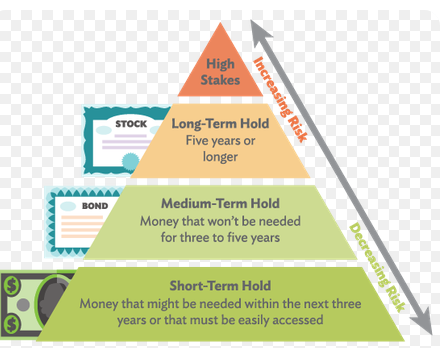
Just as more at-bats increase your chance of a hit, a bigger risk-capital pool can finance more bright ideas. This is especially true among proven hitters in both baseball and business.
The founding fathers saw wealth created by successful people as good. The Constitution protected them from being singled out for special taxes. Everyone paid the same percentage on sales or property. The rich, of course, paid more in real terms because they had more property and bought more. They financed the explosive growth of our first full century.
Of course, change as humanity had never experienced before was bound to cause upheaval. New wealth challenged the old aristocracy’s status, new industries displaced those in eliminated trades, and mass migration to overcrowded cities gave community new meaning. The economist Joseph Schumpeter called this “Creative Destruction. Those adversely affected were not pleased and struck back.
Claiming vast wealth disparity, they pushed for a constitutional change: the Sixteenth Amendment, which taxed the successful at higher rates than others. This change came after thousands of years of aristocracy holding almost all the wealth. It started at 10% and increased over time, reaching 70% to 94% between 1944 and 1981.
At the same time, many government agencies were created to regulate “out of control” industries, with the number expanding especially during the Great Depression. Coupled with high taxes, the capital needed to maintain and expand supply, especially risk capital, was diminished.
By the 1970s, the supply-demand balance was so out of whack that it produced the greatest inflation in our history. Luckily, some realized the folly of high taxes on capital and strangling regulations, and the Carter administration began deregulating some major industries. The Reagan administration continued deregulation while lowering taxes on the successful.
The salutary effect of these actions moved us in a better direction. For example, in the high-risk oil business. High energy prices played a big part in the “Great Inflation,” rising from just $3 a barrel to $40. We expected to see $100. Instead, with controls removed, it fell, bottoming out at $10, as new fields were found and developed.
We dodged a bullet by changing course, but others weren’t so lucky. Those who rejected capital as bad and clung to Marxist ideas, as the chart above illustrates, replaced the capital-producing machine, the private sector, with government-directed economies. Caught between dwindling new resources and promises made to gain power, they squeezed what they could from the existing capital stock.
As other industries became uncompetitive in the world market without smart capital investment, the USSR and Venezuela had to rely on natural-resource cash, mainly oil. Ultimately, to make ends meet, they even ate their seed corn, the capital needed to maintain production. The USSR collapsed, and millions fled Venezuela, while its oil production dropped by over two-thirds. It’s now a U.S. satrapy.
Lacking major natural resources, Cuba has limped along at subsistence on others’ charity. Presently, it relies on remittances from Cubans who fled abroad, mainly to the U.S. Its infrastructure is crumbling, with only intermittent electricity.
Even in the face of mountains of evidence to the contrary, the progressives on the left and MAGA on the right want the government to take the market-created capital, so it can distribute it to their adherents so that they can live with “{dignity.” The geniuses running the government will work it all out.
If you want to see how that works out, I suggest a trip to Cuba. Walk around Havana to see what “living with dignity ” looks like.
Europe is mired in bureaucracy and regulation. To plant your seed corn, you have to jump through multiple hoops imposed by the government. As a result, the European Union, which not long ago had a higher GDP than the U.S., now lags far behind.
Before we take bows, Larry Fink, the Chairman and CEO of BlackRock, the world’s largest asset manager, recently warned in the Wall Street Journal, “America Needs More Capital.” A $32 trillion economy needs lots of seed corn to maintain and grow.
How does this square with the very loud demands for wealth taxes and other drains on capital? As we’ve seen, transferring seed corn from financing the future to present consumption hasn’t worked out very well.
This situation exposes the divide between optimists willing to bet on the future and those who want the immediate gratification of a big meal now. Count me among the optimists who revere those in the past who sowed the seed corn and made a better life for us. We need to do the same.

