It is widely reported that Socialism is more popular than ever in the U.S. and is gaining on Capitalism as our preferred economic system. This shift is most prominent among young people, many of whom claim that Capitalism just hasn’t delivered for them. Because of Capitalism’s failures, we are in the middle of an affordability crisis.
While this may make some sense on the surface, a closer look is warranted. Affordability is just another way of saying prices are too high and rising. In other words, Inflation. Economist Milton Friedman famously stated that “inflation is always and everywhere a monetary phenomenon,” arguing it results from the money supply growing faster than economic output—too much money chasing too few goods.
Capitalism means the least government interference in the economy. Private enterprise has no control over the money supply. Only the Government, through the Federal Reserve (FED), has that power. The FED is a 1913 progressive creation with a poor record on Inflation:
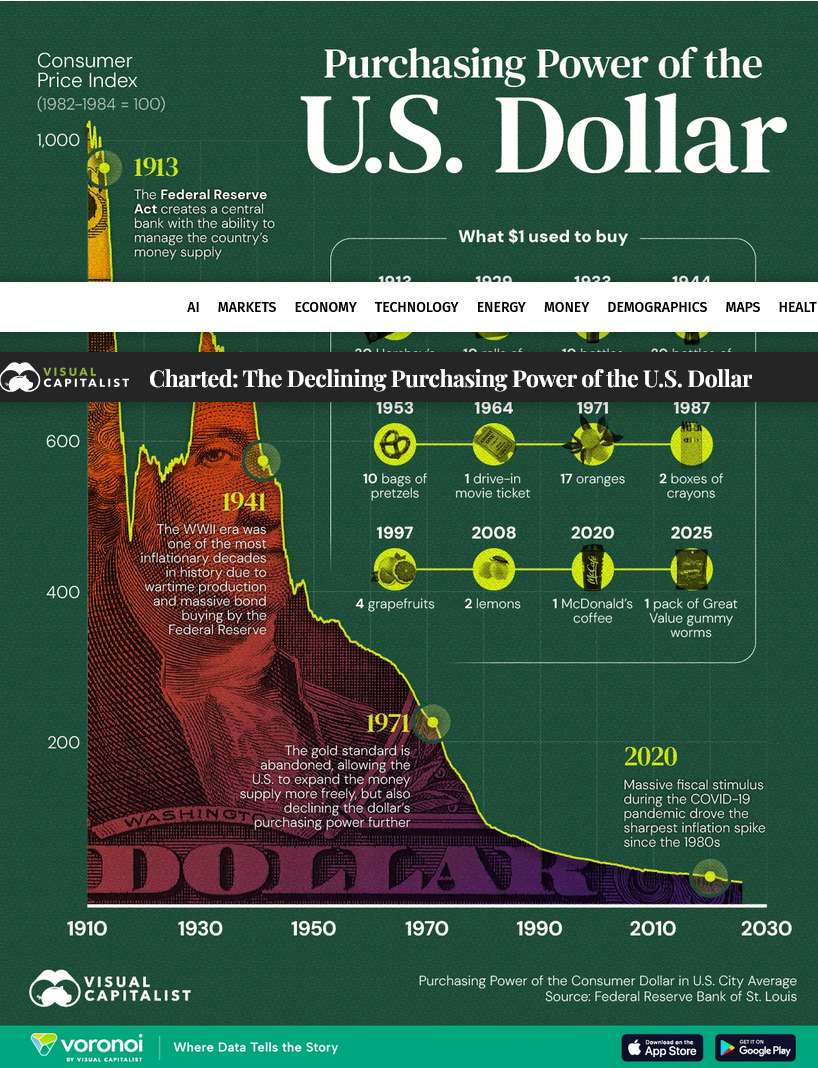
Except for wars, sustained rising prices were virtually unknown before the FED. In fact, during the Gilded Age, a period with little government interference but amazing growth, prices consistently fell, increasing real wages. Inflation, then, is a government phenomenon. Blaming Capitalism is misplaced. Looking to the Government for solutions flies in he face of experience.
This situation led me to look more closely at the other prevalent criticisms of Capitalism. The first thing you find is this: Adam Smith and his followers, moving away from the government-controlled mercantilist and feudal systems then in existence, never used the term Capitalism. Instead, they used free markets or free enterprise. Smith himself called it a “system of natural liberty.” French socialist Louis Blanc used the word capitalisme around 1850 to mean “the appropriation of capital by some to the exclusion of others.” He obviously meant it as a pejorative.
Maybe this explains why the media and academia use Capitalism rather than free market or free enterprise when referring to an economic system relying on markets to direct investment and set prices?
The Gallup poll shows Socialism’s favorability rising to 43% vs. Capitalism at 53%, while Free Enterprise in the same poll sits at 77%. Yet Capitalism and Free Enterprise are considered synonyms in every dictionary, meaning essentially the same.
Curious, I asked AI what the major failures of Capitalism were touted. They centered on five general n deficiencies. Unequal distribution of Wealth, market failures, prioritizing demand over morality, environmental degradation, and labor exploitation make for quite an indictment.
Since we aren’t gods and aren’t perfect, a reasonable inquiry into this bill of particulars should ask: compared to what? Has any other system done a better job in these areas?
From our earliest agrarian hierarchies, through feudalism and mercantilism, almost all Wealth for thousands of years was held by the landed aristocracy, generally less than 10%. The vast majority of the population (often 90% or more) consisted of peasants, serfs, or laborers who were legally tied to the land, completely illiterate, and living at subsistence levels. One might ask, what wealth distribution?
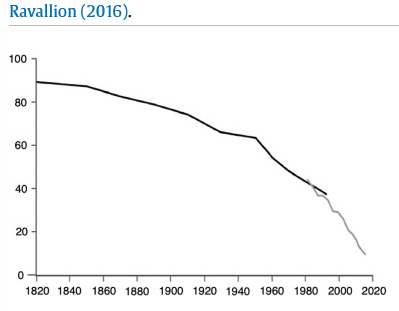
In advanced capitalist nations, less than 1% of the population lives at the extreme international subsistence level or in extreme poverty. You have to concede that’s an improvement. These gains came despite a massive population increase:
Number of people living in extreme poverty Worldwide
In the U.S., the upper middle class, at about one-third, has the most people and is the fastest-growing group. That means that, when you add the upper class, most Americans not only get by but live very well.
We hear, especially from the progressives, that the Tech Oligarchs have all the money and power. Still, the new book “The Everywhere Millionaires: Who Is Really Rich in America and How They Got There”, by Owen Zidan and Eric Zwick, tells a different story. The five million households with more than five million dollars have thirteen times the Wealth of the Forbes 400. Given their money and numbers, this group hardly lacks political power. As every citizen gets to vote, Wealth and power, it turns out, are spread wide.
The progressives might concede we’re doing better than in the olden days, but they claim “modern methods” would work better. Socialism can result in real wealth equality. If so, why hasn’t it ever? Wherever it’s been tried, the party in charge ends up with what little Wealth there is: Cuba and Venezuela are living examples.
Even if you could achieve absolute economic equality in Cuba, something likely impossible anywhere, it just means you’re equally miserable. Contrast that with Capitalism’s ever-widening spread of the good life. People have expanding choices. Maybe we don’t always make the right ones, but at least we have them.
It’s the bedrock of the progressive movement from the late 19th century till now: Capitalism leads to market failures where resources are misallocated or monopolistic practices emerge. What’s surprising is how many people claiming to be conservatives also take this as gospel. If the market has a setback, or a company grows so large through innovation and organization that it dominates its market, government intervention is necessary.
Again, it has to be noted that in 1913, the progressives gained control of the money supply with the establishment of the Federal Reserve (FED), as our national bank. It was touted as a way not only to maintain the dollar’s purchasing power, but also to avert the periodic downturns.
Since Government interventions, we still have recessions because, as Tyler Goodspeed points out in his definitive book “Re$sions,” the downturns are random confluences of nasty happenings, including government actions—a perfect storm. This circumstance makes them impossible to predict and avoid. We had them before the Fed and progressive reforms, and we’ve had them since.
The two worst downturns in our history, the Great Depression and the Great Recession, occurred under the FED’s watch. It isn’t that we didn’t have severe downturns before the FED got up to speed; the 1837, 1873, and 1921 downturns were severe.
The difference is in the recoveries. ’37, ’73, and ’21 saw robust recoveries, returning to solid growth without government action. I include ’21 with the earlier period as it was the last recession without any meaningful government intervention. James Grant told this story best in his book, “The Forgotten Depression 1921: The Crash that Cured Itself.”
Less than a decade later, another perfect storm occurred, but this time the Fed took a series of actions. According to Milton Friedman and others, unfortunately, the wrong ones. Under both Hoover and especially Roosevelt, the Government continuously intervened in the economy to no avail. Only after WWII, when the Government backed off, did a real recovery take place. George Selgin spells out the New Deal’s failure in his clear-cut “False Dawn.” The Government, rather than helping, hindered the recovery.
The Government’s well-intentioned actions contributed significantly to the Great Recession, but the piling on of regulations and over-the-top Fed actions such as “Quantitative Easing “made for what many consider the worst recovery in history—those who disagree point to the Great Depression.
If Government intervention fails to prevent or even lessen economic setbacks, but makes recoveries much worse, maybe letting free markets sort things out, as in ’21, is the better course.
Continued in the next post

