We’re entering the mid-term election home stretch, and it looks as if it will come down to which we hate more: Trump or Socialism. Polls show a majority of Americans dislike both. Younger voters abhor Trump. At the same time, older Americans feel the same way about socialism. Each party is expending resources to convince the populace which is more terrifying.
This state of affairs makes it easy to follow the campaigns. Thank goodness there are no other concerns we need to discuss before they become a crisis. After all, our exploding national debt is a long-term worry. Our losing the Iran war only confirms that foreign adventures always turn bad. Just stay at home. Like, that’s a possibility in an ever-shrinking world.
I don’t want to be a wet blanket, but there are signs that the debt crisis may be closer than we think. Are you aware that the U.S. government is about to sell 30-year bonds at the highest interest rate in a quarter of a century? Don’t feel bad; most people aren’t:
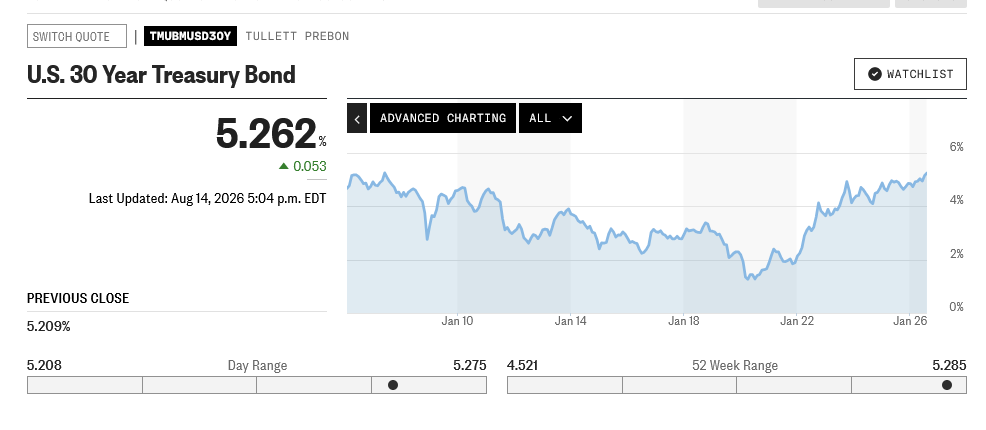
The current rate on the long Treasury bond yields more now than at the height of Quantitative Easing (QE) coming out of the Great Recession. It’s higher than when we had 9% inflation under Biden.
This is true even though the Treasury issues far fewer of these long bonds than short-term obligations. Generally, there is a ready market for long bonds from insurance and pension funds that need to match long time frames and commitments, and the Treasury accommodates them, but refrains from issuing more for fear it will raise rates the Federal Reserve has little or no control over.
The Federal Reserve can no longer affect longer-term interest rates because of the masses of longer-term bonds bought under QE to keep rates down in the past. Those bonds are now held at a loss. That’s right, our central bank is losing money. The new Fed chairman, Kevin Warsh, was no fan of the QE program that resulted in the first loss since the Fed’s first year in 1915, so it’s unlikely to repeat it.
The climbing long rate seems to signal future inflation problems. We are already paying more interest on our debt than we do for national defense. With the impending insolvency of Social Security and Medicare just a few years out, spending looks like it has nowhere to go but up. With most of the debt short-term, any further interest rate rise is reflected almost immediately in much higher payments.
Japan, with debt two and a half times its GDP, is further along a crisis path. Its currency came under attack, meaning a possible inflationary devaluation. In the past, nations under similar attacks either raised interest rates or sold reserves to buy and bolster their currency.
Raising interest rates only adds to the deficits, creating a vicious cycle. Japan has plenty of reserves in the form of U.S. Treasuries to defend the Yen, but large amounts of U.S. obligations dumped on the market likely would raise our interest rates.
Treasury Secretary Scott Bessent is trying to avert this situation by lending Japan the dollars it needs to defend the Yen, so it doesn’t need to sell U.S. Treasuries. So far, the patch seems to work, but more dollars are out there and could come back to haunt us at any time. A crisis may be just around the corner, rather than somewhere in the future, yet almost no one is talking about it. What happens if another high-debt nation’s currency comes under attack?
Our military doctrine used to include the ability to fight two regional conflicts successfully at once. Now it appears we can’t handle even one. The Iran War has exposed our hugely expensive forces as antiquated, resource-poor, and incompetently led. Just as we thought Iran was weak and ripe for attack, our adversaries may think the same of us and pounce.
I’ve already made my points about how poor the war planning was. How did killing some top leaders and dropping a lot of our limited supply of ordnance get past any war-gaming as a viable plan? Iran’s response possibilities were well known, but we have no counters. Six months into the conflict, and we still have no answers to a lesser power’s modern drone and rocket warfare. The few things we have that work, we’re rapidly running out of.
Our only real answer is to blockade Iran with our vast and expensive fleet and apply some financial tools, in hopes that it deals so much pain and destruction to the Iranians that the country collapses.
We’ve seen this scenario before in places such as Cuba and Venezuela. The last people to feel the pain are those in charge. Ordinary people get crushed. Silly me, I thought the war’s objective was to foster regime change so the Iranian people could thrive while at peace with their neighbors. Whatever goodwill we had with Iranians is taking a big hit, the opposite of our interests.
We keep hearing about new weapons and systems that will let us catch up and regain dominance, but other than a drone boat and Iranian-inspired drones and missiles, has anyone seen any of these in combat? While some developing weapons are being tested and evaluated recently in the Iran War, a new weapons exchange with Ukraine and Israel would give wider choices under more varied circumstances.
As it is, we appear unable to muster the organization and updates we’ve done in past wars. We need thousands of drones for offense, defense, and observation, but we’re raising tariffs to keep out foreign-made drones and parts, protecting our infant domestic drone industry. When will companies like the one Donald Trump Jr has an interest in be able to deliver effective weapons?
Of course, catching up takes money, so why is the President ordering many of our newer Aircraft Carriers to undergo a hugely expensive retrofit to steam catapults, instead of the more effective and less costly electronic ones they currently have? We should be evaluating carriers’ place in wars dominated by drones and rockets before this costly retrofit.
As it is, we’re sending a carrier home from the Middle East that’s experienced problems due to long deployment, and moving its replacement leaves the entire Pacic without a carrier. Now we want to take more carriers out of commission to retrofit? This confusion shows our lack of purpose and understanding.
The rot in our military is on display, but is anyone making an issue of it now, before it’s too late and we have a real crisis? Just as our disastrous Afghan pullout encouraged Russia to attack Ukraine, we may be encouraging a Chinese move against Taiwan, or Russia against a NATO partner.
Instead of yelling Trump bad, or you’re a communist, we need some adults aware of problems that need immediate attention before things get out of hand. Good luck with that in our fractured political world. I know explaining these problems in terms people can understand is difficult for our politicians and media, but that’s their job. Time is growing short.


[…] little over a month ago, I pointed out two crises that aren’t getting the kind of scrutiny one might expect in an election year. Just because […]
LikeLike