One week out from the midterm elections is a good time to see how things are perceived, so we can judge what happens when the votes are counted.
Early on, most experts thought Republicans could lose the House, with Democrats needing only to flip a few seats. The Senate, however, looked safe for the GOP with a favorable map. Now polls show Democrats in a good position to take both houses.
This change may lead to a very contentious future. While the House can give an administration a tough time, losing both Houses can cause real pain. Confirming appointments for itself and the judiciary will be difficult, and in many cases impossible. If the two houses of Congress disagree on legislation, they go to conference for possible compromise. With both houses Democrat, that’s far less likely.
Facing opposition legislation, Trump can only veto—anything he proposes is a dead letter. He has more leeway in foreign affairs, but even there he may run up against the power of the purse. The administration will face endless congressional hearings.
An impeachment may be in the cards. The Democrats may think the third time is the charm. Trump could be the lamest lame duck.
Trump has only himself to blame. When he took office, inflation had declined to 3% year over year. Still high, but down from a whopping 7% under Biden. While the Big Beautiful Bill had some questionable stuff, like no tax on tips, it had enough supply-side elements, when paired with regulatory reform, to help supply meet demand—a proven way to bring inflation down:
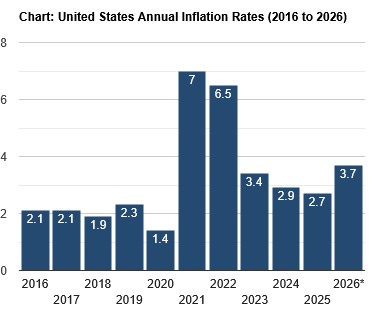
*The latest inflation data (12-month based) is always displayed in the chart’s final column.
Then came Trump’s “Liberation Day,” when he slapped big tariffs everywhere. Tariffs raise prices. How did this square with Trump’s promise to bring them down? It didn’t. It contradicted it. Even though the Supreme Court found the tariffs illegal and refunds are going out, Trump doubled down with new tariffs. Confusion reigns. Businesses don’t invest much when they’re confused.
Not content with his tariffs adding to prices, last February he decided to attack Iran. Claiming it would be a short war, here we are with trade restricted in two of the world’s most important trade routes. This situation is raising prices worldwide. Still without a workable war plan, there is no end in sight. Instead of falling to the Federal Reserve’s 2% goal, we’re at 3.7% and likely heading toward 4%.
With wages chasing prices and falling behind, “affordability” is the biggest election theme. As I warned, longer-term bonds were signaling higher interest rates, and sure enough, they’re rising. Now it’s even more expensive to buy a house or a car, or to pay your credit card balance. A $2 trillion deficit at a time the administration claims is great will do that.
Incumbents and other strong candidates could still save the Republican Senate majority, but Trump prioritized loyalty over electability and drove out established senators in Texas and North Carolina. senators. In Georgia and South Carolina, loyalty to Trump meant weaker candidates, not stronger ones.
Now, a huge amount of Republican campaign cash is pouring into the Texas race; that won’t help win pickups in Minnesota, Michigan, and New Hampshire, where they have good candidates. It’s Texas, for God’s sake, and you can lose? Trump had to go to South Carolina to shore up his chosen candidate.
With all of Trump’s missteps, it looks like the Democrats are a shoo-in for both houses, and if he were up against a party with a viable plan, that would be so. But that isn’t the case. The Democrats, if they have any ideas at all, have bad ones that failed in the past.
Identifying problems like affordability isn’t the same as solving them. The last time they were in control, they produced the highest inflation in forty years. Those price increases are still part of today’s “afforability Crisis.”
Socialism: the government owns and directs all commerce, starting with grocery stores; it imposes price controls, starting with rent; and it provides subsidies so everyone can live a dignified life. Where has any of this ever worked? Cuba, Venezuela, or the USSR?
Non-Democratic Socialists of America (DSA) Democrats claim they’re not that extreme, but what are they offering? All I hear from them is crickets. The far left holds the megaphone.
The twist in this election: maybe just a little change, even though mid-term elections historically run against the party in the White House. Add a president running in the mid-to-low 30% range in the polls, and we should expect a blue wave.
Yet if the Democrats offer little or no workable solutions to our problems, voters may return to previous patterns or favor individual candidates for their personal qualities. Michelle Tafoya, John Sununu in New Hampshire, or Susan Collins in Maine aren’t known for aligning with Trump.
The outcome could leave the Senate Republican and the House narrowly Democratic. With a small House majority, leadership would face an expanded Progressive caucus, which might pose a similar challenge to getting things done as the Freedom Caucus did when Republicans controlled the House.
Trump may find a majority depending on Sununu, Collins, and Tafoya, less to his liking than the one with those he drove out.
Foreign wars and out-of-control spending, rapidly adding to historically high debt, will find little room for new solutions. All the effort and money spent, and nothing resolved.
However, if the House stays with the Republicans and the Senate does too, Democrats may have to ask themselves why the party exists at all. With only proven bad ideas to offer and ignoring real problems, they’ll look more and more like the Whigs in the 1850s. The election outcome may be surprising.

