Third Party Message For Elon Musk

Here we go again. A billionaire suddenly discovers our two-party system is dysfunctional. Instead of serving the desires of most Americans, each party reflects its extremes. This time it’s Elon Musk. It brought back memories of my association with Starbucks founder Howard Schultz’s brief Third-Party campaign. That campaign asked for people with fresh ideas to submit them.

At the time, I was creating my Future Party series. I concluded that any new party has to stand for something or a set of things. Just being against the other guys won’t work. Rather than dealing with personalities, people unhappy with the current two parties need to unite around common goals. The Republicans opposed the spread of slavery when the Democrats and Whigs equivocated.

I communicated this conclusion, along with a link to Dave’s Healthcare Plan, on this site. After all, it isn’t right to pontificate without contributing to a solution. To my surprise, the campaign asked me to join an “outside the box”ideas group. Someone there liked the Plan, and I will hear the details shortly.

What I heard next was that Howard Shultz was dropping his third-party crusade. I received an email stating that the idea group wanted to continue, but there was no further correspondence.  

I often wondered what would’ve happened if, instead of the “Third Way” pablum Schultz spouted, he had put forth bold ideas to solve real problems, rather than being perceived as just a spoiler. Dave’s Plan offers completely portable, universal healthcare and retirement benefits. It utilizes the money and structures we already have in place. It might’ve provoked discussion and attention. It’s not Democrat or Republican, just a comprehensive answer to big problems.

Continue reading

Inflation Hurts And The Pain Will Continue

Democratic Politicians and allied media, echoing some economists like Paul Krugman, paint a rosy picture of our economy. They question why we’re less content while supposedly outperforming other nations. Catherine Rampall, the Washinton Post economics columnist, tells us, “Nearly everything Americans believe about the economy is wrong, according to a recent Harris-Guardian poll. And that’s pretty much everyone’s fault.” This narrative implies that our dissatisfaction is unfounded. But is this the whole truth? Are there no deeper economic issues that we need to address?

After a lifetime of talking to people about their finances, I have gained a profound understanding of how people assess their financial well-being. In most cases, having a growing amount left over at the end of each month tells them whether they’re just subsisting or can think of the things that make life worth living—a vacation, maybe with your family, or a better house. Whatever your dream, it always requires money. Unless you have discretionary income, you can’t fulfill it, whatever it is.

When every basic bill, from rent to utilities and insurance, elicits a gasp, even a raise can’t alleviate the feeling of being trapped. The necessities of life, like food, transportation, and clothing, become burdens, and dreams start to fade. This situation is actual for many hardworking Americans struggling to make ends meet.

While economists discuss prices and wages, the reality is far more complex. Your pay may rise, but your grandpa’s and grandma’s income may be more fixed. Where they could pay their way in the past, now they need help to meet their rising bills. You thought you had the kid’s education covered, only to find a widening gap. These stark realities are not just isolated incidents but the daily norm for more people. No wonder those telling us how well we’re doing only get blank stares.

Inflation is the source of most of our angst, but if you feel future inflation isn’t dangerous, steps to rein it aren’t topping your to-do list. Everybody seems to be waiting for the Federal Reserve to lower interest rates, which presupposes inflation is under control. How likely is this situation to be accurate in the future?

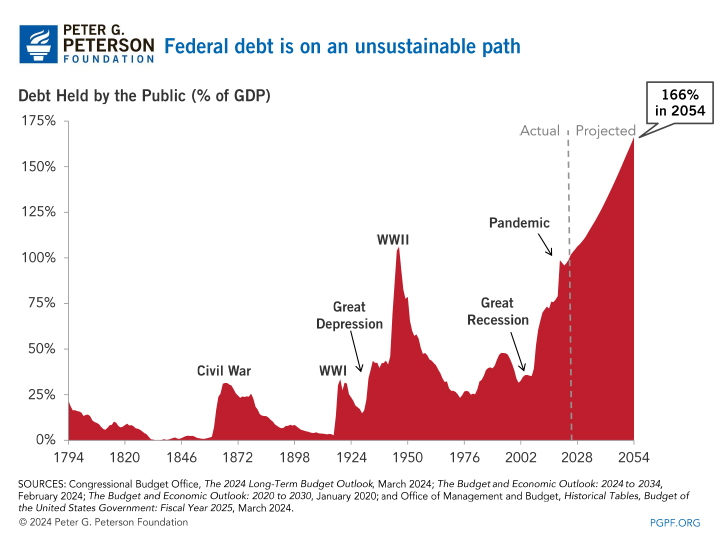
The classic definition of inflation is “too much money chasing too few goods.” We have to borrow when revenues don’t cover our government’s expenditures. If we dump ever-growing amounts of debt on the market and the Federal Reserve fails to intervene, ever-rising interest rates will be required to find buyers. Already, we pay more on our debt than on defense. In the future, the payments will crush the entire budget. This crisis is not a distant possibility but a potential economic catastrophe that we must address:

Of course, the Federal Reserve can buy the debt with money created out of thin air. This course of action is how we get runaway inflation: one way or another, overspending results in the unkindest tax inflation.

Continue reading

Shouldn’t We Get Something For Our Money?

It’s hard to keep up with the Biden debacles. While we wait for the administration to explain the latest fiasco, the raid on Trump’s Florida residence, we need to continue evaluating Build Back Better, oops, the Inflation Reduction Act. While the Congressional Budget Office (C.B.O.) points out that the legislation does nothing to reduce inflation, the claim is it will save the planet. Just ask the New York Times columnist, Paul Krugman. 

Too bad the $380 billion spent on this march to the Green New Deal will make no noticeable difference in the earth’s temperature by the end of the century. Wall Street Journal contributor Bjorn Lonberg ran the numbers and found that the most optimistic case lowers the temperature by 0.028 degrees Fahrenheit. The pessimistic case is 0.0009. 

This result is understandable once you realize nothing we in the U.S. does will make any difference in the earth’s temperature as long as the third world, China, and India continue to expand the use of fossil fuels massively. Nations desiring to improve the lives of their people understand the need for cheap reliable energy. Suppose it’s locally sourced; so much the better. That isn’t the windmills and solar panels we’re pushing.  

To make the pain equal worldwide, The World Bank is lobbying for a single world carbon tax. Even though this idea has support in some quarters, the National Bureau of Economic Research (NBER) finds a slight increase in world G.D.P. at the turn of the next century from a lower temperature wouldn’t be worth the pain getting there. 

Continue reading

Widget’s Revenge

Senator Joe Manchin and Senate Majority leader Chuck Schumer have agreed on what they call “the Inflation Reduction Act.” This bill is a slimed down but a still expensive version of the multi-trillion dollar “Build Back Better.” At the core is a minimum of 15% tax on over-billion dollar corporations. The revenue from this tax pays for much of what’s in the legislation.

Democrats and much of the media have applauded this provision as only fair. After all, many big corporations pay no tax. How can that be fair? At least they can give a pittance. !5% isn’t too much to ask from these wealthy corporations. 

Maybe there is more to the story. Let’s look at what I’ll call The Internation Widget Corp (IWC). In my days in Business school, a widget was the stand-in for anything produced. Company A Turns out 100 widgets an hour, but company B only 75. How can B match or exceed A?  

How would this “Inflation Reduction Bill” affect this mythical company? Demand for widgets outstripped production, leading to inflationary supply-chain disruptions. Investment in increased production is necessary to fill orders and maintain the company’s competitive position. IWC will post a profit in 2022 of a billion dollars from selling this essential to many industries.

IWC is investing $4 billion in plant and equipment to meet the challenge. Three billion borrowed. Trump’s 2017 tax reform let it offset its tax liability by rapidly depreciating this investment resulting in zero tax. It’s committing all the company’s profits and the maximum money it can borrow without losing its excellent credit rating.

Expansion means more jobs and economic activity- More taxable income down the road. Trump understood it takes invested capital to create viable employment. Business investment underpinned the Trump boom before the pandemic. In any case, expanding supply to meet demand curtails inflation.

Continue reading

Stopping Inflation IV

In the face of the administration’s claim, there is little it can do about inflation; I’ve pointed out how changes in energy and regulatory policy will change the price trajectory. We also have a labor shortage adding to the upward cost pressures. Only now we’re matching the number of employed before Covid. Yet, we are at a 3.6 unemployment rate, which means upward pressure on wages.

Coupled with lower birth rates, we are facing labor force problems. Baby boomer retirements, already shrinking the labor force, gained momentum during the pandemic. Higher transfer payments, commuting, and childcare costs keep others from returning to work. The result is a labor participation rate of just over 62%, down from over 66% at the turn of the century.

Its possible inflation may force more people to return to the workforce, but this is far from certain. We have to look to solutions that worked in the past. The United States led the world in welcoming legal immigrants, but lately, not so much. The Trump administration made sizable cuts in new legal arrivals. So far, The Biden administration has continued the reductions rather than expanded immigration. 

The inability of both parties to confront our longstanding legal and illegal immigration problems provides little hope for relief from that direction. We forget that along with higher interest, lower taxes, and less regulation, Ronald Reagan signed the last major immigration reform. All these things combined to subdue our worst inflation until now. An increase in green cards would help, but nothing gets done. The present administration largely ignores the problem. 

If we can’t increase the labor force, we must make our workers more productive. Historically machines have multiplied labor output. However, our progress on that front leaves much desired—the U.S. lags on machination. This lack is true even though there is plenty of investment capital. We aren’t matching our competitors.

While other advanced nations with slow-growing populations have replaced workers with robots, The U.S. isn’t among the leaders, lagging in seventh place:

What explains our reluctance to mechanize? Our ports are far less efficient than other major world ports. This failure has added to supply chain disruption. The slow pace, in turn, added to our current inflation.

Continue reading