Head-scratchers

Confusion rules. Has there been a time when, other than wars or economic reversals, everything was so up in the air? In just the last couple of weeks, we’ve had a meltdown over frozen Greenland, a fleet racing to the Middle East for possible military action against Iran, and the appointment of a Federal Reserve chairman philosophically at odds with the President, who appointed him. All with worldwide implications. What can we make of all this?

We’ve gone from giving the U.S. Greenland or else, to we’ll work things out—no big deal. Wait, wasn’t our need to possess Greenland a necessity for national defense? As I pointed out in the last post, we already had access to everything in Greenland that we would ever need. We antagonized our allies for no discernible end. Will Trump return to his demands again down the road?

The administration is correct in acknowledging the Arctic’s rapidly increasing importance. Still, as others and I pointed out, China has more to fear from us regarding the new Arctic trade routes than we do from it. This map makes it obvious where the choke point for both routes lies, and it isn’t Greenland. It is already part of the U.S., our state of Alaska:
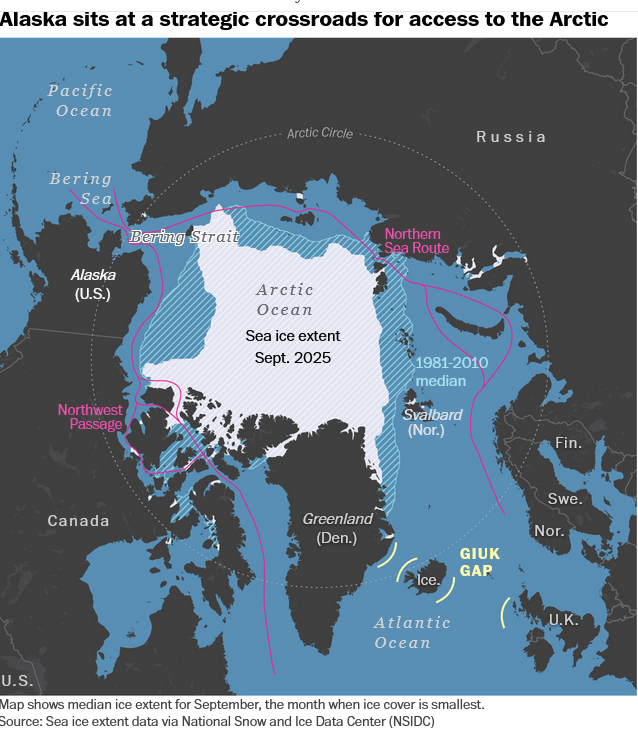
As you can see, both new shorter routes run through the Bering Strait, which Alaska dominates. A reasonably strong Alaska military position could close the strait to China’s trade, and China would have to pay hell to regain passage there, even if they could. After all, China would have to move its forces a great distance under to attack, only to find a well-positioned enemy. If we take the proper military steps in Alaska, we, not China, possess the leverage in the Arctic.

Given this strategic fact, Trump’s campaign to grab Greenland was about his legacy, rather than national defense. We’ll determine the cost of his vanity later.

Continue reading
Where Has Competence Gone

Years of heavier-than-usual rains, followed by dry and hot weather, left vast fuel for fires. Winter brings the dangerous and unpredictable Santa Ana winds. Thank goodness California Governor Gavin Newsome had the foresight to call an emergency legislative session to fund preparations to handle the threatening situation.

Realizing what could be coming to vulnerable areas, successful governors get out in front and ensure everything is ready and working. Even though Florida suffered from severe hurricanes, Governor Ron DeSantis and his crew minimized problems and returned things to normal quickly.

Florida set the standard of preparedness for California to follow, and with overwhelming Democratic majorities, getting the needed funds and authorizations to be ready to meet the dangers presented no problem for Governor Newsome.

Oh, wait a minute. , the emergency legislative session wasn’t to prepare for a severe fire season; it was to appropriate funds to thwart Trump from expelling illegal aliens from California. The danger Newsome foresaw wasn’t from out-of-control wildfires; it was the federal Government initially deporting the illegal alien criminal element.

The result of this lack of preparation is likely to be the worst wildfire disaster in history. Fire hydrants without water are incompressible, as is a key reservoir without any water. Does this sound like preparation?

This absence of competence isn’t due to Californians not being taxed enough to measure up. They pay a lot more than Floridians. So why does Florida do so much better in crisis? The Sunshine State may spend more wisely.

It isn’t global warming. Both states are equally affected—after all, it’s one planet. No state has invested more and taken more action in combating Global warming than California. Of course, all of it has had zero effect. The truth is that nothing California or even the United States can do will change the direction of global temperatures. It could be a simple difference in competence.

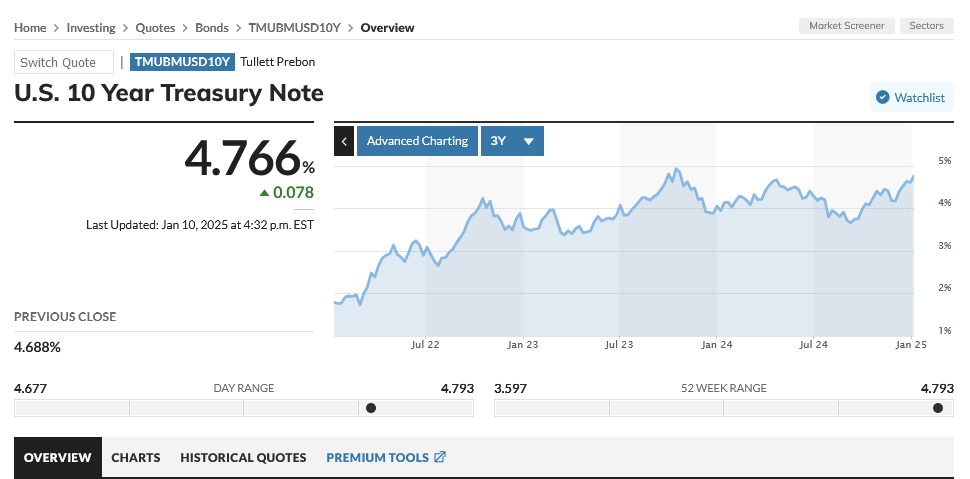
Yes, I’ve shown this chart before, but it bears watching:

While the Federal Reserve has been lowering rates, longer rates are approaching levels reached when inflation was 9%. What is it the market sees the Fed is ignoring? Could higher inflation be in our future? Could the brilliant minds at that institution be missing the signals again? Remember, a few years ago, they told us not to worry; the price rise was transitory.

Continue reading

Inflation Hurts And The Pain Will Continue

Democratic Politicians and allied media, echoing some economists like Paul Krugman, paint a rosy picture of our economy. They question why we’re less content while supposedly outperforming other nations. Catherine Rampall, the Washinton Post economics columnist, tells us, “Nearly everything Americans believe about the economy is wrong, according to a recent Harris-Guardian poll. And that’s pretty much everyone’s fault.” This narrative implies that our dissatisfaction is unfounded. But is this the whole truth? Are there no deeper economic issues that we need to address?

After a lifetime of talking to people about their finances, I have gained a profound understanding of how people assess their financial well-being. In most cases, having a growing amount left over at the end of each month tells them whether they’re just subsisting or can think of the things that make life worth living—a vacation, maybe with your family, or a better house. Whatever your dream, it always requires money. Unless you have discretionary income, you can’t fulfill it, whatever it is.

When every basic bill, from rent to utilities and insurance, elicits a gasp, even a raise can’t alleviate the feeling of being trapped. The necessities of life, like food, transportation, and clothing, become burdens, and dreams start to fade. This situation is actual for many hardworking Americans struggling to make ends meet.

While economists discuss prices and wages, the reality is far more complex. Your pay may rise, but your grandpa’s and grandma’s income may be more fixed. Where they could pay their way in the past, now they need help to meet their rising bills. You thought you had the kid’s education covered, only to find a widening gap. These stark realities are not just isolated incidents but the daily norm for more people. No wonder those telling us how well we’re doing only get blank stares.

Inflation is the source of most of our angst, but if you feel future inflation isn’t dangerous, steps to rein it aren’t topping your to-do list. Everybody seems to be waiting for the Federal Reserve to lower interest rates, which presupposes inflation is under control. How likely is this situation to be accurate in the future?

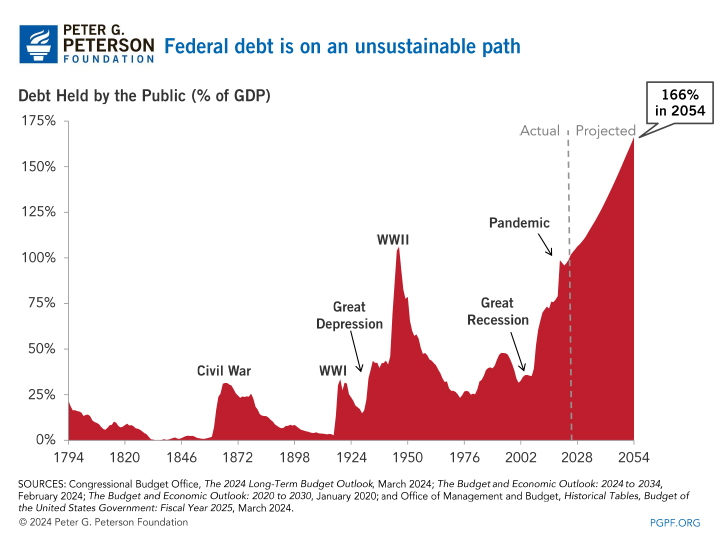
The classic definition of inflation is “too much money chasing too few goods.” We have to borrow when revenues don’t cover our government’s expenditures. If we dump ever-growing amounts of debt on the market and the Federal Reserve fails to intervene, ever-rising interest rates will be required to find buyers. Already, we pay more on our debt than on defense. In the future, the payments will crush the entire budget. This crisis is not a distant possibility but a potential economic catastrophe that we must address:

Of course, the Federal Reserve can buy the debt with money created out of thin air. This course of action is how we get runaway inflation: one way or another, overspending results in the unkindest tax inflation.

Continue reading