No Predictions, Just Clues

As I alluded to in my last post, I was optimistic a year ago. Wrong on a lot, but I had some idea of how things might go. Right now, I have to admit, I’m clueless. The Ukraine War still rages. We’re bombing boats on the high seas and suspected terrorist sites in Nigeria. Not exactly peace on earth.

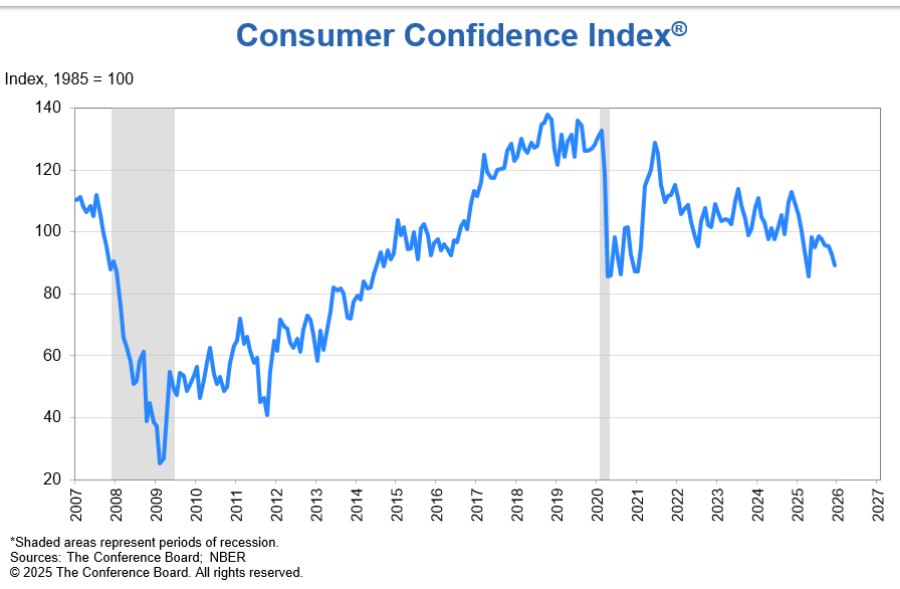
Inflation is still uncomfortably high. The national debt gets scarier by the minute. Employment is dicey, and manufacturing jobs are falling. Consumer sentiment is weak:

Yet the stock market keeps hitting new highs, and the economy is growing. What gives? Darned if I know, given today’s crosscurrents. I’ll share the clues I’m looking for that clarify the situation.

The first, expected early in 2026, is the Supreme Court’s ruling on the executive branch’s tariff powers. So many of Trump’s second-term actions depend on his ability to slap tariffs on anyone at will; any limits will change the face of his administration. Without knowing what restrictions the court will put on the executive, it’s hard to plan.

If the court narrowly decides that the law underlying the tariffs fails to cover them, but no further, the administration can invoke another law and reimpose the tariffs. Those who are negatively affected will sue again, and we’re back to square one, confused. Previously, I complained that the court was taking way too much time to decide a fundamental constitutional question: Does the first article of the Constitution mean what it clearly states, only Congress has the power to levy tariffs?

Continue reading

What Works?

Progressives have the word ‘affordability’ and are going to run with it. Two prominent areas where costs are particularly burdensome for the public are housing and healthcare. Ranting about high prices only gets you so far. At some point, you have to come up with solutions.

Who better to look to for progressive answers than Ezra Klein, the New York Times columnist, turned the left’s Abundance guru due to his co-authored book “Abundance.” For the latest from the left on healthcare, who better than the principal author of the Affordable Care Act, Ezekiel J. Emanuel?

In his book, Klein unearthed the reason for our inability to build anything. We don’t make enough houses because of government restrictions and red tape. Heavens, what else will he find directly under his nose? He provides us with this illuminating chart in a recent article to state the obvious:

Klein offers insights into progressive solutions. The Center for American Progress and the Searchlight Institute would give some rent subsidies, but, like all subsidies, this would only add to demand, not increase supply, unless you could address the red tape and restrictions.

Many of the restrictions are aimed at preventing the construction of multi-family units in established single-family housing communities. Klein admits this could lower values, so there is no incentive for owners to increase density. People rarely vote against their economic interests.

This situation leaves Klein with one solution that I’ve expounded on in this blog: modular housing. Do the major work in factories rather than on-site. He, again, cites the Center for American Progress. “It wants the federal government to seed a major research program to fund innovation in housing construction.” Backdoor subsidies through military and other government purchases would maintain market continuity and the demand needed to bring in manufacturers.

Klein puts it this way, “One problem the modular housing industry has faced is the absence of steady demand to keep the factories running and work out the kinks of construction.” But then he refers to Sweden, where “more than 40 percent of new homes — and more than 80 percent of single-family homes — are fabricated off-site.” How can a small nation maintain a vibrant modular home industry when we have a market 32 times greater, and we can’t?

Continue reading

Biden Lost It. What About Trump?

We have experienced what was probably the biggest presidential cover-up in history, with the measures taken to hide Joe Biden’s cognitive decline. These stealth actions resulted in the disastrous Afghan pullout, the highest inflation in forty years, two wars, and an attempt to forgive billions of student loans simply by executive order. Only James Buchanan’s Administration compares in failure.

Now I’m worried we’re seeing a repeat, possibly on a grander scale. Given some of his actions, we have to consider that Donald Trump is increasingly delusional. Compared to the tired and confused Biden, many people will point to Trump’s hyperactivity as proving that old age isn’t affecting him. This conclusion ignores the fact that manic activity itself is a danger sign.

It’s difficult to believe that the people closest to us are unaware of a person’s decline or their personality traits becoming extreme. Just as the Democrats in and out of the white house had to know Biden wasn’t up to the job and getting worse, Republicans and others in the white house and Congress seem to ignore a troubled Trump.

Even with visual knowledge of Biden’s decline, Democrats discouraged anyone else from running for President. Dean Phillips, the only one who mounted a challenge, was ultimately driven from the party. For reasons of personal ambition, misplaced loyalty, a devious plan, or fear of reprisal, Democrats stood with Biden until a disastrous debate made his failing clear to everybody. Could something similar be taking place on the other side?

Tariffs are the centerpiece of the Trump administration, so that’s a good place to start. While not the easiest subject for an average person, it is undoubtedly within the realm of administration experts. Afghanistan seemed far away and wasn’t much on the public’s mind until the situation escalated. Tariffs aren’t easily understood, but they can now harm businesses, disrupt the nation’s finances, and even lead to a Constitutional crisis.

Continue reading

Ballroom Or Royal Court

While we’re waiting for some possibly momentous news, such as the Israeli Defence Force finally finishing off Hamas in Gaza, a Russia-Ukraine ceasefire, and a court ruling on Trump’s Tariffs, it might be a good time to reflect on some rules for leading to better government. A few posts ago, I featured an observation of the poorest performing nations, which were the ones where the state allocated resources and selected winners and losers rather than allowing the market to do the job.

What is the purpose of government other than providing the framework for its citizens to thrive? This structure must begin with the protection of body and property from arbitrary loss. Whether it’s an invader, thieves, or the government itself, you and your property are safe from capricious forces.

One of our great blessings is inheriting the English common law and the principles of representative government. We codified and expanded on these principles. An American citizen can’t be deprived of freedom or property without due process, as enshrined in our Constitution and its amendments, especially the first ten. Rather than a supreme leader doling out favors either directly or through subordinates, people should interact without government interference as much as possible.

These freedoms resulted in heretofore unheard-of economic growth, first in the British Isles, but followed closely by the young United States. The closer other nations emulated these two, the more their people benefited.

If you lack the basics of food, clothing, and shelter, not much else matters. In countries that provide a framework where people are free to choose not only the basics but also much more. (“More” in the sense of my series”The Long Journey to More”) The nations where rulers direct the economy struggle with even the essentials.

Marxists and other progressives claim that the expertise of an elite class can lead us to the promised land. The “best and the brightest,” rather than people interacting, know better. Those comprising the ruling elite live well, but the rest do not. In Cuba, Venezuela, or Argentina, where the state directs the economy, living standards fell.

Continue reading

Topping Out?

Could we be at the apex of the second Trump administration? The president is claiming victory on every front. Major trade deals with the E.U. and Japan, among others, were announced, with markets reaching new highs. Everyone is bending a knee to the master of the deal. Everyone knows because Donald Trump is on TV around the clock, telling us how great everything is going. To hear him tell it, there is almost too much winning.

Just under the surface, one can see some big rocks that the Administration is approaching. Both Japan and the E.U. imports are subject to a fifteen percent tariff. This rate seems stiff and protective of our manufacturing industries, such as the automotive sector, but a closer look reveals a different picture.

Reason’s economic and trade writer, Eric Boehm, points out that our domestic carmakers are dependent on inputs from Canada and Mexico, which are subject to a 25 percent levy. Using lower-cost parts and materials, Toyota could build autos completely in Japan, pay the tariff, and still undercut our auto manufacturers. The companies and the auto workers are already complaining about the disadvantage.

71% of Toyota cars sold in the U.S. are made here. This production supports hundreds of thousands of jobs in the U.S. With the price advantages afforded by the agreement to produce in Japan, these jobs are at risk.

If the 15% rate is suitable for Japan to produce at home, the E.U., subject to the same rate, will find itself in a similar position. European auto makers also employ a large number of people in the U.S. The Street put it this way, “The Big 3 now has a similar problem with EU competitors, as their 15% duties pale in comparison to the 25% duties U.S. manufacturers have to pay to get their cars from their Canadian and Mexican plants.” 

Continue reading