Trump vs. Trump?

Recent events have added credibility to some of my posts. Not long ago, I cautioned that the Federal Reserve’s (Fed) series of interest rate cuts might be at odds with the actual inflation outlook. The Biden spending spree adds to our high national debt, while the Social Security (S.S.) Trust Fund runs dry at best in ten years, with both parties adding to the program woes. Medicare may be in even worse shape.

Biden’s proposals will increase S.S. payouts to government retirees, and with Trump’s plan not to tax any S.S. income, retiree checks could face cuts even sooner. Maintaining the current level of payments will mean even more government borrowing. Already expected to lend trillions more, bond buyers must absorb more extensive offerings in the future. In the face of increasing interest rate risk, they’ll want more upfront.

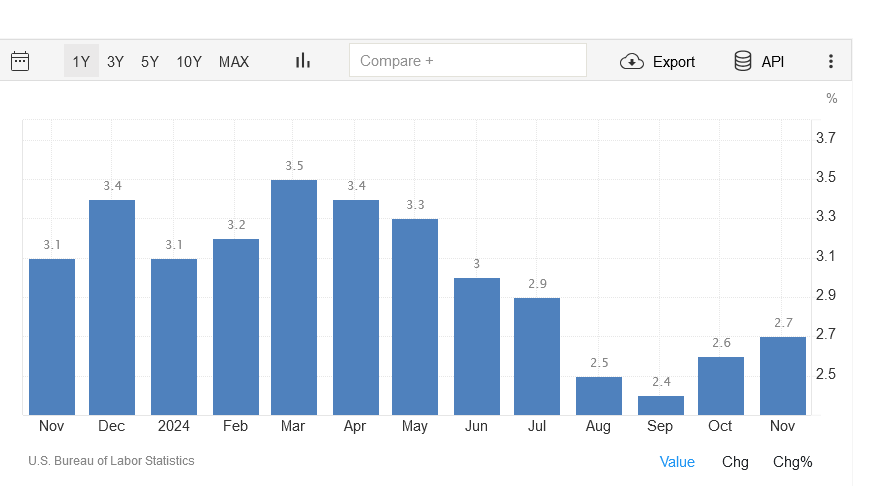
The first chart is the inflation rate, showing it is still above the 2 % target:

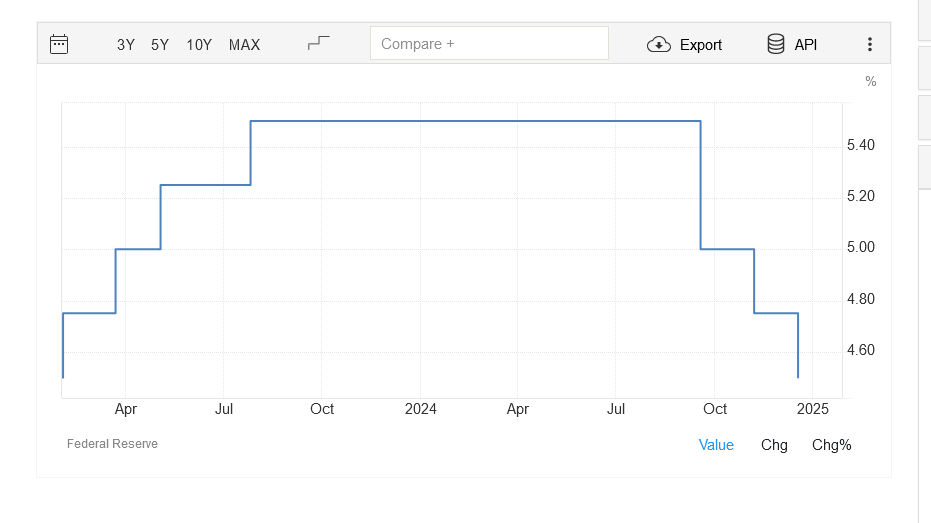
This chart shows the Fed’s interest rate cuts:

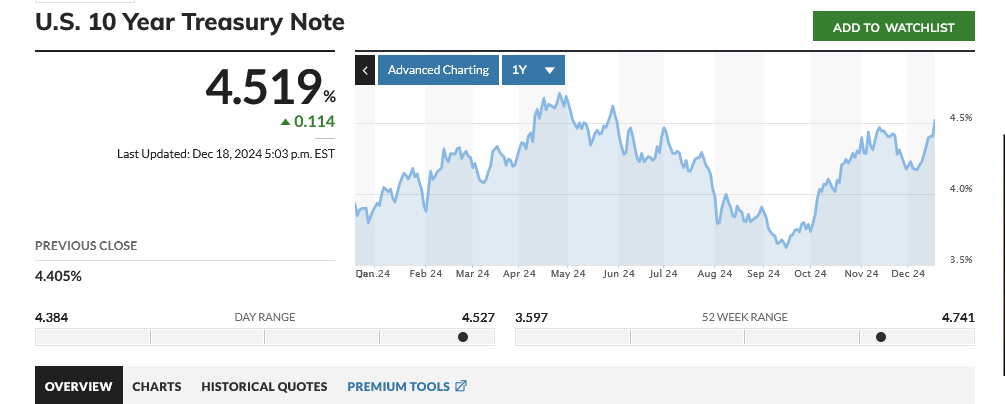
While the U.S. 10yr Bond interest rate returned to near its highs:

Mortgage rates stay high:

This week, the Fed cut short-term rates another quarter point but said it would probably cut two times next year instead of the signaled four. The Dow dropped over 1,100 points. Confusion is the only explanation.

Continue reading

Are Things Getting Even Stranger?

I’ve reached a point where I realize the administration and its media heralds’ approach to the Gaza War has reached the same state of incoherence as their actions in Afghanistan and Ukraine. After a promising start, the former ended in catastrophe, and the latter is headed in the same direction. 

They demand Israel institute a civilian Gazan government before the war is over. Imagine attempting this approach in Nazi Germany while a good part of the Wehrmacht is still intact. The idea of Mahmoud Abbas stepping in to rule the strip is laughable. The Gazans chased his Fatah-ruled Palestinian Authority out shortly after the Israelis left Gaza in 2005.

Producing a reformed, newly constituted Palestinian Authority, even if possible, would take considerable time. Who would rule until then? A coalition of Arab states? How long would that take?

Even if you put some government in place, how would it enforce its rules? Hamas still has an estimated ten to twenty thousand heavily armed fighters. Where are the police or troops going to come from to stop Hamas from continuing to attack Israel or take over the new government?

The U.S. Army recommends 20-25 counterinsurgents to every 1,000 residents. The Gaza population of around 2 million requires 40,000 troops to suppress an armed insurrection. Exactly where are these troops coming from to duke it out with Hamas? Israel isn’t about to accept a Palestinian force of that size. The vast majority of Palestinians support Hamas’s October 7 attack. Such a force might join forces with Hamas and attack Israel. 

Has anyone heard from any Arab nations volunteering substantial military? Even if they did, would they take on a heavily armed opponent?

Continue reading

Following Up

In my last post, I condemned the president of my alma Mater, Northwestern, as a dishonorable Jew for giving perks to the pro-Hamas demonstrators while doing nothing to make Jewish students and others feel safe on campus. Shortly after, I received an email from President Michael H. Schill, linking to His OP-ED in the Chicago Tribune, explaining his actions. Eagerly, I clicked to see if his assurance that Jewish students were still welcome and safe at N.U. is clearly stated. I’d rather be wrong about him if the campus were welcoming and safe for all. 

It’s sad to say that Schill is even worse than I thought. Even though Jews are the ones most threatened, he only mentions them obliquely, “First and foremost, we needed to protect the health and safety of our entire community, including our Jewish students.” The protestors are pro-Hamas. The group that just murdered and savaged the most significant number of Jews since the Holocaust and still holds hostages. Even with the “settlement, “keffiyeh-wearing demonstrators remain on Deering Meadow for another month. Wearing the headscarves shows solidarity with those desiring to dispose of all the Jews between the Jordan and the Mediterranean Sea.

In the 1930s, Germans wore brown shirts to show their hatred of Jews. Now, the protestors wear keffiyehs to convey the same sentiment. How does this deliver any feeling of welcome or safety to Jews on campus?

Understandably, Schill’s “settlement” and actions have drawn Jewish wrath. Rather than fighting the clear and present antisemitism, he equates it with virtually non-existent anti-muslin acts. “Second, we believe in free expression, but that most assuredly does not include antisemitic or anti-Muslim harassment or intimidation.” 

While Schill rolled over and placated the demonstrators, Ben Sasse, the University of Florida President, faithfully adhered to his school’s rules. Those rules allowed free speech, but if you broke them, you faced immediate suspension. As a result, students, including Jews, went about the business of learning without disturbance. 

Continue reading

Juden Betreten Verboten

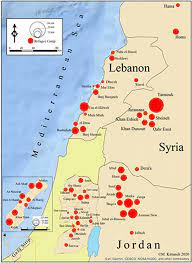
With all the turmoil on campus across the nation, I thought a reminder of the tough Arab neighborhood Israel exists in with a map of the Arab League:

How many of the protestors can even find Israel on the Map? Anyway, on to my post.

It’s as if a sign declaring Juden Betreten Verboten, Jews, entry forbidden, is hanging on Deering Library on the Northwestern University (N.U.) campus. My alma mater has informed the world Jews are no longer welcome. I never thought I’d ever see this day. To placate Hamas supporters that occupied Deering Meadow, the ample open space in front of the library with tents and ant-israel paraphernalia, the university showered the protestors with goodies if they would leave—scholarships and professorships, along with special accommodations. 

Why would a University reward those siding with Hamas, a terrorist organization dedicated to destroying millions of Jews? The truth is the school has a long history of anti-semitism. Only a few years before I enrolled in 1955, Jews were subject to a hard quota. During the time I attended N.U., it started to ease its policies not only toward Jews but Blacks and others. For instance, removing the required photos on entrance applications increased black admissions in the ’60s. Still, quotas lasted until 1964. Integrating fraternities, sororities, and housing brought people of different backgrounds together, which was a subject we worked on. I was proud of the direction and progress.

Continue reading

Three Story Lines Revisited

It was a busy week with significant developments. Three of them fall in areas I’ve commented on in the past. It’s crucial to compare where we are with what I wrote on the third parties, the Gaza war, and abortion, as these past commentaries hold significant relevance to our current situation.

In my series, ‘The Future Party” (On this Site), I stressed the pressing need for a more competitive political landscape. We must enhance our choices at all levels. Recent presidential elections have presented us with candidates most Americans didn’t want to vote for. The current election, featuring two widely unpopular candidates, is a stark reminder of this issue. The ‘No Labels Party,’ which pledged to offer more options, should’ve thrived in this climate. While it has made progress in securing spots on state ballots, they’re facing a lot of work getting candidates. 

In my series, ‘The Future Party,” I concluded that you can’t defeat someone without one and must stand for something. I based my brief involvement with the emerging Howard Shultz third-party campaign on crafting a platform for the Starbucks founder to champion. However, no such platform materialized, and Shultz withdrew when it appeared he could potentially harm the Democrats, thereby inadvertently supporting the re-election of the Republican incumbent. This excuse is a stark reminder that new voices must have substance and conviction to make a lasting impact.

Continue reading