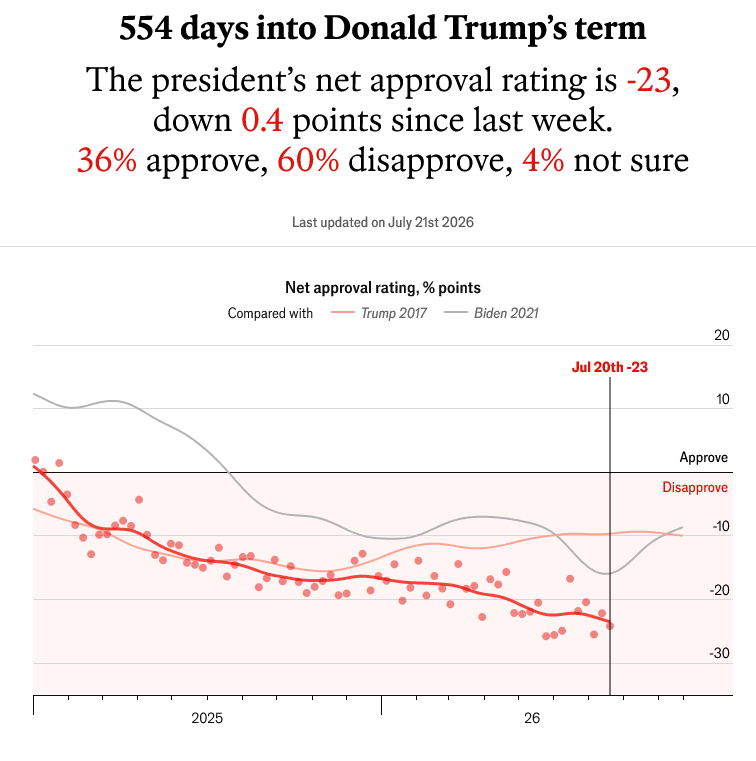
A year ago, I posted “Topping Out?,” where, even though Trump seemed triumphant to many, I opined that he was at the apogee of his second term and that the path forward was downhill. He might never again be as popular, or appear as powerful. A year later, the problems and policies I pointed out contributed significantly to his present low standing:
Strutting up to any cameras available, Trump told us at the time that his tariffs had made us richer, and nations all over the world would invest trillions in our country. He blasted then Fed Chairman Powell for not lowering interest rates. Trump claimed inflation would go away under his policies; Powell was blocking the Trump boom. He had to go. While rates didn’t go down, the Fed may have been discouraged from raising them. The “Great Big Beautiful Bill had recently passed. Trump was making his mark on the world like nothing ever seen before.
It’s hard to remember how strong and dominant the President appeared just a year ago. Yet the seeds of downturn were present at the time. Most of his cornerstone tariff policy had already been declared unconstitutional by the Court of International Trade (CIT). Though few did, any reading of the court’s decision could only alert one to the trouble the policy was in.
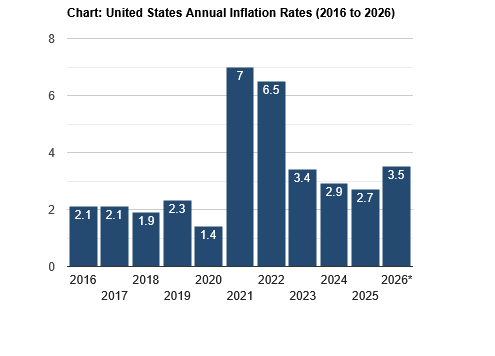
Rather than receding, prices were still stubbornly high last August. At just under 3%, the rate of inflation was well above the Fed’s 2% goal. Trump’s tariffs were adding to price pressures. The President’s demand for lower interest rates seemed at cross purposes with low prices.
A year later, any supply-side gains from “the Big beautiful Bill,” were offset by tariffs and spending, leaving inflation high throughout the year:
The Appeals and Supreme Court upheld the CIT decision, forcing refunds under the original law relied on. The administration imposed more widespread tariffs under another, but short-term, law, which just expired. Now we have a third legal rationale underlying broader tariffs. The later tariffs are in court; the CIT already declared the recently expired ones unconstitutional, but they are under appeal.
This state of affairs sets up the absurd situation where possibly a trillion dollars will go back and forth between illegal collection and refunds with interest before all is said and done. To what end? Our importers who write their tariff checks are being whipsawed. With the interest owed on illegally collected tariffs, the Treasury could lose money, while consumers still paid higher prices. Nobody is amused.
The administrations confused everybody. Who can plan longer term? To make matters worse, Trump let importers know he’d “remember” if they applied for refunds of the illegally collected tariffs. Sounds more like the mafia than America.
Worse, virtually no one abroad likes or trusts us. They may like our ranch dressing and air conditioning, but the Trump administration has picked fights with its friends. If the earlier tariffs didn’t do enough damage, the latest batch accuses 60 nations of abetting slave labor. Our closest ally, Canada, is being hit with even higher tariffs under a provision of the disastrous Smoot-Hawley Act of 1930.
As I predicted a year ago, Trump’s policies of price-raising tariffs and low interest rates failed to lower prices as he promised, giving rise to today’s “affordability crisis.” Of course, the Democrats and their media allies beat the Republicans with it every day.
In a mid-July 2025 post, I struck a more hopeful note on Ukraine. I’ve held from the beginning that Ukraine had little chance of winning if they couldn’t shoot back. What I meant was Russia couldn’t have safe war-making capabilities out of reach of Ukraine’s weapons. Ukraine needed long-range weapons. Biden never provided them. Even when he gave somewhat longer-range weapons, they came with restrictions.
Trump seemed to relent and provide some longer-range systems if the Europeans paid for them, but still with the restriction that they not go anywhere near Moscow. I wondered if Trump was trying to prevent the passage of the widely backed Graham-Blumenthal sanctions bill, which might cause Russia real pain.
Unfortunately, later in the month, Trump held his disastrous Alaska meeting with Putin, showing he still had disdain for Ukraine. Rather than taking the opportunity to bolster his standing by pushing a settlement favorable to the good guys, he instead continued his bromance with Putin.
No thanks to Trump, Ukraine has developed its own longer-range weapons, especially long-range drones, and the Russian homeland is feeling the pain, including Moscow. Ukraine may have gained the upper hand, but Trump rightly gets no credit.
It’s interesting to note the Graham-Blumenthal sanctions bill finally came up for a vote, but only because of Senator Graham’s untimely death. Passage is seen as a tribute to the late Senator. Senator. Trump only signed on now because of his friendship with Graham.
In the Trump administration’s muddled Ukraine policy that we observed a year ago, we saw a lack of strategic thinking. It’s hard to see any benefit for the U.S. in a Putin Victory; his defeat lessens the danger to Europe, allowing us to move assets to the Far East to face our more dangerous adversary, China. Putin’s Russia isn’t about to forsake its China alliance for us.
Unfortunately, this absence of strategic thinking allowed the present Iran mess. I’ve been dismayed by the lack of a proper strategic plan. Maybe I shouldn’t have, given Ukraine. Killing some top leaders and dropping a lot of ordnance without anticipating the enemy’s reaction is malpractice.
What did our military leaders learn in our fine service War Colleges? First, you have to attend. Does it surprise you that none of the three people running the Iran War, Sec. of War Pete Hegseth, Joint Chiefs Chairman Gen. Dan Caine, and Admiral Brad Cooper, have ever attended any War College? This fact tells you all you need to know about how Trump values strategic thinking.
All the signs were there a year ago. Rather than recognizing and repairing weaknesses, Trump ignored them, explaining the administration’s steep decline and its present dire straits.
 Detour on the Road