Rethinking World Energy

Trump’s energy policies are far more practical and less costly than Biden’s. Relying on natural gas as a competitive, lower-emitting fuel source while we seek even lower or non-emitting sources at a competitive price is a good fit for the U.S. Unlike the Biden Troika, the supply line is all domestic.

Where the Trump policy may fall short is on the global stage. If natural gas is our transition fuel, it makes even more sense to promote it worldwide. In my last post, I drew attention to the coal boom in Asia. As we know, emissions will never fall worldwide until we rein in coal use. We’re doing it here with Natural Gas. With sensible policies, the same is possible globally.

Delivering lots of stable energy is crucial for providing better lives enjoyed by more advanced nations. Look around your abode and count everything you plug in without a thought that makes your life better. For three-quarters of a billion people, this is just a dream.

While Asia has made great strides in providing electricity, albeit using a lot of coal, Sub-Sahara Africa has the most people without power and the fastest-growing population:
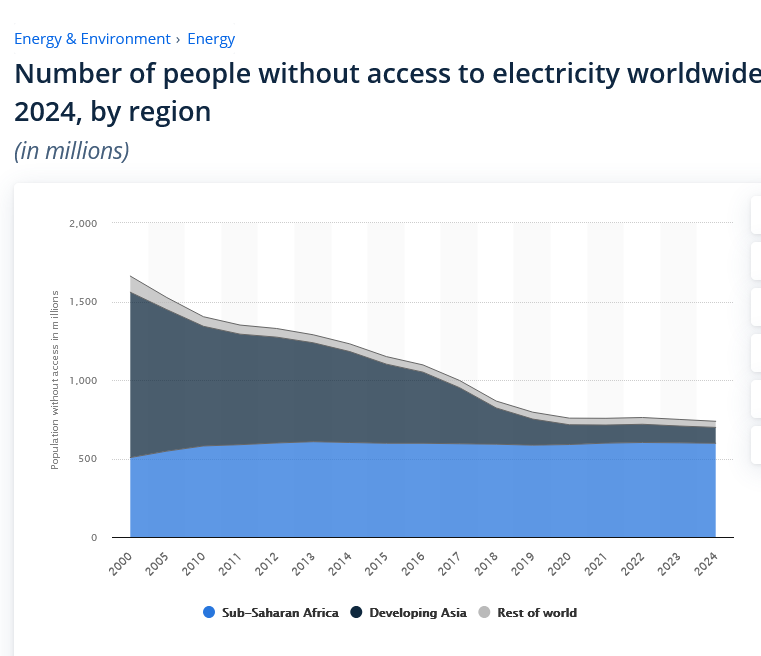
The area isn’t bereft of natural gas—just the opposite. There is plenty of gas to exploit, but the problem is attracting the capital and expertise to exploit the deposits—financial institutions in the developed world, like Biden, favor windmills and solar panels.

This mindset has resulted in bizarre projects like Rift Valley windmills. The magnificent area in East Africa is a major migratory route for birds and animals, and we all know windmills and birds don’t mix. They detract from an area’s beauty. Would we stand for windmills at the Grand Canyon? Yet this project gets financing.

Continue reading
Changing Times

In line with my efforts to see all sides of an issue, I keep up with ideas on both the left and the right. CNN and Washington Post (WP) columnist Fareed Zakaria usually provides good insight into establishment thinking, especially on foreign affairs. His latest  WP column is an eye-opener. He calls into question the left’s efforts to benefit the working class.

Most noncollege graduates in Red states voted for Trump and Republicans, even though the Biden administration made significant efforts to provide job-producing projects there. Instead of appreciating their benefactors, the ingrates voted for the opposition.

Zakaria feels the left’s prevailing theory is to move away from a market-oriented economy to one with sweeping government interventions. “It passed massive infrastructure and climate spending bills, explicitly designed to help noncollege educated Americans.” Zakaria points to two congressional districts, one in Texas and the other in Mississippi, that received the most significant government-backed projects but still voted increasingly Republican.

Attributing the continuing working-class Republican migration to race, identity, and culture issues among noncollege-educated whites, he thinks the Democrats should concentrate on their “solid base of college-educated professionals, women and minorities,” and strive to add moderate swing voters. He observes, “Biden keeps touting his pro-union credentials but is increasingly speaking of a bygone era. In 2023, only 6 percent of private sector workers belonged to a union.” The votes to win are elsewhere.

Shortly after reading the Zakaria article, I read Peter Suderman, Reason Magazine’s features editor, “Biden’s Legacy: He Didn’t Build That,” “…over and over again, that’s what happened under Biden: Vast sums were spent or authorized, but nothing came of it.” Maybe that’s why the people in Texas and Mississippi aren’t thrilled if there is no lithium refinery or battery factory. Because of red tape, opposition, and slow-moving bureaucracies, building things in the U.S. takes forever or never gets done.  

Continue reading

Where Has Competence Gone

Years of heavier-than-usual rains, followed by dry and hot weather, left vast fuel for fires. Winter brings the dangerous and unpredictable Santa Ana winds. Thank goodness California Governor Gavin Newsome had the foresight to call an emergency legislative session to fund preparations to handle the threatening situation.

Realizing what could be coming to vulnerable areas, successful governors get out in front and ensure everything is ready and working. Even though Florida suffered from severe hurricanes, Governor Ron DeSantis and his crew minimized problems and returned things to normal quickly.

Florida set the standard of preparedness for California to follow, and with overwhelming Democratic majorities, getting the needed funds and authorizations to be ready to meet the dangers presented no problem for Governor Newsome.

Oh, wait a minute. , the emergency legislative session wasn’t to prepare for a severe fire season; it was to appropriate funds to thwart Trump from expelling illegal aliens from California. The danger Newsome foresaw wasn’t from out-of-control wildfires; it was the federal Government initially deporting the illegal alien criminal element.

The result of this lack of preparation is likely to be the worst wildfire disaster in history. Fire hydrants without water are incompressible, as is a key reservoir without any water. Does this sound like preparation?

This absence of competence isn’t due to Californians not being taxed enough to measure up. They pay a lot more than Floridians. So why does Florida do so much better in crisis? The Sunshine State may spend more wisely.

It isn’t global warming. Both states are equally affected—after all, it’s one planet. No state has invested more and taken more action in combating Global warming than California. Of course, all of it has had zero effect. The truth is that nothing California or even the United States can do will change the direction of global temperatures. It could be a simple difference in competence.

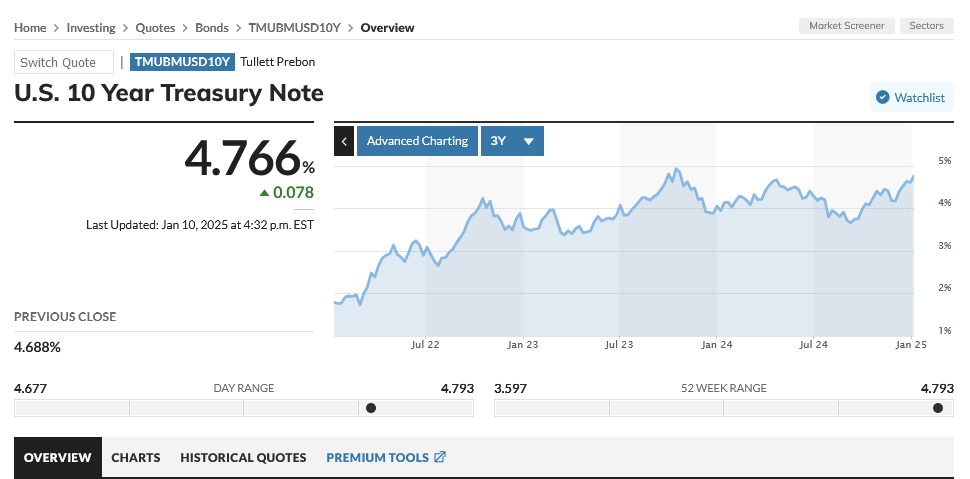
Yes, I’ve shown this chart before, but it bears watching:

While the Federal Reserve has been lowering rates, longer rates are approaching levels reached when inflation was 9%. What is it the market sees the Fed is ignoring? Could higher inflation be in our future? Could the brilliant minds at that institution be missing the signals again? Remember, a few years ago, they told us not to worry; the price rise was transitory.

Continue reading

’24’s Leftover Mysteries

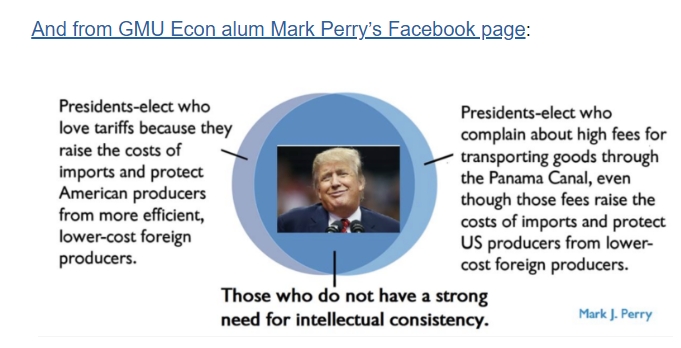
As we enter 2025, some ’24 mysteries remain unresolved. Donald Trump ran his successful campaign with a variety of seemingly contradictory positions. I was reminded of these when the Cafe Hayek blog pointed to economist Mark Perry’s illustration:

This contradiction made me think of other Trump contradictions. Peace and safety while withdrawing our troops from the Middle East. Without our support, the Kurds overseeing tens of thousands of ISSIS followers may face an attack by Turkish forces, rendering them unable to prevent a resurgence of the deadly group. Remember, Turkish leader Erdogan has territorial ambitions of his own. This possibility doesn’t sound peaceful to me.

We all know that politicians make all sorts of claims that step on each other, but now it’s time to introduce legislation, and conflicts remain unresolved. The idea is to write one or two big reconciliation bills containing the whole Trump program.

Inflation is a paramount issue that accounts for Trump’s victory, yet many of the president-elect’s promises are likely to raise prices. Besides tariffs that, like sales taxes, increase what you’re paying, lower taxes for favored groups, such as those working for tips or retirees, will likely result in higher interest rates or printing money. As I’ve pointed out, either will raise prices.

Unquestionably, the Biden Administration’s wild spending on the Green New Deal, infrastructure, and chips led to the highest inflation in forty years, but will Trump attempt to repeal all of this legislation? Taken together, these acts are an enormous industrial policy. Repeal all since state-directed economies have no record of success.

The question is whether Trump will tackle the problems wholeheartedly or simply piecemeal. The latter will be conflict on conflict. For instance, will Trump’s buddy, Elon Musk, stand still for eliminating his electric vehicle incentives and green tax credit sales? Will members of Congress allow the scrapping of big projects scheduled for their districts? Many businesses have sunk big money based on the Biden-era legislation. Can they continue without the promised subsidies and credits, or must they swallow significant losses on sunk costs? Even major oil companies put big bucks into green projects.

Continue reading