Inflation Hurts And The Pain Will Continue

Democratic Politicians and allied media, echoing some economists like Paul Krugman, paint a rosy picture of our economy. They question why we’re less content while supposedly outperforming other nations. Catherine Rampall, the Washinton Post economics columnist, tells us, “Nearly everything Americans believe about the economy is wrong, according to a recent Harris-Guardian poll. And that’s pretty much everyone’s fault.” This narrative implies that our dissatisfaction is unfounded. But is this the whole truth? Are there no deeper economic issues that we need to address?

After a lifetime of talking to people about their finances, I have gained a profound understanding of how people assess their financial well-being. In most cases, having a growing amount left over at the end of each month tells them whether they’re just subsisting or can think of the things that make life worth living—a vacation, maybe with your family, or a better house. Whatever your dream, it always requires money. Unless you have discretionary income, you can’t fulfill it, whatever it is.

When every basic bill, from rent to utilities and insurance, elicits a gasp, even a raise can’t alleviate the feeling of being trapped. The necessities of life, like food, transportation, and clothing, become burdens, and dreams start to fade. This situation is actual for many hardworking Americans struggling to make ends meet.

While economists discuss prices and wages, the reality is far more complex. Your pay may rise, but your grandpa’s and grandma’s income may be more fixed. Where they could pay their way in the past, now they need help to meet their rising bills. You thought you had the kid’s education covered, only to find a widening gap. These stark realities are not just isolated incidents but the daily norm for more people. No wonder those telling us how well we’re doing only get blank stares.

Inflation is the source of most of our angst, but if you feel future inflation isn’t dangerous, steps to rein it aren’t topping your to-do list. Everybody seems to be waiting for the Federal Reserve to lower interest rates, which presupposes inflation is under control. How likely is this situation to be accurate in the future?

The classic definition of inflation is “too much money chasing too few goods.” We have to borrow when revenues don’t cover our government’s expenditures. If we dump ever-growing amounts of debt on the market and the Federal Reserve fails to intervene, ever-rising interest rates will be required to find buyers. Already, we pay more on our debt than on defense. In the future, the payments will crush the entire budget. This crisis is not a distant possibility but a potential economic catastrophe that we must address:
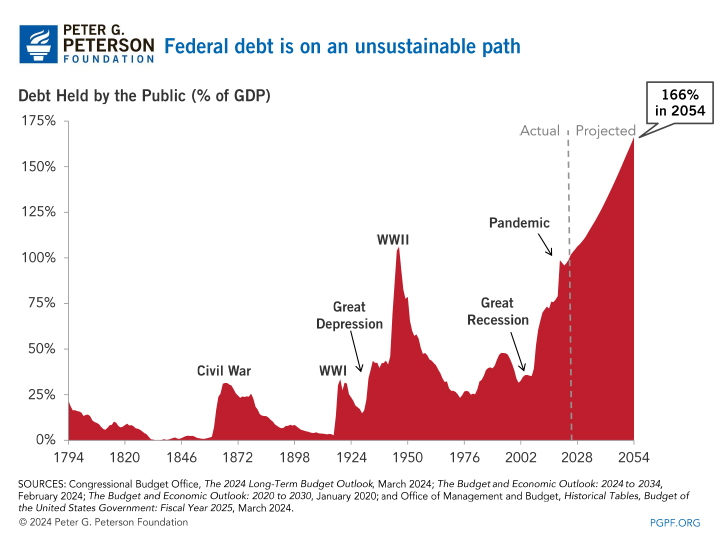
Of course, the Federal Reserve can buy the debt with money created out of thin air. This course of action is how we get runaway inflation: one way or another, overspending results in the unkindest tax inflation.

Continue reading
Are Things Getting Even Stranger?

I’ve reached a point where I realize the administration and its media heralds’ approach to the Gaza War has reached the same state of incoherence as their actions in Afghanistan and Ukraine. After a promising start, the former ended in catastrophe, and the latter is headed in the same direction. 

They demand Israel institute a civilian Gazan government before the war is over. Imagine attempting this approach in Nazi Germany while a good part of the Wehrmacht is still intact. The idea of Mahmoud Abbas stepping in to rule the strip is laughable. The Gazans chased his Fatah-ruled Palestinian Authority out shortly after the Israelis left Gaza in 2005.

Producing a reformed, newly constituted Palestinian Authority, even if possible, would take considerable time. Who would rule until then? A coalition of Arab states? How long would that take?

Even if you put some government in place, how would it enforce its rules? Hamas still has an estimated ten to twenty thousand heavily armed fighters. Where are the police or troops going to come from to stop Hamas from continuing to attack Israel or take over the new government?

The U.S. Army recommends 20-25 counterinsurgents to every 1,000 residents. The Gaza population of around 2 million requires 40,000 troops to suppress an armed insurrection. Exactly where are these troops coming from to duke it out with Hamas? Israel isn’t about to accept a Palestinian force of that size. The vast majority of Palestinians support Hamas’s October 7 attack. Such a force might join forces with Hamas and attack Israel. 

Has anyone heard from any Arab nations volunteering substantial military? Even if they did, would they take on a heavily armed opponent?

Continue reading

Following Up

In my last post, I condemned the president of my alma Mater, Northwestern, as a dishonorable Jew for giving perks to the pro-Hamas demonstrators while doing nothing to make Jewish students and others feel safe on campus. Shortly after, I received an email from President Michael H. Schill, linking to His OP-ED in the Chicago Tribune, explaining his actions. Eagerly, I clicked to see if his assurance that Jewish students were still welcome and safe at N.U. is clearly stated. I’d rather be wrong about him if the campus were welcoming and safe for all. 

It’s sad to say that Schill is even worse than I thought. Even though Jews are the ones most threatened, he only mentions them obliquely, “First and foremost, we needed to protect the health and safety of our entire community, including our Jewish students.” The protestors are pro-Hamas. The group that just murdered and savaged the most significant number of Jews since the Holocaust and still holds hostages. Even with the “settlement, “keffiyeh-wearing demonstrators remain on Deering Meadow for another month. Wearing the headscarves shows solidarity with those desiring to dispose of all the Jews between the Jordan and the Mediterranean Sea.

In the 1930s, Germans wore brown shirts to show their hatred of Jews. Now, the protestors wear keffiyehs to convey the same sentiment. How does this deliver any feeling of welcome or safety to Jews on campus?

Understandably, Schill’s “settlement” and actions have drawn Jewish wrath. Rather than fighting the clear and present antisemitism, he equates it with virtually non-existent anti-muslin acts. “Second, we believe in free expression, but that most assuredly does not include antisemitic or anti-Muslim harassment or intimidation.” 

While Schill rolled over and placated the demonstrators, Ben Sasse, the University of Florida President, faithfully adhered to his school’s rules. Those rules allowed free speech, but if you broke them, you faced immediate suspension. As a result, students, including Jews, went about the business of learning without disturbance. 

Continue reading

Juden Betreten Verboten

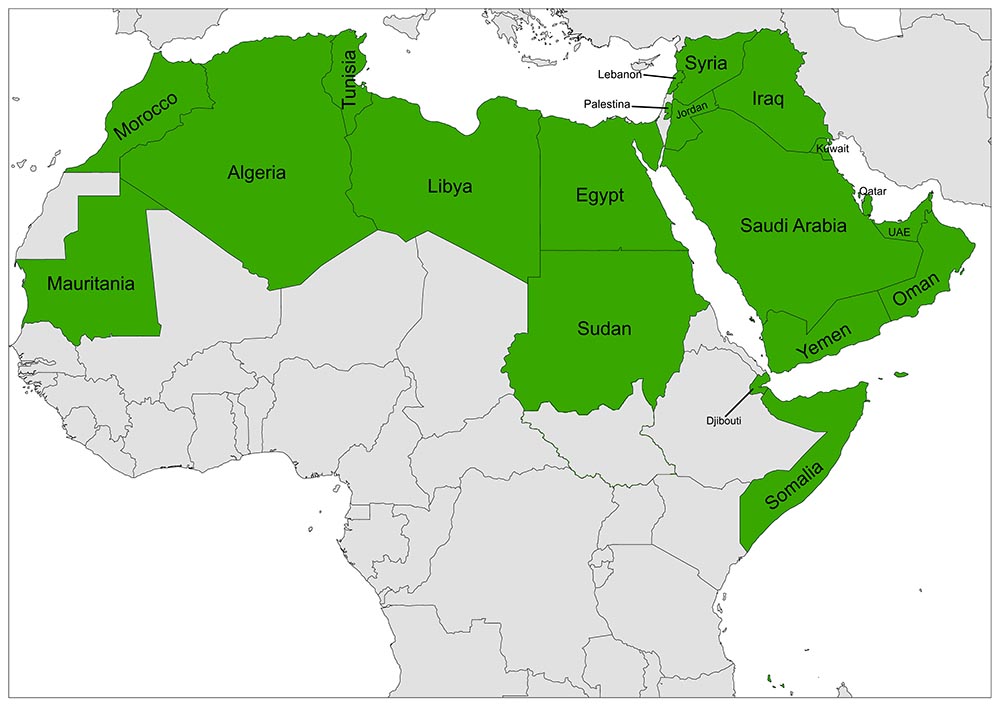
With all the turmoil on campus across the nation, I thought a reminder of the tough Arab neighborhood Israel exists in with a map of the Arab League:

How many of the protestors can even find Israel on the Map? Anyway, on to my post.

It’s as if a sign declaring Juden Betreten Verboten, Jews, entry forbidden, is hanging on Deering Library on the Northwestern University (N.U.) campus. My alma mater has informed the world Jews are no longer welcome. I never thought I’d ever see this day. To placate Hamas supporters that occupied Deering Meadow, the ample open space in front of the library with tents and ant-israel paraphernalia, the university showered the protestors with goodies if they would leave—scholarships and professorships, along with special accommodations. 

Why would a University reward those siding with Hamas, a terrorist organization dedicated to destroying millions of Jews? The truth is the school has a long history of anti-semitism. Only a few years before I enrolled in 1955, Jews were subject to a hard quota. During the time I attended N.U., it started to ease its policies not only toward Jews but Blacks and others. For instance, removing the required photos on entrance applications increased black admissions in the ’60s. Still, quotas lasted until 1964. Integrating fraternities, sororities, and housing brought people of different backgrounds together, which was a subject we worked on. I was proud of the direction and progress.

Continue reading