You see an accident about to happen, but no matter how loud you yell, no one hears. Or maybe no one was listening. Even before the US and Israel started their attack on Iran, some foresaw the need for friends on the ground in that nation. Some suggested the Kurds as a good bet for establishing a safe area in Iran to organize, train, and equip the resistance. If others had a better idea for the armed overthrow of the ruling Regime, that’s fine, but without this basic strategy, just bombing would fail.
Once the attack unfolded, we had nothing-zilch on the ground. Worse, we were unprepared to counter the likely Iranian response—no adequate defense against the Regime’s large stock of rockets, and especially drones. When Iran closed the Strait of Hormuz, likely with mines, we had no minesweepers. To top things off, we went through so much of our very expensive ordinance that we may run out.
The next thing we knew, we had a ceasefire that left us short of all our objectives. We needed real regime change to have an Iranian government we could trust not to develop nuclear weapons, and the rockets to deliver them. No more pawns such as Hezbollah, Hamas, and the Houthis terrorize our area friends, especially Israel.
Now we have a Memorandum of Understanding (MOU) that has opened the Strait but also removes our counter-blockade. This situation puts us back to before the attack, but illuminates our failure to achieve any of our objectives. We’ll talk about Iran’s nuclear program over the next two months. Trump has conceded any restraint on ballistic missiles. If Iran behaves, we’ll return the money we seized and set up a $300 billion “reconstruction fund ” paid for by our Gulf friends.
With the opening of the Strait, oil money flows to Iran without sanctions. These funds will feed its terrorist network to threaten Israel and its neighbors, while it strengthens the Regime—the MOU depends on the end of hostilities between Hezbollah and Israel. Not part of the negotiations, Israel is still under pressure to abide by it. Yet it needs a buffer in Lebanon to protect its northern areas from constant attack:
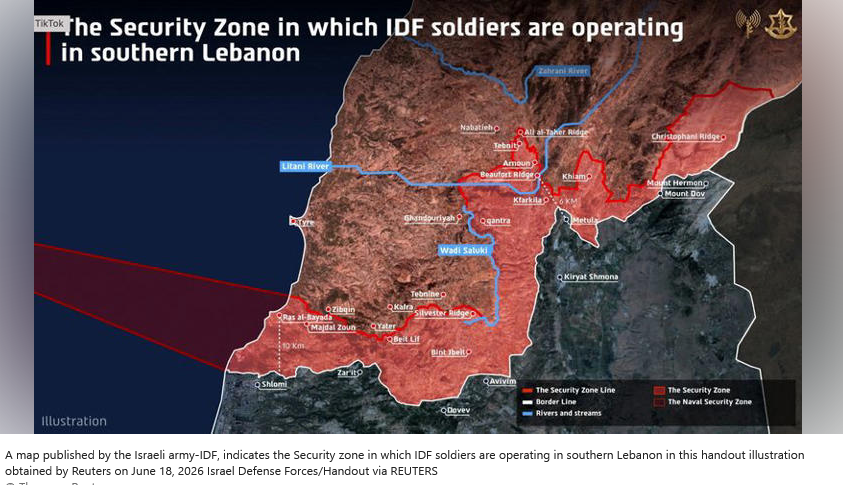
While the US and especially Israel have gained nothing so far, Iran shows its dominance over the Strait, its ability to hit not only its neighbors, but targets as far away as Europe, money will increasingly flow into its coffers to finance its pawns, and drive a visible wedge between the US and Israel, while doing nothing on Iran’s nuclear program. This situation goes a long way toward Iranian regional hegemony. Any reasonable person would conclude Iran is coming out on top.
The administration claims it will gain more, especially regarding the nuclear program, during the MOU’s 60-day negotiating period, but this is unlikely. Ending just before Labor Day, the traditional election campaign kickoff, how likely is the US to start massive bombing if Iran gives us little or nothing? A lessened Military posture on our part is more likely. Fleet units and marines, having been at sea for many months, may have been sent home. Iran will deploy more, not fewer, rockets and drones in key positions. The Iranian people, seeing our fecklessness, aren’t about to revolt. Less leverage, not more lies in the future.
A sad outcome for Epic Fury. It’s easy to lay the blame at President Trump’s feet. After all, the buck stops with the President. However, the rot may be much deeper. Since George W. Bush raised the bet in Iraq and Afghanistan and stabilized the situation, have we militarily done anything right? Obama withdrew our troops from Iraq, and we got the ISIS Caliphate. Does anybody think our actions in Libya made any sense? We’re still feeling the effects of Biden’s abrupt Afghan withdrawal.
Presidents have huge, expensive military and intelligence operations that provide advice, options, and plans. Yet we keep stepping in it. Did these departments give solid info, but these Presidents disregarded their input? Were these situations war-gamed? What did they show?
In the present circumstance, what led up to our decision to attack? People have pointed out failings right from the start, even pointing out things needed before we acted. As taxpayers, we have every right to information about what led to what appears to be a fiasco. Congress must provide us with answers. Oversight is their job, and we need to demand that they provide answers about the waste of our money.
The point isn’t just to lay blame. If we are to survive as a nation, we need to perform better. We spend more on defense than any other nation, maybe even a combination of nations, yet weaker opponents get the upper hand. Did someone point out the major flaws in our approach? If they felt marginalized, why didn’t they resign or retire rather than go along?
Defense Secretary James Mattis, in Trump’s first term, resigned rather than go along with the Afghan and Syrian pullout plans. We were still in both places when Biden took over. Making your position clear can make a difference. Did anyone have grave reservations but failed to say they couldn’t go along, even if it cost them? I haven’t heard of any resignations or sudden retirements. We can only surmise they’re all complicit and need to go.
Beyond the planning, did anyone point out that our vaunted military lacks the means for today’s wars? Right off the bat, we suffered heavy losses to our bases and our friends’ infrastructure damage from rockets and especially drones. Given the prominence of drone warfare in the years of the ongoing Ukraine War, our lack of drone capability is strange. How do we explain the lack of minesweepers? When a cheap drone takes out our $40 million helicopter, it might be a clue we’re doing something wrong.
Russia has been using hypersonic missiles in Ukraine. We know China has them, yet we’re still in the procurement stage. We have expensive ships, but our navy, unlike during the Reagan Era, is unable to keep the Strait open. Congress has control over expenditures and needs to figure out why we’re not getting the performance we’re paying for.
With China threatening Taiwan and North Korea eying South Korea, reversing our lack of capability post haste is a necessity, or we will face even greater problems. We can’t sweep this mess under the rug. The “World’s Greatest Military” has to find a way to stop losing wars.

