Neville Trump

If Trump’s goal in opening peace talks with Putin is to end the current Ukraine war and ensure Russia doesn’t begin a new chapter a few years down the road, he has a strange way of going about it. Instead of presenting Putin with a list of actions the U.S. will take unless Russia agrees to workable guarantees of Ukraine’s borders, Trump’s Secretay of Defence announced NATO membership for Ukraine is off the table. Then, his Vice President infers the right-of-center German Christian Democrats should hook up with the pro-Russian Alternative for Germany (Afd).

If this wasn’t bad enough, Trump chose to denigrate Ukraine’s President as a Dictator responsible for the continuing war. Trump demands President Zelinsky hold an election. According to Trump, he has little support in Ukraine. (The latest poll has Zellinsky’s popularity at 57%),

Trump proposed that Ukraine pledge its natural resources for U.S. development to secure any more U.S. aid, and no U.S. forces will ever be involved in maintaining Ukraine’s borders. What is strange is that many of the resources are in the Russian-occupied part of Ukraine,

Putin must be dancing a jig over his good fortune. He can visualize sharing a Nobel Peace Prize with Trump while waiting to devour the rest of Ukraine for dessert. He doesn’t have to give up a thing.

What caused Trump to denounce the Ukrainian President? He dared complain about his exclusion from the talks that would decide his nation’s fate. One of the few remaining columnists, George Will, whose first memories were of World War II, reminds us of a similar circumstance on the road to that horrible war. The leaders of Great Britain, France, Italy, and Germany gathered in Munich to decide the fate of Czechoslovakia. The one excluded was the leader of that nation.

British Prime Minister Neville Chamberlain claimed the agreement reached there promised “Peace in our Time.” Seven months later, Germany completed the takeover of the doomed nation. History gives Zelinsky every reason to object to Trump and Putin deciding the life or death of his country. Trump even excluded friendly European nations from the talks. The U.S. President’s anti-involvement stance echoes Chamberlain’s observation about “a quarrel in a faraway land between people of which we know nothing.”

Continue reading
Inflation Isn’t Going Away

Inflation continues, and our politicians are busy blaming each other rather than offering common sense solutions. They and the media keep pointing to specific products and sectors in the Consumer Price Index (CPI), causing the price to rise. Akin to the blind men describing an elephant, it’s energy, no rent, no wages, and on and on. We must realize that certain items aren’t going up simultaneously, but an increase in one leads to another; once inflation takes hold, it continues to rachet up until supply increases force prices down or demand is curtailed to the point that lack of sales stops prices from rising.

The last significant inflationary period was in the 1970s and early ’80s. It was brought under control by a combination of the Federal Reserve, raising the cost of borrowing so high it crushed demand, resulting in a severe recession. At the same time, we lowered taxes and regulations. Government pushback, such as Reagan’s firing of the Air comptrollers and continued business movement to right-to-work states, curbed wage demands and improved productivity.

Lowering expenses and making more investment capital available increased businesses’ incentive to expand production. The increase in supply met or exceeded demand, mitigating price pressures. We often forget to look at the profit & Loss effect spurring investment:

The impact on energy prices illustrates how well this worked.

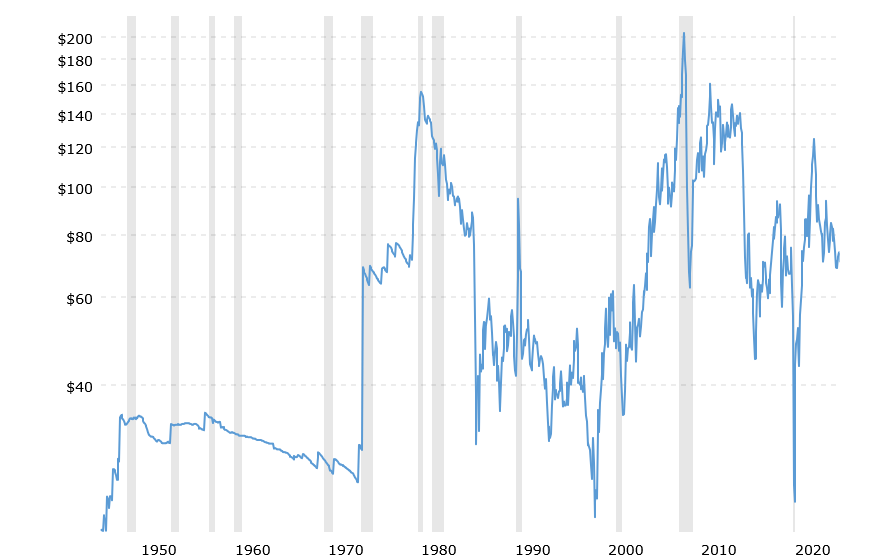
The Great Inflation of the 1970s got its kickstart with the dramatic increase in the crude oil price following the Arab oil embargo. Because oil prices affect so much of the economy, price pressure spreads. Prices followed as transport, chemicals, fertilizer, and heating costs increased.

Rather than suppress the resulting inflation through high interest rates, the Fed created more money to accommodate it.

Continue reading

Allow People To Interact

All the noise about the Elon Musk-led Department of Government Efficiency (DOGE) lopping off unneeded chunks of the Federal Government and the horrified response by the big government-favoring progressive left got me thinking about what the purpose of Government is in the modern world and how we can match it to those goals.

My take on the question will shock and horrify others, but hear me out. The purpose of modern Government is to provide the structure for free and open markets to thrive. These markets are another way of saying people can freely and safely interact.

Markets are the best way to allocate resources to better the human condition. Nothing, including the various forms of socialism, mercantilism, feudalism, or tribalism, has lifted humanity more than free and open markets. If you don’t accept this, I urge you to read “Super Abundance.” As the structures necessary for markets to thrive expanded, humanity’s living standards have dramatically improved, even as its numbers have grown.

The reasons for market superiority aren’t hard to find. Billions of people using the latest information will arrive at better decisions and make them quicker than the relatively few elites in Government. In the information age, this advantage only grows.

Markets are the most democratic form of choice. People vote for their preferences. These are hard choices because their money is involved rather than theoretical. We are all human, so markets make mistakes momentarily but self-correct as new information enters the continuous exchange. We invest funds to receive a proper return. If the profit potential leaves, so do we.

Continue reading

Trump Can Do Better

Donald Trump often sees problems, but as someone who spends little time on in-depth analysis, he comes up with questionable solutions. One example is his suggestion that Jordan and Egypt take in Gazans to ease reconstruction efforts. The two nations immediately shot down the idea, and it isn’t hard to see why. Jordan already has more Palestinian refugees than native citizens. Returning to “Black September” in 1970, their presence has been problematic. They’re not about to add to a problem they never wanted in the first place.

Egyptian President Abdel Fattah el-Sisi gained his position by disposing of the previous Muslim Brotherhood government. Hamas, which governs the Gazans, is an outgrowth of the Muslim Brotherhood’s Palestinian branch. The last thing he wants is to strengthen the Brotherhood’s numbers in his country.  

Trump should’ve known all this and avoided the negative blowback. Still, the president isn’t wrong to wonder, as a builder himself, how you can build a viable Gaza in place of the existing rubble when overrun with 2,000,000 displaced people in just 141 square miles. Gaza was overpopulated and under-employed before the war. Now, the situation is infinitely worse.

Considering Gaza’s makeup, I offered my “Solution for Gaza” posts. Rather than a full-scale invasion, designate areas to be leveled by explosives, inform everyone to leave, then blow them up. Working towards the sea and away from the Israeli border, food and other supplies are landed on the shore by ship. The ships are then required to take women, children, and infirm to safety in accepting countries. If the Arab world and other countries are concerned about these Palestinians, let them show it. International aid now supporting the Gazans would follow them, so there was little if any, increase in cost.

People were horrified, claiming it would level and depopulate Gaza. Looking at things now, with Gaza a pile of rubble and the number of women and children killed, the plan seems a lot better than what has happened.

I never thought the destruction and shipping of refugees would go on for very long before Hamas would give in. Faced with a slow but relentless low-cost action, Hamas couldn’t wait for the last Gazan civilian shipped out of a leveled Gaza. Pressure from other Arab countries faced with accepting Palestinian refugees would leave Hamas little choice.

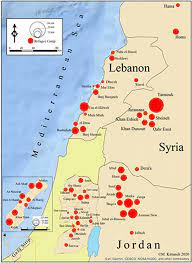
Even though the situation is different now, with Gaza destroyed, few Gazans have left. We have to understand why there were so many Gazans. In 1948, 7000,000 Arabs fled the new nation of Israel, mainly at the urging of the Grand Mufti of Jerusalem. The U.N. established the United Nations Relief and Works Agency for Palestine Refugees in the Near East (UNWRA) 1949 to aid them. The agency set up numerous camps ringing Israel:

Why did the U.N. feel it was necessary to create a new refugee agency when the International Refugee Organization (IRO) had existed since World War II and was doing great work in resettlement? This group evolved into the Office of the United Nations High Commissioner for Refugees (UNHCR), the primary vehicle for caring for and resettling refugees worldwide. It has accomplished the resettlement of tens of thousands of refugees annually.

Continue reading