No Predictions, Just Clues

As I alluded to in my last post, I was optimistic a year ago. Wrong on a lot, but I had some idea of how things might go. Right now, I have to admit, I’m clueless. The Ukraine War still rages. We’re bombing boats on the high seas and suspected terrorist sites in Nigeria. Not exactly peace on earth.

Inflation is still uncomfortably high. The national debt gets scarier by the minute. Employment is dicey, and manufacturing jobs are falling. Consumer sentiment is weak:

Yet the stock market keeps hitting new highs, and the economy is growing. What gives? Darned if I know, given today’s crosscurrents. I’ll share the clues I’m looking for that clarify the situation.

The first, expected early in 2026, is the Supreme Court’s ruling on the executive branch’s tariff powers. So many of Trump’s second-term actions depend on his ability to slap tariffs on anyone at will; any limits will change the face of his administration. Without knowing what restrictions the court will put on the executive, it’s hard to plan.

If the court narrowly decides that the law underlying the tariffs fails to cover them, but no further, the administration can invoke another law and reimpose the tariffs. Those who are negatively affected will sue again, and we’re back to square one, confused. Previously, I complained that the court was taking way too much time to decide a fundamental constitutional question: Does the first article of the Constitution mean what it clearly states, only Congress has the power to levy tariffs?

Continue reading

Hopes Dashed in ’25

A year ago, I was still befuddled by the Democrats having secured the Republican Presidential nomination for the weakest candidate, Donald Trump, by burying him in bogus lawsuits. That made him a sympathetic figure to many and sucking all the media attention away from his competition. Democrats nominated the only person who could manage to lose big. While pondering this turn of events, I had to come to terms with the fact that Trump was back.

As I pointed out at the time, the outlook could be very positive. After all, Trump’s first term employed supply-side economics to cut taxes on capital and work to reduce onerous regulations. These actions have led to solid pre-COVID growth. Increasing supply is the best way to tackle the high inflation engendered by the Biden administration’s heavy spending. A government-directed economy was shoveling vast sums into the fight against “climate change.” Covid relief swallowed more billions.

Daming the river of wild spending to reduce demand growth, while pumping up supply, worked for Reagan in subduing double-digit inflation and promised to work for Trump. Sure, Trump had added some things to his campaign, such as no tax on tips, overtime, and Social Security, which are not supply-side, but on balance, things looked to be improving on the economic front.

After Trump’s peaceful first term, the war in Ukraine and in the Middle East raged under Biden after his disastrous Afghan withdrawal. In the campaign, Trump promised to bring peace quickly to both areas.

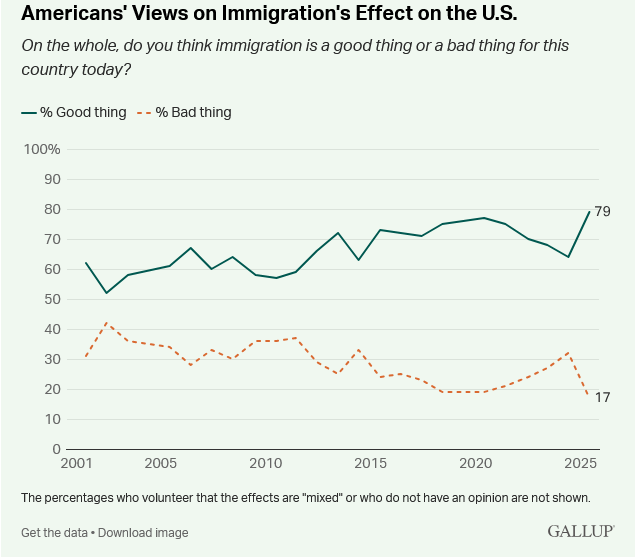
Millions of illegal aliens streamed across our southern border, with the Biden administration just throwing up its hands. Americans know they need immigrants, but not in this way. Trump promised to get control of the border.

The Trump Administration has taken action in all three areas, but it’s unpopular:

The question is why? While other essential problem areas, such as education and healthcare, exist, these three are most directly under the president’s control. The states dominate education, and neither party has a handle on reasonably priced healthcare.

While Trump, in his first term, imposed tariffs on a few products, such as steel and aluminum, and forced a revision of the NAFTA trade treaty with Canada and Mexico, the administration granted many tariff exemptions, and the new treaty had only minor changes. This time around, Trump has wielded tariffs like a club, hitting everyone in the room.

One thing we know about tariffs is that they don’t lower prices—quite the opposite. Claiming crisis conditions and national security, Trump last spring imposed the highest tariffs on imports since the infamous Smoot-Hawley tariffs—coffee from Brazil and chocolates from Switzerland were deemed existential threats.

Continue reading

A Tale Of Two Assessments

On foreign policy and national security, we were recently treated to two assessments that provide guidance on the underlying foundations of the administration’s policy and American attitudes in these areas. The National Security Strategy(NSS) was issued in November 2025 by the Trump administration. At the recent gathering of many of the country’s best minds on foreign policy at the Ronald Reagan Presidential Library, the Reagan National Defense Survey was widely discussed.

Karl Rove, in the Wall Street Journal, points out that many of the government’s positions are in stark opposition to the attitudes of the American Public.  For instance, our policy towards Europe. In Ukraine, the Reagans Survey found, “A strong majority (62%) want Ukraine to prevail in its war with Russia, and 64% support sending U.S. weapons, up  9 points from last year, with bipartisan gains (59% of Republicans, 75% of Democrats).”  “Favorability toward NATO has reached its highest level ever at 68%, with strong bipartisan support for Article V commitments.”

The NSS says, “as a result of Russia’s war in Ukraine, European relations with Russia are now deeply attenuated, and many Europeans regard Russia as an existential threat.” The American public agrees that Russia is a threat. We want Ukraine to prevail.

Reading both, you get a sense that Americans still want to stand by our friends, especially those who share our values. On the other hand, the administration’s NSS takes a harder line with our longtime friends and allies than with Russia and China. One can’t help but wonder if down the road we might find ourselves without any friends.

We’ve seen Japan and South Korea hammered and forced to make U.S. investment commitments while facing higher tariffs. Our friendly neighbor, Canada, has incurred Trump’s ire, even though he updated the NAFTA trade treaty with Mexico and Canada in his first term.

Continue reading

What Works?

Progressives have the word ‘affordability’ and are going to run with it. Two prominent areas where costs are particularly burdensome for the public are housing and healthcare. Ranting about high prices only gets you so far. At some point, you have to come up with solutions.

Who better to look to for progressive answers than Ezra Klein, the New York Times columnist, turned the left’s Abundance guru due to his co-authored book “Abundance.” For the latest from the left on healthcare, who better than the principal author of the Affordable Care Act, Ezekiel J. Emanuel?

In his book, Klein unearthed the reason for our inability to build anything. We don’t make enough houses because of government restrictions and red tape. Heavens, what else will he find directly under his nose? He provides us with this illuminating chart in a recent article to state the obvious:

Klein offers insights into progressive solutions. The Center for American Progress and the Searchlight Institute would give some rent subsidies, but, like all subsidies, this would only add to demand, not increase supply, unless you could address the red tape and restrictions.

Many of the restrictions are aimed at preventing the construction of multi-family units in established single-family housing communities. Klein admits this could lower values, so there is no incentive for owners to increase density. People rarely vote against their economic interests.

This situation leaves Klein with one solution that I’ve expounded on in this blog: modular housing. Do the major work in factories rather than on-site. He, again, cites the Center for American Progress. “It wants the federal government to seed a major research program to fund innovation in housing construction.” Backdoor subsidies through military and other government purchases would maintain market continuity and the demand needed to bring in manufacturers.

Klein puts it this way, “One problem the modular housing industry has faced is the absence of steady demand to keep the factories running and work out the kinks of construction.” But then he refers to Sweden, where “more than 40 percent of new homes — and more than 80 percent of single-family homes — are fabricated off-site.” How can a small nation maintain a vibrant modular home industry when we have a market 32 times greater, and we can’t?

Continue reading

A Discussion Starter

Gathering in Atlanta for Thanksgiving, no one ventured anything along political lines until our son’s 86-year-old mother-in-law asked everyone what they thought of Majorie Taylor Green (MTG), the controversial Georgia Republican representative. Everyone chimed in. She is everyone’s hero for standing up to President Trump, including the family Democrats. She’s even on the left-wing “The Week” magazine, contesting Trump:

This reaction shows far-out positions race across media at the speed of light, while we shun actual policy discussions. Name the first twenty politicians you think of. Sure, you’ll include Joe Biden, Kamala Harris, and the Clintons and Obamas.

Still, beyond them, you’re likely to name the likes of Donald Trump, Bernie Sanders, A.O.C., Zohran Mamdani, Jasmine Crockett, Pete Hegseth, Sean Duffy, and J.D. Vance. What do they all have in common? They’re all media savvy. It may not be too strong to say that the media brought them to their present prominence.

While we are well aware of these people, none of us associates them with any deep, well-reasoned policy positions. To be sure, they have policies, free buses, little or no immigration, high tariffs, and price controls, but none of them provides a well-reasoned defense of their positions, leaving the tasks to others. Think tanks and media outlets are left to make their positions seem coherent.

Contrast that with Reagan’s radio talks, spelling out and selling his policies. Clinton and Carter were policy wonks.

Continue reading