Hans Christian Andrson Told It Right

In my August 1, blog post, I wondered if Donald Trump’s second term was “Topping Out”? The President looked like the King of the Hill. The Stock Market hitting new highs and tariff-induced deals seemed to promise a manufacturing boom that would take us to untold prosperity, or at least that’s what Trump endlessly told us.

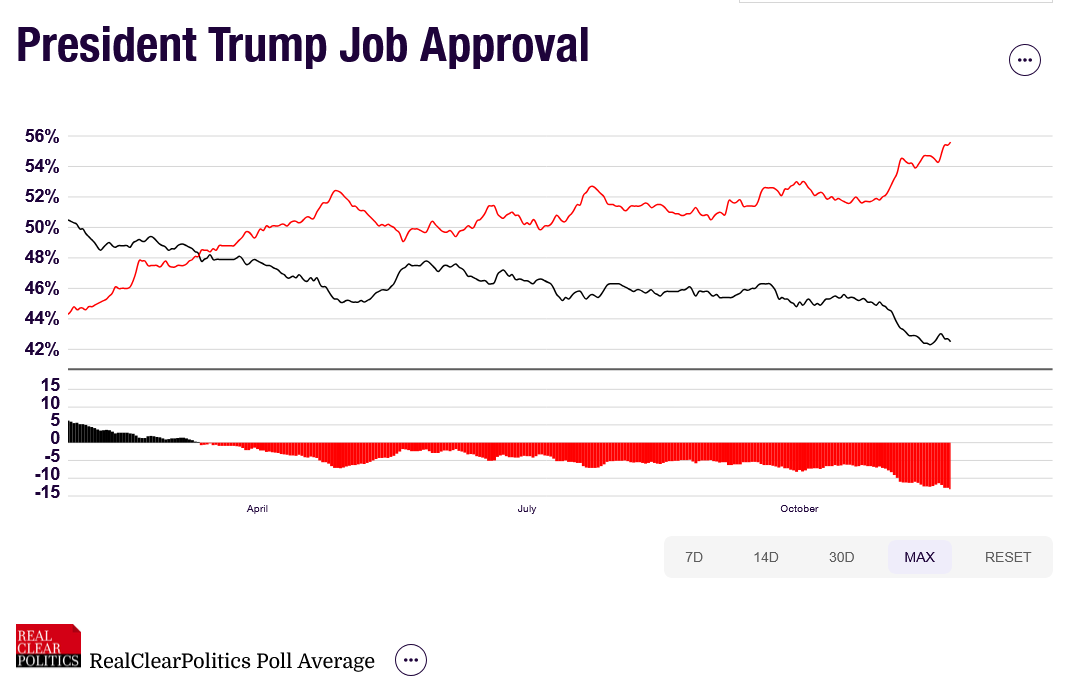
The passage of the Great Big Beautiful Bill, which allows businesses to write off capital investments immediately, is expected to contribute to the upcoming boom. Trump trumpeted his imminent settling of the world’s wars. What’s not to like? I warned of shoals ahead. One problem is that Trump has never had Reagan’s widespread appeal:

The cornerstone of Trump’s economic policy is his ability to use tariffs as a bludgeon to extract concessions from the rest of the world and force American businesses to plead their cases on bended knee, some even giving the Government an ownership stake. The world awaited Trump’s next action.

Yet, the majority of the tariffs had already been deemed illegal by two courts. The appeals court has upheld those verdicts, and we’re awaiting the Supreme Court’s final decision after just hearing oral arguments. If the High Court had only wanted to nullify the tariffs imposed under the single subject law, it could have refused to take the case. That action would’ve avoided prolonging the pain while ending most tariffs.

It’s too horrifying to think that the court wants to take the power to tax away from Congress and award it to the President, so it may wish to clarify how narrow the executive power is in this area, defining what actually constitutes an emergency, setting limits as to the time before you have to go to Congress. The bludgeon may become a twig, and Trump’s economic policy, domestic and foreign, evaporates.

While the President has had some success in fostering peace in some places, the two most significant areas of conflict, Israel and Ukraine, have received vastly different responses from Trump.

Both featured an unprovoked attack seeking to destroy these states ultimately. Israel and Ukraine seek to embrace Western values, while Russia and Hamas profess the opposite. Both Ukraine and Israel have waged truly brave and intelligent innovative wars, much to the shock of their enemies. America should know what the right side is to support, given our values.

While Israel has received the utmost Trump administration support, including direct defensive support and the bombing of a common enemy, Iran, the U.S. only provides arms bought and paid for by others and intermittent intelligence to Ukraine. Trump fetes Israel’s Netenyhu, but treats Ukraine’s Zelensky like a pariah.

Given the similarities of the two wars, what accounts for Trump’s differing positions? The administration, and even the special envoys, are mostly the same. The scientific method seeks to isolate and identify a single, distinct factor that explains a phenomenon.

Vice President Vance’s distaste for Ukraine is hardly a secret, given his part in humiliating Zelensky in the Oval Office. His and his supporters’ views dominate the administration of Ukraine policy. The same people are present in discussions of Middle East policy, but with two notable additions: Trump’s daughter, Ivanka, and his son-in-law, Jared Kushner, both Orthodox Jews, have also taken part in this area. During the previous Trump administration, they played a significant role in facilitating the Abraham Accords, arguably one of Trump’s most notable foreign policy achievements.

Continue reading

Gone With The Whigs

Watching both Bill Maher and Michael Smercondesh bemoaning the rise of Marxism in the Democratic Party this week caught my attention. The high visibility of Bernie Sanders and A.O.C., along with other “democratic socialists,” during our lengthy government shutdown, coupled with the likely election of one of their own as Mayor of our largest city, has caused a stir among those who consider themselves more moderate.

Their consternation reminded me of my dismay at Donald Trump’s 2016 success in the Republican Party. How could someone representing a minority of a minority suddenly become President? I thought of myself as a typical free-market, small-government, peace-through-strength Reagan Republican. Long-time Democrat Trump, with his anti-immigrant, pro-tariff positions, didn’t sound like Ronald Reagan. I voted for the libertarian ticket.

Running against one of the world’s most unpopular candidates, Hillary Clinton, Trump became President. Neither candidate had the support of even half of the American people. I sensed that a majority of the country was like me —deeply dissatisfied with the choices offered by our major parties. This lack of choice led me to begin my series on a “Future Party.”

The original idea was to establish a new party for independents and disaffected Democrats and Republicans to find a home. Independents could be comfortable not being subservient to any particular ideology. This vision led me to a brief and inconsequential association with Starbucks founder Howard Schultz’s short-lived third-party movement.

Instead of charting a course based on superior policies to those of either the Democrats or the Republicans, Schultz withdrew, fearing he would help Donald Trump by splitting the Democratic vote. We had just submitted ideas when he dropped out. Instead of staking out policies that appealed to everyone because they were better, he revealed where his heart truly resided.

Before the last election, former West Virginia Senator Joe Manchin failed to launch a third-party run on the same basis. Fear of aiding Trump dominated his thinking rather than a belief that he had a better path for America. That’s because he, like Schultz, didn’t have one.

In both instances, neither Schultz nor Manchin had anything more to offer than the promise to work across the aisle for workable compromises. In the “Future Party Series,” I concluded that for a third party to succeed, it must stand for something and make every effort to sell it.

The one successful third party, the Republicans, weren’t deterred by splitting the anti-Democratic vote in 1854. They knew what they stood for; they were against slavery. In 1860, Abraham Lincoln was elected the 16th President of the United States. The Whig Party disappeared.

People on both sides will come together on what they agree on, regardless of their existing party. A case in point is the opposition to Trump’s expansive tariff policy. Twelve Democratic state attorneys general joined forces with the libertarian free-market Liberty Justice League to bring suit against the Administration’s tariffs. Briefs supporting their case have been filed from across the spectrum, from the U.S. Chamber of Commerce to the Brennan Law Center.

Continue reading

November’s First Week

Next week will be much more impactful than usual. Elections in New Jersey, Virginia, and New York City will provide us with real-time insight into the electorate’s mood. On November 5th, the Supreme Court will hear oral arguments on the Tariff cases. We may get a grasp on how the court will rule in this momentous area.

Off-year elections tend to favor the out-of-power party, and polls show Democrats leading in these elections. However, polls show the races in New Jersey and Virginia favor the Democratic Party. However, the gubernatorial races in New Jersey and Virginia are narrowing. Instead of being on the attack, the Democrats are back on their heels.

In New Jersey, the incumbent Governor is highly unpopular. High taxes and energy prices plague the state. Fealty to the “Green New Deal” sees unsightly windmills on the famous Jersey Shore. Yet the Democratic candidate seems devoid of workable ideas to right the ship, leaving the energetic Republican candidate on the offensive.  

The vast majority of Virginians oppose biological men on girls’ sports teams and in their bathrooms. An 80-20 issue, and Abigail Spanberger, the Democratic candidate, can’t find a way to align with the girls. Menacing messages from the Democratic Attorney General candidate included threats to an opponent’s children. Spanberger can’t even say he should drop out.

New York City is among the bluest places in America, but it has faced myriad problems. Businesses and people, especially high-value taxpayers, are moving out. High taxes, crime, deteriorating services, bad schools, and very high-priced housing have diminished the “Big Apple’s appeal since the heady Giuliani and Bloomberg mayoralties. The city has long been a creative melting pot. For instance, almost one in eight New Yorkers is Jewish.

Continue reading

A Heads Up For Trump

The Washington Post reports that President Trump is considering attending the Supreme Court’s oral arguments in the tariff cases scheduled for November 5. It’s hard to see this threat as anything other than an attempt at intimidation. No president ever did this. Something about this executive branch’s effort to menace another branch made me think of another leader’s actions along these lines against another coequal branch of government.

At loggerheads with Parliament over its refusal to fund his endeavors, Charles I of the U.K. raised money through forced loans in defiance of that body and even threatened it. He entered Parliament with soldiers in an attempt to arrest some members. The idea was to wrest the Power of the purse — Parliament’s basic Power — from that body. The result was the English Civil War, where Parliament prevailed. Charles didn’t fare so well:

With the Power of the purse firmly embedded in the legislative branch, the principle migrated to the English colonies, where the Crown appointed the Governors. Still, the colonists elected the legislature that controlled funding. It’s no surprise that the legislative Power of the purse appears in the very first article of our Constitution.

Trump vs. V.O.S Selections —the official case name —is the most important separation-of-powers case since Truman seized the steel mills. To my mind, Trump’s tariffs are so expansive that they dwarf Truman’s action. Suppose a President can proclaim an emergency, which he can solely define, and usurp a revenue source expressly delegated to the legislative branch. In that case, the executive can neuter that branch and destroy our foundational system of checks and balances.

Continue reading

Getting Immigration Right

Immigration is a continuing flash point in America, but we rarely look at the facts and data. Emotions have led to deadlock on one of our most important policy questions. Let’s start with what we know:

The more we deport migrants, the sooner we will experience negative population growth. A glance at our social programs reveals the disastrous consequences of this path. Social Security will have to cut benefits by 2033 as things presently stand. With even fewer people supporting our retirees, the system collapses. We’ll need more people to fill jobs in an expanding economy.

Once we understand that our future depends on a growing population, the only question is how to achieve it. More births would be beneficial, but no one has yet found a way to increase births in advanced economies. That leaves immigration. However, this conclusion doesn’t mean throwing the borders open and taking in all comers. Done correctly, immigration can be a win-win proposition.

There are approximately 400,000 to 500,000 unfilled manufacturing jobs in the U.S. as of mid-2025. More than 1 million skilled trades jobs are unfilled, a figure expected to continue growing. The cybersecurity sector is projected to have 3.5 million unfilled positions in 2025. The nursing profession faces significant projected shortages, with approximately 1 million openings predicted for the decade of 2022-2032. These figures inform us that we need more skilled workers.  

Instead of the confusing and ineffective visa programs for skilled workers we have presently, I propose that anyone with skills worldwide can register for clearance. Once approved, authorized individuals can receive a visa at any time in the future.

Continue reading