The Pursuit Of Happiness

While waiting for the long-overdue Supreme Court Tariff ruling, I’ve had time to reflect on why so many Americans have either a dim view or little knowledge of our capitalist economic system. How can a simple, common-sense system be misunderstood by so many?

I’ve been reading Zhang Weiying’s “The Logic of the Market: An Insider’s View of Chinese Economic Reform” to better understand how the Chinese economy compares to our own. Most economists talk in jargon, but the Author explains capitalism in terms of happiness rather than marginal returns and GDP.

In capitalism, people engage in consensual exchange. Consumers and suppliers freely exchange a wide range of goods. As each gets what they asked for, both are happy. You go to the supermarket, you get what you want, and the store gets paid. Both of you win.

However, if goods or cash change hands with only one party happy and the other sad, it’s robbery. Think about that. Someone points a gun at you, demanding your stuff. The thief is happy, but you’re really sad. The point of human interaction is shared satisfaction, rather than gloom.

The gauging of happiness and sadness in society to determine whether an action is successful or just a thief. can be applied to both governance and economics. Most commercial transactions in free-market economies result in happiness for all the participants. You go to Costco, get a hot dog, and fill your cart with goods you value. At checkout, both you and Costco are happy.

Continue reading

Getting It Right At 250

We always get to see numerous replays of the New Year’s Eve Times Square Ball drop, but this year was different. Instead of the Ball staying grounded, it went right back up, proclaiming the U.S.’s impending 250th birthday, to drop again on July 3. This coming event can’t help but shine a bright light on one of history’s most extraordinary groups-our founding fathers.

Sadly, the people with the loudest megaphones on both the right and the left have chosen to present a distorted view of these remarkable people. The New York Times’ much-debunked 1619 Project portrayed the Founding Fathers as pro-slavery and the Revolution fought to preserve it. While historians and economists pointed out the project’s numerous errors, it lives on in progressive circles along with the nonsensical idea “Slavery is America’s original sin.”

The only thing original about slavery in colonial America was the Quakers, along with their co-religionists in England, calling for the abolition of the eons-old practice. Before Quakers, no religion, not the Catholics, Muslims, Hindus, Buddhists, or any other religion considered slavery a sin. From the Quakers’ shared spaces with other congregationalist Protestants, the idea that slavery is an abomination spread. Slavery was hardly original here, but the abolitionist cause was.

In a world of hereditary caste systems, with people as chattels at the bottom, whether we called them slaves, serfs, coolies, or untouchables, their lives were controlled by those above them. Challenging this system was genuinely original.

It is telling that for all his achievements, Ben Franklin could never sit in the House of Lords. No wonder self-made Americans weren’t keen on the British class system.

It is, therefore, discouraging to see what many consider the beginning of the impending birthday celebration: Ken Burns’ six-part PBS series “The American Revolution” repeats the popular messaging in progressive circles that the founding fathers were pro-slavery.

Continue reading

A Discussion Starter

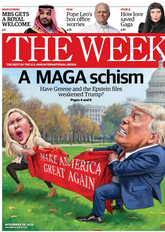
Gathering in Atlanta for Thanksgiving, no one ventured anything along political lines until our son’s 86-year-old mother-in-law asked everyone what they thought of Majorie Taylor Green (MTG), the controversial Georgia Republican representative. Everyone chimed in. She is everyone’s hero for standing up to President Trump, including the family Democrats. She’s even on the left-wing “The Week” magazine, contesting Trump:

This reaction shows far-out positions race across media at the speed of light, while we shun actual policy discussions. Name the first twenty politicians you think of. Sure, you’ll include Joe Biden, Kamala Harris, and the Clintons and Obamas.

Still, beyond them, you’re likely to name the likes of Donald Trump, Bernie Sanders, A.O.C., Zohran Mamdani, Jasmine Crockett, Pete Hegseth, Sean Duffy, and J.D. Vance. What do they all have in common? They’re all media savvy. It may not be too strong to say that the media brought them to their present prominence.

While we are well aware of these people, none of us associates them with any deep, well-reasoned policy positions. To be sure, they have policies, free buses, little or no immigration, high tariffs, and price controls, but none of them provides a well-reasoned defense of their positions, leaving the tasks to others. Think tanks and media outlets are left to make their positions seem coherent.

Contrast that with Reagan’s radio talks, spelling out and selling his policies. Clinton and Carter were policy wonks.

Continue reading

Turkeys before Thanksgiving

As we approach the Holidays and the New Year, our leaders are in a full retreat from reality. This situation doesn’t bode well for our future. As I pointed out in my last post, Democrats only offer bromides featuring price controls and socialism that have proven to make matters even worse. However, they’re not in control of anything at the national level, and can only throw temper tantrums like the lengthy Government we just experienced. For all the problems it caused, it changed nothing.

Our Republican President is another story. With control of the executive branch, both houses of Congress, and a conservative Supreme Court majority, he sets the agenda. If the recent elections weren’t enough of a wakeup call, Trump’s continued decline in approval indicates that the public isn’t buying what he’s selling:

The 2024 Democratic election debacle, in part, was traced to taking too many 80-20 positions, such as biological boys playing women’s sports, with them holding the short end. Now, Trump takes minority positions, but doesn’t seem to realize it. Trump’s inability to see the big picture may not only leave him an impotent lame duck but also threaten the future of the Republican Party by alienating core supporters and moderates alike.

Failing to speak against some of his most ardent “New right” supporters, who claim there is nothing wrong with the likes of Tucker Carlson normalizing the anti-Semite Nick Fuentes on his podcast. I’ve denounced left-wing anti-semitism, and right-wing bigotry is no less odious. There is nothing inclusive about “white supremacy” and “Christian Nationalism.”

Trump’s inexplicable deference to Putin’s Russia took an even darker turn this week, with an ultimatum to Ukraine that they must accept his 28-point peace plan by Thanksgiving. A plan that asks nothing of Russia, but demands Ukraine give up strategic land and cap its military strength, while forgoing NATO membership forever. In other words, a rolling surrender.  

Continue reading

Gone With The Whigs

Watching both Bill Maher and Michael Smercondesh bemoaning the rise of Marxism in the Democratic Party this week caught my attention. The high visibility of Bernie Sanders and A.O.C., along with other “democratic socialists,” during our lengthy government shutdown, coupled with the likely election of one of their own as Mayor of our largest city, has caused a stir among those who consider themselves more moderate.

Their consternation reminded me of my dismay at Donald Trump’s 2016 success in the Republican Party. How could someone representing a minority of a minority suddenly become President? I thought of myself as a typical free-market, small-government, peace-through-strength Reagan Republican. Long-time Democrat Trump, with his anti-immigrant, pro-tariff positions, didn’t sound like Ronald Reagan. I voted for the libertarian ticket.

Running against one of the world’s most unpopular candidates, Hillary Clinton, Trump became President. Neither candidate had the support of even half of the American people. I sensed that a majority of the country was like me —deeply dissatisfied with the choices offered by our major parties. This lack of choice led me to begin my series on a “Future Party.”

The original idea was to establish a new party for independents and disaffected Democrats and Republicans to find a home. Independents could be comfortable not being subservient to any particular ideology. This vision led me to a brief and inconsequential association with Starbucks founder Howard Schultz’s short-lived third-party movement.

Instead of charting a course based on superior policies to those of either the Democrats or the Republicans, Schultz withdrew, fearing he would help Donald Trump by splitting the Democratic vote. We had just submitted ideas when he dropped out. Instead of staking out policies that appealed to everyone because they were better, he revealed where his heart truly resided.

Before the last election, former West Virginia Senator Joe Manchin failed to launch a third-party run on the same basis. Fear of aiding Trump dominated his thinking rather than a belief that he had a better path for America. That’s because he, like Schultz, didn’t have one.

In both instances, neither Schultz nor Manchin had anything more to offer than the promise to work across the aisle for workable compromises. In the “Future Party Series,” I concluded that for a third party to succeed, it must stand for something and make every effort to sell it.

The one successful third party, the Republicans, weren’t deterred by splitting the anti-Democratic vote in 1854. They knew what they stood for; they were against slavery. In 1860, Abraham Lincoln was elected the 16th President of the United States. The Whig Party disappeared.

People on both sides will come together on what they agree on, regardless of their existing party. A case in point is the opposition to Trump’s expansive tariff policy. Twelve Democratic state attorneys general joined forces with the libertarian free-market Liberty Justice League to bring suit against the Administration’s tariffs. Briefs supporting their case have been filed from across the spectrum, from the U.S. Chamber of Commerce to the Brennan Law Center.

Continue reading