Gone With The Whigs

Watching both Bill Maher and Michael Smercondesh bemoaning the rise of Marxism in the Democratic Party this week caught my attention. The high visibility of Bernie Sanders and A.O.C., along with other “democratic socialists,” during our lengthy government shutdown, coupled with the likely election of one of their own as Mayor of our largest city, has caused a stir among those who consider themselves more moderate.

Their consternation reminded me of my dismay at Donald Trump’s 2016 success in the Republican Party. How could someone representing a minority of a minority suddenly become President? I thought of myself as a typical free-market, small-government, peace-through-strength Reagan Republican. Long-time Democrat Trump, with his anti-immigrant, pro-tariff positions, didn’t sound like Ronald Reagan. I voted for the libertarian ticket.

Running against one of the world’s most unpopular candidates, Hillary Clinton, Trump became President. Neither candidate had the support of even half of the American people. I sensed that a majority of the country was like me —deeply dissatisfied with the choices offered by our major parties. This lack of choice led me to begin my series on a “Future Party.”

The original idea was to establish a new party for independents and disaffected Democrats and Republicans to find a home. Independents could be comfortable not being subservient to any particular ideology. This vision led me to a brief and inconsequential association with Starbucks founder Howard Schultz’s short-lived third-party movement.

Instead of charting a course based on superior policies to those of either the Democrats or the Republicans, Schultz withdrew, fearing he would help Donald Trump by splitting the Democratic vote. We had just submitted ideas when he dropped out. Instead of staking out policies that appealed to everyone because they were better, he revealed where his heart truly resided.

Before the last election, former West Virginia Senator Joe Manchin failed to launch a third-party run on the same basis. Fear of aiding Trump dominated his thinking rather than a belief that he had a better path for America. That’s because he, like Schultz, didn’t have one.

In both instances, neither Schultz nor Manchin had anything more to offer than the promise to work across the aisle for workable compromises. In the “Future Party Series,” I concluded that for a third party to succeed, it must stand for something and make every effort to sell it.

The one successful third party, the Republicans, weren’t deterred by splitting the anti-Democratic vote in 1854. They knew what they stood for; they were against slavery. In 1860, Abraham Lincoln was elected the 16th President of the United States. The Whig Party disappeared.

People on both sides will come together on what they agree on, regardless of their existing party. A case in point is the opposition to Trump’s expansive tariff policy. Twelve Democratic state attorneys general joined forces with the libertarian free-market Liberty Justice League to bring suit against the Administration’s tariffs. Briefs supporting their case have been filed from across the spectrum, from the U.S. Chamber of Commerce to the Brennan Law Center.

Continue reading

A Heads Up For Trump

The Washington Post reports that President Trump is considering attending the Supreme Court’s oral arguments in the tariff cases scheduled for November 5. It’s hard to see this threat as anything other than an attempt at intimidation. No president ever did this. Something about this executive branch’s effort to menace another branch made me think of another leader’s actions along these lines against another coequal branch of government.

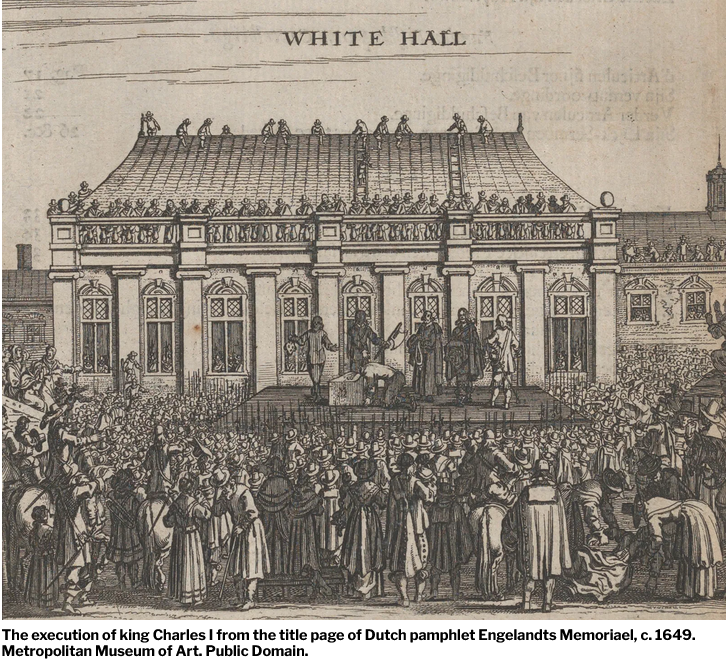
At loggerheads with Parliament over its refusal to fund his endeavors, Charles I of the U.K. raised money through forced loans in defiance of that body and even threatened it. He entered Parliament with soldiers in an attempt to arrest some members. The idea was to wrest the Power of the purse — Parliament’s basic Power — from that body. The result was the English Civil War, where Parliament prevailed. Charles didn’t fare so well:

With the Power of the purse firmly embedded in the legislative branch, the principle migrated to the English colonies, where the Crown appointed the Governors. Still, the colonists elected the legislature that controlled funding. It’s no surprise that the legislative Power of the purse appears in the very first article of our Constitution.

Trump vs. V.O.S Selections —the official case name —is the most important separation-of-powers case since Truman seized the steel mills. To my mind, Trump’s tariffs are so expansive that they dwarf Truman’s action. Suppose a President can proclaim an emergency, which he can solely define, and usurp a revenue source expressly delegated to the legislative branch. In that case, the executive can neuter that branch and destroy our foundational system of checks and balances.

Continue reading

Don’t Call This Administration Conservative

Core principles of conservatism

While the specifics of conservative beliefs can vary, common principles include:

  • Tradition: A preference for long-standing institutions and practices over sudden or radical change.
  • Limited Government: A belief that governmental power and scope should be restricted to protect individual liberty and free markets.
  • Fiscal responsibility: A focus on low taxes, reduced government spending, and minimal debt.
  • Strong national defense: Support for a powerful military to ensure national security and project power abroad.
  • Social conservatism: Emphasis on traditional morality, often rooted in religious beliefs, including support for the traditional family structure and opposition to abortion and certain LGBTQ+ rights.
  • Individualism: A belief in personal responsibility, self-reliance, and individual achievement, viewing society as composed of individuals rather than collective groups. 

When I Googled “Conservative,” these are the principles the AI generated. Barry Goldwater and Ronald Reagan would find them compatible with their philosophies. The former is the first conservative I was able to vote for. The latter governed as best he could as a conservative. Those of us who supported the Conservative movement of the era have trouble with what the administration is passing off as conservative, when in many cases, they’re the opposite.

When Trump first ran for President, he made certain moves to demonstrate to conservatives that he was one of them. He promised to appoint judges from the Federalist Society’s list. Old Reagan hand Larry Kudlow and Steve Moore were enlisted to deliver an economic program of tax cuts and regulatory reduction. Much to my dismay and that of others, he delivered.

Meanwhile, most of Trump’s first term suffered under the cloud of “Russiagate,” a totally fabricated Russian Collusion charge that depended on a fake dossier paid for by the Clinton campaign. Even with some tariffs levied on Steel, Aluminum, and Chinese imports, and the initiation of misguided COVID lockdowns, conservatives were mainly satisfied with Trump’s performance. Increased defence spending and robust actions against ISIS and Syria meant little aggression abroad.

Even though many conservatives were appalled by Trump’s claims that the 2020 election was stolen, and his action or lack of action on January 6th, the Hunter Biden Laptop cover-up balanced their ire.

Going on to the 2024 election, the ex-president was swamped in lawsuits seemingly designed only to entrap one person: Donald Trump. To conservatives, using the Government’s legal systems to go after a single individual for political reasons looked like banana republic tactics. Putin keeps his opponents off the ballot by invoking bogus laws, but Americans don’t.  

Continue reading

Aftermath

Since Charlie Kirk’s assassination, both parties have been exposed not only for rank hypocrisy but also for their similarity. For instance, Jimmy Kimmel went on his network TV show and said, “We hit some new lows over the weekend, with the MAGA gang desperately trying to characterize this kid who murdered Charlie Kirk as anything other than one of them and everything they can to score political points from it.” He made this statement, well after the shooter’s mother had explained how he had moved leftward in politics and argued with his conservative father.

Kimmel, his writers, or producers had to know there was no basis for his claim that a MAGA supporter had committed the heinous crime. He lied to his audience. A few days later, ABC suspended him. Conservatives applauded, while those on the left cried that the network was was denying the comedian’s free speech.

This explosive situation recalled a similar divisive situation at ABC some years back. In 2018, Roseanne Barr had posted a rant on twitter against Obama senior advisor Valerie Jarrett, saying, “If the muslim brotherhood & Planet of the Apes had a baby =VJ.” Even though Rosanne quickly apologized, ABC fired her from her hit TV show. At the time, many others and I on the right said ABC should give the comedian some slack, while those on the left saw it as just punishment for what they perceived as a racist remark.

Roseanne’s trials with mental illness are well known. From being institutionalized after a teenage auto accident and other afflictions, her erratic behavior is no secret. However, an off-kilter take on the world may contribute to her comic genius. After her apology, perhaps a suspension while she received some help would’ve sufficed, but ABC showed her no mercy. Adding insult to injury, the network continued the series under another name for seven profitable years without the star.  

Even though Kimmel has not apologized to date for his blatant lie, many on the left demand his immediate reinstatement. We are aware of Rosanne’s mental health issues, but what is Kimmel’s excuse? Yet, so far, he has suffered a lesser penalty. Remember, he isn’t in trouble for telling a joke, but telling an awful lie implicating an innocent group in a murder and then refusing to apologize.

Before those on the right get too far up on their high horse, we hear cheers on the right for FCC Chairman Brendan Carr’s license revocation threats against ABC and its affiliates. His threats might’ve been what cemented Kimmel’s suspension. You can’t construe Carr’s words as anything other than government interference with media content.

Continue reading

Biden Lost It. What About Trump?

We have experienced what was probably the biggest presidential cover-up in history, with the measures taken to hide Joe Biden’s cognitive decline. These stealth actions resulted in the disastrous Afghan pullout, the highest inflation in forty years, two wars, and an attempt to forgive billions of student loans simply by executive order. Only James Buchanan’s Administration compares in failure.

Now I’m worried we’re seeing a repeat, possibly on a grander scale. Given some of his actions, we have to consider that Donald Trump is increasingly delusional. Compared to the tired and confused Biden, many people will point to Trump’s hyperactivity as proving that old age isn’t affecting him. This conclusion ignores the fact that manic activity itself is a danger sign.

It’s difficult to believe that the people closest to us are unaware of a person’s decline or their personality traits becoming extreme. Just as the Democrats in and out of the white house had to know Biden wasn’t up to the job and getting worse, Republicans and others in the white house and Congress seem to ignore a troubled Trump.

Even with visual knowledge of Biden’s decline, Democrats discouraged anyone else from running for President. Dean Phillips, the only one who mounted a challenge, was ultimately driven from the party. For reasons of personal ambition, misplaced loyalty, a devious plan, or fear of reprisal, Democrats stood with Biden until a disastrous debate made his failing clear to everybody. Could something similar be taking place on the other side?

Tariffs are the centerpiece of the Trump administration, so that’s a good place to start. While not the easiest subject for an average person, it is undoubtedly within the realm of administration experts. Afghanistan seemed far away and wasn’t much on the public’s mind until the situation escalated. Tariffs aren’t easily understood, but they can now harm businesses, disrupt the nation’s finances, and even lead to a Constitutional crisis.

Continue reading