A Tale Of Two Assessments

On foreign policy and national security, we were recently treated to two assessments that provide guidance on the underlying foundations of the administration’s policy and American attitudes in these areas. The National Security Strategy(NSS) was issued in November 2025 by the Trump administration. At the recent gathering of many of the country’s best minds on foreign policy at the Ronald Reagan Presidential Library, the Reagan National Defense Survey was widely discussed.

Karl Rove, in the Wall Street Journal, points out that many of the government’s positions are in stark opposition to the attitudes of the American Public.  For instance, our policy towards Europe. In Ukraine, the Reagans Survey found, “A strong majority (62%) want Ukraine to prevail in its war with Russia, and 64% support sending U.S. weapons, up  9 points from last year, with bipartisan gains (59% of Republicans, 75% of Democrats).”  “Favorability toward NATO has reached its highest level ever at 68%, with strong bipartisan support for Article V commitments.”

The NSS says, “as a result of Russia’s war in Ukraine, European relations with Russia are now deeply attenuated, and many Europeans regard Russia as an existential threat.” The American public agrees that Russia is a threat. We want Ukraine to prevail.

Reading both, you get a sense that Americans still want to stand by our friends, especially those who share our values. On the other hand, the administration’s NSS takes a harder line with our longtime friends and allies than with Russia and China. One can’t help but wonder if down the road we might find ourselves without any friends.

We’ve seen Japan and South Korea hammered and forced to make U.S. investment commitments while facing higher tariffs. Our friendly neighbor, Canada, has incurred Trump’s ire, even though he updated the NAFTA trade treaty with Mexico and Canada in his first term.

Continue reading

What Works?

Progressives have the word ‘affordability’ and are going to run with it. Two prominent areas where costs are particularly burdensome for the public are housing and healthcare. Ranting about high prices only gets you so far. At some point, you have to come up with solutions.

Who better to look to for progressive answers than Ezra Klein, the New York Times columnist, turned the left’s Abundance guru due to his co-authored book “Abundance.” For the latest from the left on healthcare, who better than the principal author of the Affordable Care Act, Ezekiel J. Emanuel?

In his book, Klein unearthed the reason for our inability to build anything. We don’t make enough houses because of government restrictions and red tape. Heavens, what else will he find directly under his nose? He provides us with this illuminating chart in a recent article to state the obvious:

Klein offers insights into progressive solutions. The Center for American Progress and the Searchlight Institute would give some rent subsidies, but, like all subsidies, this would only add to demand, not increase supply, unless you could address the red tape and restrictions.

Many of the restrictions are aimed at preventing the construction of multi-family units in established single-family housing communities. Klein admits this could lower values, so there is no incentive for owners to increase density. People rarely vote against their economic interests.

This situation leaves Klein with one solution that I’ve expounded on in this blog: modular housing. Do the major work in factories rather than on-site. He, again, cites the Center for American Progress. “It wants the federal government to seed a major research program to fund innovation in housing construction.” Backdoor subsidies through military and other government purchases would maintain market continuity and the demand needed to bring in manufacturers.

Klein puts it this way, “One problem the modular housing industry has faced is the absence of steady demand to keep the factories running and work out the kinks of construction.” But then he refers to Sweden, where “more than 40 percent of new homes — and more than 80 percent of single-family homes — are fabricated off-site.” How can a small nation maintain a vibrant modular home industry when we have a market 32 times greater, and we can’t?

Continue reading

A Discussion Starter

Gathering in Atlanta for Thanksgiving, no one ventured anything along political lines until our son’s 86-year-old mother-in-law asked everyone what they thought of Majorie Taylor Green (MTG), the controversial Georgia Republican representative. Everyone chimed in. She is everyone’s hero for standing up to President Trump, including the family Democrats. She’s even on the left-wing “The Week” magazine, contesting Trump:

This reaction shows far-out positions race across media at the speed of light, while we shun actual policy discussions. Name the first twenty politicians you think of. Sure, you’ll include Joe Biden, Kamala Harris, and the Clintons and Obamas.

Still, beyond them, you’re likely to name the likes of Donald Trump, Bernie Sanders, A.O.C., Zohran Mamdani, Jasmine Crockett, Pete Hegseth, Sean Duffy, and J.D. Vance. What do they all have in common? They’re all media savvy. It may not be too strong to say that the media brought them to their present prominence.

While we are well aware of these people, none of us associates them with any deep, well-reasoned policy positions. To be sure, they have policies, free buses, little or no immigration, high tariffs, and price controls, but none of them provides a well-reasoned defense of their positions, leaving the tasks to others. Think tanks and media outlets are left to make their positions seem coherent.

Contrast that with Reagan’s radio talks, spelling out and selling his policies. Clinton and Carter were policy wonks.

Continue reading

Turkeys before Thanksgiving

As we approach the Holidays and the New Year, our leaders are in a full retreat from reality. This situation doesn’t bode well for our future. As I pointed out in my last post, Democrats only offer bromides featuring price controls and socialism that have proven to make matters even worse. However, they’re not in control of anything at the national level, and can only throw temper tantrums like the lengthy Government we just experienced. For all the problems it caused, it changed nothing.

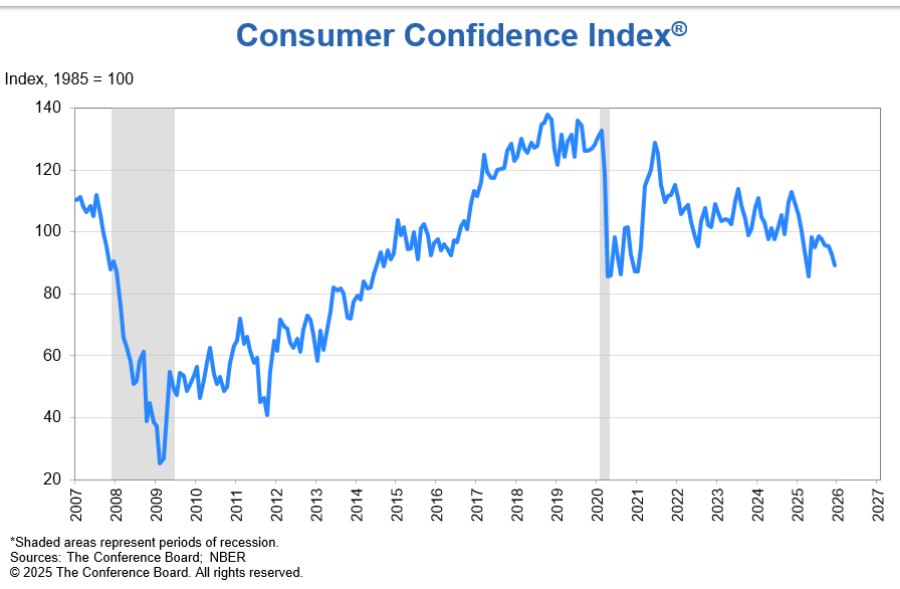
Our Republican President is another story. With control of the executive branch, both houses of Congress, and a conservative Supreme Court majority, he sets the agenda. If the recent elections weren’t enough of a wakeup call, Trump’s continued decline in approval indicates that the public isn’t buying what he’s selling:

The 2024 Democratic election debacle, in part, was traced to taking too many 80-20 positions, such as biological boys playing women’s sports, with them holding the short end. Now, Trump takes minority positions, but doesn’t seem to realize it. Trump’s inability to see the big picture may not only leave him an impotent lame duck but also threaten the future of the Republican Party by alienating core supporters and moderates alike.

Failing to speak against some of his most ardent “New right” supporters, who claim there is nothing wrong with the likes of Tucker Carlson normalizing the anti-Semite Nick Fuentes on his podcast. I’ve denounced left-wing anti-semitism, and right-wing bigotry is no less odious. There is nothing inclusive about “white supremacy” and “Christian Nationalism.”

Trump’s inexplicable deference to Putin’s Russia took an even darker turn this week, with an ultimatum to Ukraine that they must accept his 28-point peace plan by Thanksgiving. A plan that asks nothing of Russia, but demands Ukraine give up strategic land and cap its military strength, while forgoing NATO membership forever. In other words, a rolling surrender.  

Continue reading

“Affordability” Is The Word

Remember, in last year’s presidential campaign, the word we kept hearing was “Weird.” Part of the Democrats’ campaign strategy against the Republican ticket, the term gained such wide traction that it was later named one of Merriam-Webster’s words of the year for 2024. Now they’re back again with a new word. “Affordability.” Republicans have even joined in its use.

Zohran Mamdani won the New York City mayoralty race, decrying the absence of “affordability.” Donald Trump now claims he’s close to bagging the elusive “Affordability.” Both major parties now plan their 2026 election strategies on convincing the nation they’re the ones to deliver “affordability.”

The remedies offered by both sides sound more like comedy routines than solutions, but the laugh is on us. You don’t have to have a PHD. in economics to realize some simple facts. If prices remain high and continue to rise, it indicates an excessive demand chasing a limited supply. We quaintly call this the “Law of supply and demand.” The high price of anything is a signal to the market to produce more.

The Federal Reserve can reduce the supply of dollars, or the government can raise taxes to a point where there is less money available for spending, and the likely resulting slower business conditions lead to reduced demand. That path is painful for voters, so neither party advocates those policies.  

That leaves increasing supply. The Trump administration aims to return to the reduced regulation and favorable business tax policies that were effective during the first term of the Trump presidency. These policies are classic supply-side economics. Don’t get in the way of the market. High prices, if left uninterfered with, will attract capital and innovation, filling the gap.

Continue reading