The Cart Before The Horse

The last post dealt with the unreality of finding the workers required to make it all in the U.S. President Trump almost daily continues to announce a company or nation will invest billions in production in America. According to our leader, we’re bringing back all those good-paying jobs that left our Rust Belt states in despair. However, Hyundai’s proposed steel mill in Louisiana may be the exception that proves the rule.

Since the 1970s, the U.S. steel industry, mainly in the Midwest, has been retreating. Foreign competitors used their comparative advantages to deliver quality products at better prices. The fate of U.S. Steel illustrates the decline. Once dominant, with its vast mills in places like Gary, Indiana, and Pittsburgh, Pennsylvania, it’s now a weak minor player subject to absorption by Nippon Steel.

In towns like Gary, Indiana, well-paid steel union members lived comfortable middle-class lives. Now, like their primary employer, the decline is evident. Even with ongoing government protections, U.S. Steel isn’t competitive.

So if the rule is that significant U.S. steel production isn’t competitive on the world market, why is Hyundai bucking the trend? Tariffs play a part, but they’ve only kept the industry on life support. Does Hyundai see a comparative advantage?

This plant will be an electric arc facility that will consume much reliable power. Where better to locate than a place where natural gas is plentiful? This plant highlights our comparative advantage in energy production. In the modern world, machines do the heavy lifting, requiring inexpensive, reliable energy sources. If the government doesn’t get in the way, the U.S. has an energy cost advantage over almost all other nations.

Germany has learned this the hard way. Using cheap Russian natural gas to run its industrial complex, it produced the products that made the nation a great exporter. The Ukraine war cut its Russian gas imports while it was bringing online only unreliable wind and solar to replace its nuclear plants. Germany is struggling because it’s burning coal and importing more expensive natural gas.

Continue reading

These Bubbles Need to Be Popped

Prompted by my belief that radical elements in each increasingly control the two established parties, I posted the series on the “Future Party.” (It is Available on this site.) I worried this situation would lead to wild policy swings whenever we change presidents. Unfortunately, this has been the case from Obama to Trump. Bolstered by initial control of both houses of Congress, each president pursued policies opposite their immediate predecessor.

One only has to look at our border migrant policies. Trump tightened Obama’s, only to find Biden reversed course on his first day. Trump’s return reversed Biden on his first day. This whiplash is also evident in foreign, domestic, and economic policies.

In the past, people could count on continuity. Businesses could commit to multi-year plans. Friends and allies knew they could count on us instead of watching their backs. If there were problems, we could hash things out before radical change.

That’s all in the past. Where the far ends of each party differ, they are often direct opposites. The progressive wing of the Democratic Party backs its climate change convictions with billions of dollars for windmills, solar, and electric vehicles (EVs), which are anathema to the Republican right. They look to oil and gas to continue to power the world. To that end, they’ve encouraged vast liquefied Gas Terminals. This situation leaves anyone with significant power needs with a damned if you do, damned if you don’t headache.

Now, Donald Trump has escalated this uncertainty. He has reversed Biden’s energy policies and added supply chain anxiety with constantly changing tariff policies.

Continue reading

’24’s Leftover Mysteries

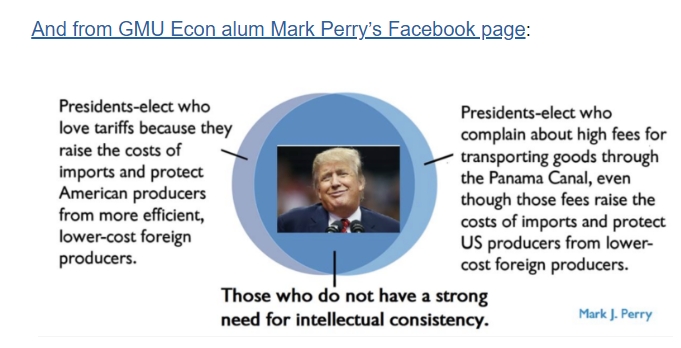
As we enter 2025, some ’24 mysteries remain unresolved. Donald Trump ran his successful campaign with a variety of seemingly contradictory positions. I was reminded of these when the Cafe Hayek blog pointed to economist Mark Perry’s illustration:

This contradiction made me think of other Trump contradictions. Peace and safety while withdrawing our troops from the Middle East. Without our support, the Kurds overseeing tens of thousands of ISSIS followers may face an attack by Turkish forces, rendering them unable to prevent a resurgence of the deadly group. Remember, Turkish leader Erdogan has territorial ambitions of his own. This possibility doesn’t sound peaceful to me.

We all know that politicians make all sorts of claims that step on each other, but now it’s time to introduce legislation, and conflicts remain unresolved. The idea is to write one or two big reconciliation bills containing the whole Trump program.

Inflation is a paramount issue that accounts for Trump’s victory, yet many of the president-elect’s promises are likely to raise prices. Besides tariffs that, like sales taxes, increase what you’re paying, lower taxes for favored groups, such as those working for tips or retirees, will likely result in higher interest rates or printing money. As I’ve pointed out, either will raise prices.

Unquestionably, the Biden Administration’s wild spending on the Green New Deal, infrastructure, and chips led to the highest inflation in forty years, but will Trump attempt to repeal all of this legislation? Taken together, these acts are an enormous industrial policy. Repeal all since state-directed economies have no record of success.

The question is whether Trump will tackle the problems wholeheartedly or simply piecemeal. The latter will be conflict on conflict. For instance, will Trump’s buddy, Elon Musk, stand still for eliminating his electric vehicle incentives and green tax credit sales? Will members of Congress allow the scrapping of big projects scheduled for their districts? Many businesses have sunk big money based on the Biden-era legislation. Can they continue without the promised subsidies and credits, or must they swallow significant losses on sunk costs? Even major oil companies put big bucks into green projects.

Continue reading

A Look On The Bright Side

As we approach the white house return of Donald Trump, there seem to be two distinct views of what it portends. On the left, it means a mass roundup of illegals and their placement in concentration camps awaiting export—the economy in shreds without adequate labor. Inflation is roaring upward, fed by tariffs and rising prices. Tax cuts add to the flames by producing huge deficits. The resulting high interest rates put homes and much else out of reach.

Inequity will rise, with Trump’s billionaire friends growing richer while the rest of us fall further behind. Efforts to make businesses and institutions more diverse and inclusive are stalled or reversed. According to Washington Post columnist David Ignatius, instead of a progressive, forward-looking society, we’ll be in the hands of the backward-looking “regressivists.”

Ukraine turned over to Russia’s tender mercies while our former friends and allies abandoned us. Belittled by Trump and harmed by his high tariffs, they retaliate, plunging the world into a deeper recession and raising the danger of World War III. Trump claims dictator powers.

While Gaetz withdrew from consideration as Attorney General, others nominated, such as Pete Hegseth for Defense, Robert Kennedy Jr. at Health and Human Services, and Tulsi Gabbard as Director of National Intelligence, confirm the left’s fears that inexperienced extremists will run the government.

In fear of these horrible outcomes, blue states are checking their resistance options. The governor of California has even called for a special session of the state legislature to raise funds for legal action. Others are seeking ways not to cooperate with or impede the federal government.

For those looking at it from this progressive point of view, the future looks bleak. However, the landscape might be more favorable for success from a right-of-center perspective.

Continue reading

Mirror Mirror

We’ve seen this movie before, or at least something similar. Trump uses his gut feeling to pick those he would support in certain situations. Top of the list of qualifications is loyalty to him. Whether they are up to the job is quite secondary. Gazing at the fawning chosen is like looking in the mirror; the more they ape him, the more he sees himself. The reflection, of course, pleases him. A narcissist likes nothing better than himself.

I’ve pointed all this out before. Who can forget those Trump-backed candidates who used his blessing to edge out people who could win in the primaries only to flame out in the general elections? Herschel Walker, Dr. Oz, Blake Masters, Karri Lake, Doug Maestriano, etc.

Losing winnable contests had dire consequences. Trump put himself first, rather than his party and, if he thought about it, the country, resulting in legislation and actions that brought us inflation and an open border. Control of the Senate in the Biden administration could’ve blunted his leftward lurch.

Continue reading