“Affordability” Is The Word

Remember, in last year’s presidential campaign, the word we kept hearing was “Weird.” Part of the Democrats’ campaign strategy against the Republican ticket, the term gained such wide traction that it was later named one of Merriam-Webster’s words of the year for 2024. Now they’re back again with a new word. “Affordability.” Republicans have even joined in its use.

Zohran Mamdani won the New York City mayoralty race, decrying the absence of “affordability.” Donald Trump now claims he’s close to bagging the elusive “Affordability.” Both major parties now plan their 2026 election strategies on convincing the nation they’re the ones to deliver “affordability.”

The remedies offered by both sides sound more like comedy routines than solutions, but the laugh is on us. You don’t have to have a PHD. in economics to realize some simple facts. If prices remain high and continue to rise, it indicates an excessive demand chasing a limited supply. We quaintly call this the “Law of supply and demand.” The high price of anything is a signal to the market to produce more.

The Federal Reserve can reduce the supply of dollars, or the government can raise taxes to a point where there is less money available for spending, and the likely resulting slower business conditions lead to reduced demand. That path is painful for voters, so neither party advocates those policies.  

That leaves increasing supply. The Trump administration aims to return to the reduced regulation and favorable business tax policies that were effective during the first term of the Trump presidency. These policies are classic supply-side economics. Don’t get in the way of the market. High prices, if left uninterfered with, will attract capital and innovation, filling the gap.

Continue reading

Gone With The Whigs

Watching both Bill Maher and Michael Smercondesh bemoaning the rise of Marxism in the Democratic Party this week caught my attention. The high visibility of Bernie Sanders and A.O.C., along with other “democratic socialists,” during our lengthy government shutdown, coupled with the likely election of one of their own as Mayor of our largest city, has caused a stir among those who consider themselves more moderate.

Their consternation reminded me of my dismay at Donald Trump’s 2016 success in the Republican Party. How could someone representing a minority of a minority suddenly become President? I thought of myself as a typical free-market, small-government, peace-through-strength Reagan Republican. Long-time Democrat Trump, with his anti-immigrant, pro-tariff positions, didn’t sound like Ronald Reagan. I voted for the libertarian ticket.

Running against one of the world’s most unpopular candidates, Hillary Clinton, Trump became President. Neither candidate had the support of even half of the American people. I sensed that a majority of the country was like me —deeply dissatisfied with the choices offered by our major parties. This lack of choice led me to begin my series on a “Future Party.”

The original idea was to establish a new party for independents and disaffected Democrats and Republicans to find a home. Independents could be comfortable not being subservient to any particular ideology. This vision led me to a brief and inconsequential association with Starbucks founder Howard Schultz’s short-lived third-party movement.

Instead of charting a course based on superior policies to those of either the Democrats or the Republicans, Schultz withdrew, fearing he would help Donald Trump by splitting the Democratic vote. We had just submitted ideas when he dropped out. Instead of staking out policies that appealed to everyone because they were better, he revealed where his heart truly resided.

Before the last election, former West Virginia Senator Joe Manchin failed to launch a third-party run on the same basis. Fear of aiding Trump dominated his thinking rather than a belief that he had a better path for America. That’s because he, like Schultz, didn’t have one.

In both instances, neither Schultz nor Manchin had anything more to offer than the promise to work across the aisle for workable compromises. In the “Future Party Series,” I concluded that for a third party to succeed, it must stand for something and make every effort to sell it.

The one successful third party, the Republicans, weren’t deterred by splitting the anti-Democratic vote in 1854. They knew what they stood for; they were against slavery. In 1860, Abraham Lincoln was elected the 16th President of the United States. The Whig Party disappeared.

People on both sides will come together on what they agree on, regardless of their existing party. A case in point is the opposition to Trump’s expansive tariff policy. Twelve Democratic state attorneys general joined forces with the libertarian free-market Liberty Justice League to bring suit against the Administration’s tariffs. Briefs supporting their case have been filed from across the spectrum, from the U.S. Chamber of Commerce to the Brennan Law Center.

Continue reading

November’s First Week

Next week will be much more impactful than usual. Elections in New Jersey, Virginia, and New York City will provide us with real-time insight into the electorate’s mood. On November 5th, the Supreme Court will hear oral arguments on the Tariff cases. We may get a grasp on how the court will rule in this momentous area.

Off-year elections tend to favor the out-of-power party, and polls show Democrats leading in these elections. However, polls show the races in New Jersey and Virginia favor the Democratic Party. However, the gubernatorial races in New Jersey and Virginia are narrowing. Instead of being on the attack, the Democrats are back on their heels.

In New Jersey, the incumbent Governor is highly unpopular. High taxes and energy prices plague the state. Fealty to the “Green New Deal” sees unsightly windmills on the famous Jersey Shore. Yet the Democratic candidate seems devoid of workable ideas to right the ship, leaving the energetic Republican candidate on the offensive.  

The vast majority of Virginians oppose biological men on girls’ sports teams and in their bathrooms. An 80-20 issue, and Abigail Spanberger, the Democratic candidate, can’t find a way to align with the girls. Menacing messages from the Democratic Attorney General candidate included threats to an opponent’s children. Spanberger can’t even say he should drop out.

New York City is among the bluest places in America, but it has faced myriad problems. Businesses and people, especially high-value taxpayers, are moving out. High taxes, crime, deteriorating services, bad schools, and very high-priced housing have diminished the “Big Apple’s appeal since the heady Giuliani and Bloomberg mayoralties. The city has long been a creative melting pot. For instance, almost one in eight New Yorkers is Jewish.

Continue reading

Getting Immigration Right

Immigration is a continuing flash point in America, but we rarely look at the facts and data. Emotions have led to deadlock on one of our most important policy questions. Let’s start with what we know:

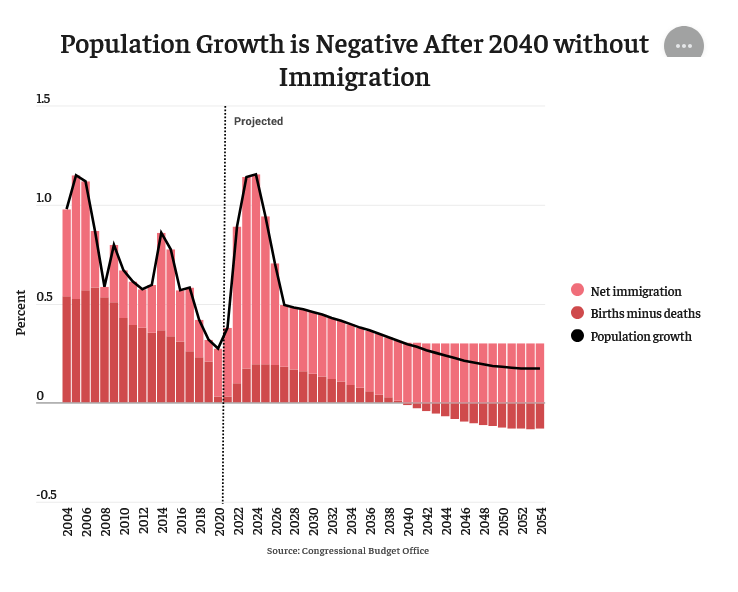
The more we deport migrants, the sooner we will experience negative population growth. A glance at our social programs reveals the disastrous consequences of this path. Social Security will have to cut benefits by 2033 as things presently stand. With even fewer people supporting our retirees, the system collapses. We’ll need more people to fill jobs in an expanding economy.

Once we understand that our future depends on a growing population, the only question is how to achieve it. More births would be beneficial, but no one has yet found a way to increase births in advanced economies. That leaves immigration. However, this conclusion doesn’t mean throwing the borders open and taking in all comers. Done correctly, immigration can be a win-win proposition.

There are approximately 400,000 to 500,000 unfilled manufacturing jobs in the U.S. as of mid-2025. More than 1 million skilled trades jobs are unfilled, a figure expected to continue growing. The cybersecurity sector is projected to have 3.5 million unfilled positions in 2025. The nursing profession faces significant projected shortages, with approximately 1 million openings predicted for the decade of 2022-2032. These figures inform us that we need more skilled workers.  

Instead of the confusing and ineffective visa programs for skilled workers we have presently, I propose that anyone with skills worldwide can register for clearance. Once approved, authorized individuals can receive a visa at any time in the future.

Continue reading

Don’t Call This Administration Conservative

Core principles of conservatism

While the specifics of conservative beliefs can vary, common principles include:

  • Tradition: A preference for long-standing institutions and practices over sudden or radical change.
  • Limited Government: A belief that governmental power and scope should be restricted to protect individual liberty and free markets.
  • Fiscal responsibility: A focus on low taxes, reduced government spending, and minimal debt.
  • Strong national defense: Support for a powerful military to ensure national security and project power abroad.
  • Social conservatism: Emphasis on traditional morality, often rooted in religious beliefs, including support for the traditional family structure and opposition to abortion and certain LGBTQ+ rights.
  • Individualism: A belief in personal responsibility, self-reliance, and individual achievement, viewing society as composed of individuals rather than collective groups. 

When I Googled “Conservative,” these are the principles the AI generated. Barry Goldwater and Ronald Reagan would find them compatible with their philosophies. The former is the first conservative I was able to vote for. The latter governed as best he could as a conservative. Those of us who supported the Conservative movement of the era have trouble with what the administration is passing off as conservative, when in many cases, they’re the opposite.

When Trump first ran for President, he made certain moves to demonstrate to conservatives that he was one of them. He promised to appoint judges from the Federalist Society’s list. Old Reagan hand Larry Kudlow and Steve Moore were enlisted to deliver an economic program of tax cuts and regulatory reduction. Much to my dismay and that of others, he delivered.

Meanwhile, most of Trump’s first term suffered under the cloud of “Russiagate,” a totally fabricated Russian Collusion charge that depended on a fake dossier paid for by the Clinton campaign. Even with some tariffs levied on Steel, Aluminum, and Chinese imports, and the initiation of misguided COVID lockdowns, conservatives were mainly satisfied with Trump’s performance. Increased defence spending and robust actions against ISIS and Syria meant little aggression abroad.

Even though many conservatives were appalled by Trump’s claims that the 2020 election was stolen, and his action or lack of action on January 6th, the Hunter Biden Laptop cover-up balanced their ire.

Going on to the 2024 election, the ex-president was swamped in lawsuits seemingly designed only to entrap one person: Donald Trump. To conservatives, using the Government’s legal systems to go after a single individual for political reasons looked like banana republic tactics. Putin keeps his opponents off the ballot by invoking bogus laws, but Americans don’t.  

Continue reading