Getting Immigration Right

Immigration is a continuing flash point in America, but we rarely look at the facts and data. Emotions have led to deadlock on one of our most important policy questions. Let’s start with what we know:
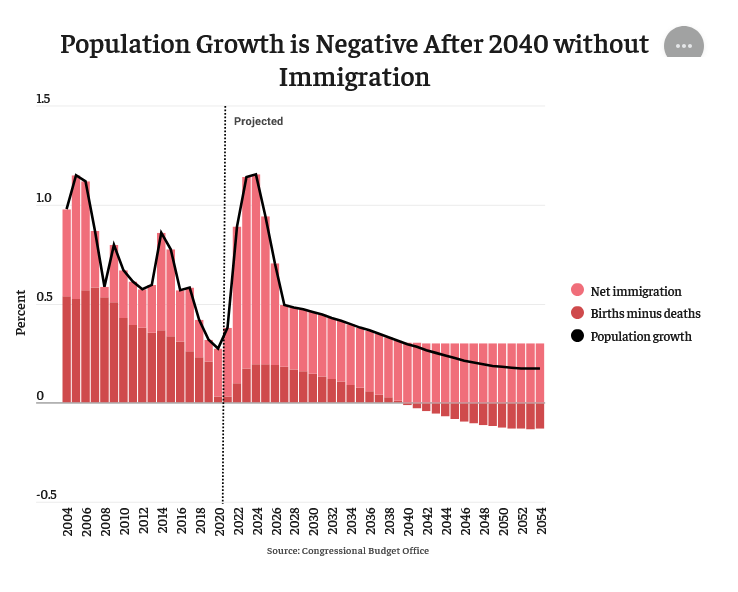
The more we deport migrants, the sooner we will experience negative population growth. A glance at our social programs reveals the disastrous consequences of this path. Social Security will have to cut benefits by 2033 as things presently stand. With even fewer people supporting our retirees, the system collapses. We’ll need more people to fill jobs in an expanding economy.

Once we understand that our future depends on a growing population, the only question is how to achieve it. More births would be beneficial, but no one has yet found a way to increase births in advanced economies. That leaves immigration. However, this conclusion doesn’t mean throwing the borders open and taking in all comers. Done correctly, immigration can be a win-win proposition.

There are approximately 400,000 to 500,000 unfilled manufacturing jobs in the U.S. as of mid-2025. More than 1 million skilled trades jobs are unfilled, a figure expected to continue growing. The cybersecurity sector is projected to have 3.5 million unfilled positions in 2025. The nursing profession faces significant projected shortages, with approximately 1 million openings predicted for the decade of 2022-2032. These figures inform us that we need more skilled workers.  

Instead of the confusing and ineffective visa programs for skilled workers we have presently, I propose that anyone with skills worldwide can register for clearance. Once approved, authorized individuals can receive a visa at any time in the future.

Continue reading

I Have My Reasons

In the last post, I stated people should back the person most closely aligned with their principles and goals that can get elected. People have pointed out that former President Trump is leading Biden in several polls, so why am I not supporting him? The simple reason is that we disagree on important issues, precisely his stance on capitalism vs. state-directed economies and his subservience to bureaucratic elites. 

That doesn’t mean I didn’t applaud his tax cuts, opposing more regulations, and solid court appointments. Support for Israel while containing Iran led to the Abraham Accords. Providing real weapons to Ukraine kept Russia at bay. 

Trump’s stance on Capitalism vs. State-directed economies, as characterized by protectionism, debt, and immigration, however, revealed Trump’s less attractive side. Subservience to bureaucratic elites, Trump clashed with my fundamental values. 

A bedrock belief in markets allocating resources rather than self-serving elites makes me hostile to industrial policies. These policies, characterized by state intervention in the economy, have historically proven ineffective and often disastrous. 

After freeing up markets and achieving remarkable growth, China is reverting to the state direction of the economy with the expected results; growth is decelerating. Soon, it will join the old Soviet Union, Cuba, Venezuela, and Argentina as countries that could be rich but choose to move backward.

Speaking of Argentina, the new president, Javier Milie, explains the differences between capitalism’s successes and the failures of statism in his address before the World Economic Forum. I only wish I had his passionate ability to make the case for markets and the people rather than the state making decisions. One can only hope he will get the support to return Argentina to its place among wealthy nations.

A state-directed economy is only possible by separating a nation from competing goods and ideas. Protectionism through tariffs is a primary tool. Trump loves tariffs. He imposed them to protect our steel and washing machine industries. While he saved some jobs in the protected sectors, the data shows he lost more jobs among the users of tariff-protected products such as autos and washing machines using the now higher price steel, making them less competitive.

Continue reading