A Heads Up For Trump

The Washington Post reports that President Trump is considering attending the Supreme Court’s oral arguments in the tariff cases scheduled for November 5. It’s hard to see this threat as anything other than an attempt at intimidation. No president ever did this. Something about this executive branch’s effort to menace another branch made me think of another leader’s actions along these lines against another coequal branch of government.

At loggerheads with Parliament over its refusal to fund his endeavors, Charles I of the U.K. raised money through forced loans in defiance of that body and even threatened it. He entered Parliament with soldiers in an attempt to arrest some members. The idea was to wrest the Power of the purse — Parliament’s basic Power — from that body. The result was the English Civil War, where Parliament prevailed. Charles didn’t fare so well:

With the Power of the purse firmly embedded in the legislative branch, the principle migrated to the English colonies, where the Crown appointed the Governors. Still, the colonists elected the legislature that controlled funding. It’s no surprise that the legislative Power of the purse appears in the very first article of our Constitution.

Trump vs. V.O.S Selections —the official case name —is the most important separation-of-powers case since Truman seized the steel mills. To my mind, Trump’s tariffs are so expansive that they dwarf Truman’s action. Suppose a President can proclaim an emergency, which he can solely define, and usurp a revenue source expressly delegated to the legislative branch. In that case, the executive can neuter that branch and destroy our foundational system of checks and balances.

Continue reading

Getting Immigration Right

Immigration is a continuing flash point in America, but we rarely look at the facts and data. Emotions have led to deadlock on one of our most important policy questions. Let’s start with what we know:

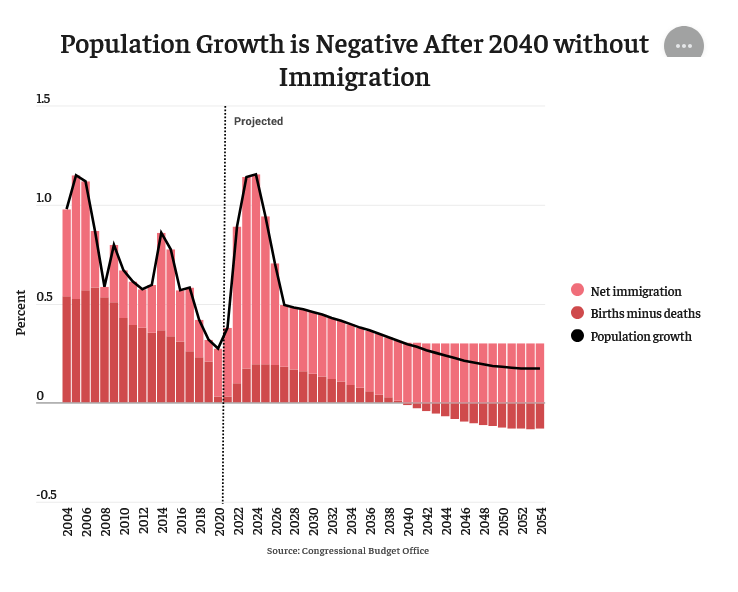
The more we deport migrants, the sooner we will experience negative population growth. A glance at our social programs reveals the disastrous consequences of this path. Social Security will have to cut benefits by 2033 as things presently stand. With even fewer people supporting our retirees, the system collapses. We’ll need more people to fill jobs in an expanding economy.

Once we understand that our future depends on a growing population, the only question is how to achieve it. More births would be beneficial, but no one has yet found a way to increase births in advanced economies. That leaves immigration. However, this conclusion doesn’t mean throwing the borders open and taking in all comers. Done correctly, immigration can be a win-win proposition.

There are approximately 400,000 to 500,000 unfilled manufacturing jobs in the U.S. as of mid-2025. More than 1 million skilled trades jobs are unfilled, a figure expected to continue growing. The cybersecurity sector is projected to have 3.5 million unfilled positions in 2025. The nursing profession faces significant projected shortages, with approximately 1 million openings predicted for the decade of 2022-2032. These figures inform us that we need more skilled workers.  

Instead of the confusing and ineffective visa programs for skilled workers we have presently, I propose that anyone with skills worldwide can register for clearance. Once approved, authorized individuals can receive a visa at any time in the future.

Continue reading

A Tale Of Two Books

Elon Musk says our two major parties have turned him off; he’s starting the “American Party.” Musk isn’t the only person uncomfortable with the direction offered by the two parties. The Democrats seem to cling to small minority positions, the majority abhors, such as biological males in women’s sports, and open borders. A Republican president playing footsy with organized labor and imposing industrial policy through tariffs. These used to be Democratic policies.

It’s not surprising that long-term adherents to either party are dismayed. Recently, I began to understand what was going on, thanks to two books., “Abundance,” by Ezra Klein and Derek Thompson, and “The New Conservatives,” edited by Oren Cass. In a post last April, I noted, “Abundance” is weak tea, heavy on lamentations about how nothing ever gets built or finished. We’ve all seen this in action, or more realistically, inaction. What I found lacking is solutions.

The authors decry California’s high-speed rail boondoggle, but fail to mention that Florida already connects major cities with its non-government high-speed rail. It’s not profitable, but it’s running and rapidly growing. Completed green power projects are more abundant in red states. Houston has affordable housing, California doesn’t.

While the U.S. as a whole suffers from excessive regulation, some individuals have found ways to accomplish their goals. Instead of merely pointing out the overregulation, the authors needed to demonstrate how to mitigate the problem, providing examples of success, even if they’re in Red States.

I was surprised to read E.J. Dionne’s critique of the book in The Washington Post. Long featured on the left of the center media, such as MSNBC, he’s a longtime window into the progressive intelligentsia’s thinking. In his words, this mild book” has “the potential to divide the party.” What, a book that ends in the aspiration for “a liberalism that builds.” What a shocking idea.

Continue reading

Challenging Bad Info

When you think you can move on from a personal crusade against faulty workplaces, such as the media, academia, and the sciences, an article appears in a prominent publication that is misleading at best or presents poor work in support of a particular point of view—Richard Fryer’s “The Economics of Slavery, an op-ed in the Wall Sreet Journal June 18th, in anticipation of the Juneteenth Holiday the next day. I join the masses of humanity in celebrating the end of chattel servitude anywhere in the world. My upset isn’t with the holiday but rather with someone using it as an opportunity to mislead.

My criticism is similar to what I wrote when I first read “The 1619 Project.” Both are tracts that consist of desired conclusions based on questionable data and straw men.

In Roland Fryer’s case, he claims to refute the idea that slavery was unprofitable. He mentions the “Woodson Center’s “1776 Unites.” However, the center notes Adam Smith’s idea that slavery was inefficient in comparison to his free trade principles. The fact that slavery exists nowhere capitalism is dominant is proof that Smith is correct. However, that has nothing to do with the rewards that owners of human chattels have received through the ages. Smith never said that British Caribbean island sugar plantation owners didn’t benefit. Home weaving was “profitable” for centuries, but hardly exists today because it’s uncompetitive in today’s mass market. Apples and oranges.

Has any of the millions of people who read or saw the movie “Gone With The Wind” concluded that Tara was unprofitable? Could an institution dating back to the Sumerians and practiced across the world in some form for thousands of years last if it was “unprofitable.?’

The author then supports his attack on this straw man with evidence he presents as well-founded scholarly work by Robert Fogel and Stanley Engerman; however, their work is highly contentious regarding both facts and methods. What is the shock in finding that plantations keep production data? Similarly, Roman and Greek slave-owning large landowners did the same. Hammurapi’s Babylon had cuneiform tally clay tablets. What would be enlightening would be comparisons of methods.

Continue reading

A Fork In The Road?

It all seemed so easy. Resolving the war in Ukraine upon Trump’s return to office—peace in Gaza and the return of all hostages. Manufacturing is sprouting up across the Rust Belt, providing a multitude of good-paying jobs, all protected by a solid tariff wall. Everyone at the rallies cheered for a new day. Well, Trump has been president for over 100 days, and it all seems like a distant memory.

If anything, the Ukraine war is even nastier, with Russia targeting civilians. While directing all sorts of pressure and humiliation toward Ukraine and its leadership, Trump, up to this point, refused to cause Russia any discomfort. Why does our president coddle an unfriendly power that is the aggressor? As I demonstrated in my post, “What’s Trump Thinking,” the notion that Russia would abandon its alliance with China is a fantasy. China isn’t about to allow a Russian defection to put the developing Arctic trade route in unfriendly hands. Putin knows that if he can’t subdue the much smaller Ukraine, he stands no chance against China. Trump seems unaware that Russia is China’s vassal state. He continues to treat Russia as a great power.

While retrieving some hostages, the war in Gaza rages on, with many still unaccounted for. A truce with the Houthis has allowed shipping to return to the Suez route, but Israel is still subject to attack.

As Iran closes in on becoming a nuclear power, Trump is in talks to trade sanctions relief for Iran putting off a nuclear weapon. This negotiation is similar to the Obama administration’s tactics. The pact they made with Iran resulted in that nation funding its pawns, Hamas, the Houthis, Bashar Assad, and Hezbollah. We all know how that turned out.

Trump’s industrial policy, centered on the use of high tariffs, has so far engendered much confusion, numerous paper promises, and little difference in Rust Belt manufacturing. Where the almost daily tariff changes lead is anyone’s guess.

Continue reading