The Washington Post reports that President Trump is considering attending the Supreme Court’s oral arguments in the tariff cases scheduled for November 5. It’s hard to see this threat as anything other than an attempt at intimidation. No president ever did this. Something about this executive branch’s effort to menace another branch made me think of another leader’s actions along these lines against another coequal branch of government.
At loggerheads with Parliament over its refusal to fund his endeavors, Charles I of the U.K. raised money through forced loans in defiance of that body and even threatened it. He entered Parliament with soldiers in an attempt to arrest some members. The idea was to wrest the Power of the purse — Parliament’s basic Power — from that body. The result was the English Civil War, where Parliament prevailed. Charles didn’t fare so well:
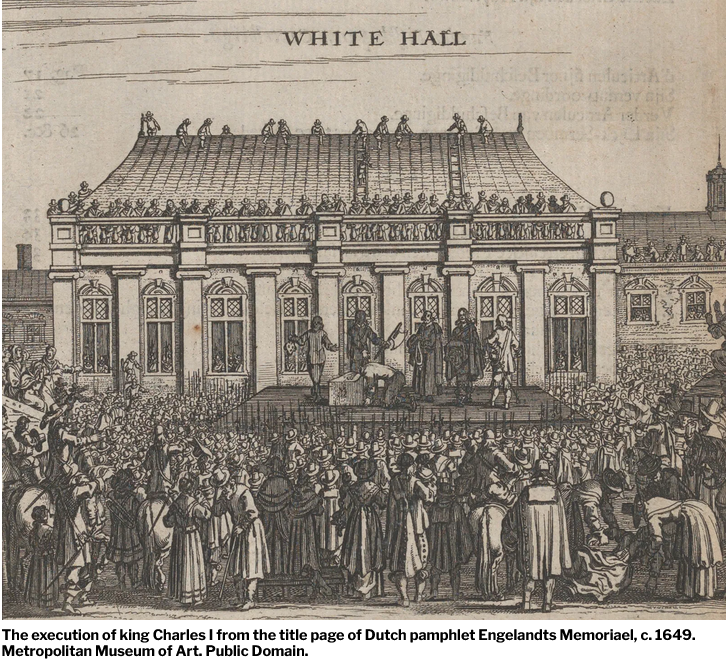
With the Power of the purse firmly embedded in the legislative branch, the principle migrated to the English colonies, where the Crown appointed the Governors. Still, the colonists elected the legislature that controlled funding. It’s no surprise that the legislative Power of the purse appears in the very first article of our Constitution.
Trump vs. V.O.S Selections —the official case name —is the most important separation-of-powers case since Truman seized the steel mills. To my mind, Trump’s tariffs are so expansive that they dwarf Truman’s action. Suppose a President can proclaim an emergency, which he can solely define, and usurp a revenue source expressly delegated to the legislative branch. In that case, the executive can neuter that branch and destroy our foundational system of checks and balances.
In striking down Biden’s forgiveness of billions of dollars in student loan debt, the Supreme Court invoked the major questions doctrine. The doctrine holds that courts are reluctant to interpret ambiguous statutory text as granting the executive the Power to decide issues of vast economic and political significance without clear congressional authorization.
The International Emergency Economic Powers Act (IEEPA), the law the Administration relied on to justify the tariffs in question, is contested in this case and does not even mention tariffs or duties. Talk about ambiguous.
Trump counters that an adverse decision would bring us to the brink of “Catastrophe.” The Billions upon billions collected then are subject to refund. Deals with foreign nations coerced under tariff threats may unravel. You can’t unscramble those eggs.
Yet, the Administration knew it was on questionable legal ground when the Court of International Trade, the lower court charged with hearing this type of case, ruled against it. Instead of holding up the implementation of the duties till it had a final ruling, Trump asked for a stay of the ruling and an expedited Appeal, and barreled ahead with tariff after tariff. He used them to force unfavorable deals on other countries.
When the appeals court upheld the lower court, it was still pedal to the metal, while the High Court gave it an expedited schedule. Now the president demands that the Supreme Court save him from the consequences of his own rash actions. Now that’s chutzpah!
Of course, the Administration claims it’s an emergency when it slaps on another tariff. We’re running a trade deficit with some countries; it’s an emergency. We need tariffs to reverse the horror. Yet, the U.S. has run a trade deficit every year since 1975. A fifty-year emergency, while the U.S. has somehow remained the most prosperous large nation in the world. Yet the Administration’s brief claims we’ll be poor without the recent tariffs.
A national security argument seems weak when the War Department asks for tariff waivers. Furniture is a national security emergency? The Administration slapped section 232 tariffs on furniture, vanities, and cabinets. An attack of killer sofas clearly is a national security threat.
When the Administration appealed the lower courts’ adverse rulings, there was a good chance the court would refuse to hear the case, thereby ending the tariffs in question and limiting the damage. Unfortunately, Trump could reimpose them under another statute, such as Section 232 of the Trade Expansion Act of 1962.
By hearing the case, the court should take the opportunity to define and put limits on “national security emergencies.” The idea of emergency power is that there is no time to go to Congress before significant harm occurs. The overriding question is: how long does it take to bring it to the legislative branch for approval—3 months, 6 months, or a year? What is the limiting factor? If the executive can proclaim an emergency about Anything, anytime, and it’s the law permanently, why have a legislative branch?
The present case raises the emergency rationale, allowing the court to impose limitations on these actions in its decision. By setting limits on emergencies, it not only supports an adverse decision against the tariffs in this case but also opens all “emergency” tariffs to challenge, no matter the cited law.. What constitutes an emergency and for how long it remains effective without congressional approval sets the limits that retain congressional Power of the purse.
Trump vs. V.O.S. raises the same questions as Charles I’s challenge to Parliament in the English Civil War, and “taxation without representation” played a key role in our revolution. Neither the King nor the executive can raise revenue without the express permission of the people’s elected representatives. Anything less leads to tyranny. This principle is fundamental to our representative Republic. If we are to remain the great nation our forefathers brought forth, the court must rule stoutly to reaffirm it.
The odds are that the court will uphold the lower courts. Anything less leads to irreparable harm. Limits on the executive make clear the separation of powers that upholds our constitutional system of checks and balances.
With such an essential Constitutional question on the docket, the party out of Power should strongly oppose the Administration’s power grab. Twelve Democratic attorneys general joined in the V.O.S. Selections challenge. Libertarians underlay the endeavor. Many conservative publications question the tariffs: only Trump and his most faithful believers, and those directly benefiting from his unilateral tariff actions, are in favor.
In this case, I hope Trump thinks twice before trying to intimidate by entering the court. Just because Charles I lost his head doesn’t mean he should.
 Detour on the Road