Max And Leo Would Understand

Major retailers run loss leader sales simultaneously on toilet paper. Consumers buy to stock up at a bargain price. A week later, these companies find their reorders are cut or refused. It turns out, manufacturers oversold toilet paper by 140%. Word gets out of a severe shortage, and People bid up the existing supply and hoard it. The price of toilet paper soars. The manufacturers face very costly lawsuits for failure to deliver. This scenario sounds familiar. That’s because we just had a toilet paper shortage with sharply rising prices during our present pandemic.

Keeping this in mind will help us understand what happened with GameStop and other traded stocks. Some individual investors felt these beaten-down stocks were selling below their actual worth. They bought and shared their reasons for buying with others on the internet. They may or may not have been aware of large short positions, but it would become apparent in any case as the share prices jumped.

Short selling is a widely used method of selling something today for delivery or liquidation later. Futures markets exist for most of the things we need. A farmer looking at the corn vs. soybeans price for delivery next November chooses the more profitable to plant. The farmer then sells corn contracts for delivery at that time. The farmer presently has no corn but will have by fall. By what we call hedging, the farmer locks in his profit. People needing corn in the future are on the buy-side. We do this with everything from copper to U.S. Treasury Bonds. We’ve done this for a long time. The Chicago Board of Trade dates back to 1848.

Other people see the November price of corn as too high or too low, and they buy and sell contracts simply hoping to profit from the price movements. These traders have no corn now or use for it in the future. These speculators are welcome to give liquidity to these markets.

Selling something you don’t own is nothing new and is needed to facilitate commerce. However, stock trading has an added wrinkle. Because of settlement rules, short-sellers have to borrow the stock to settle the trade. Generally, brokers facilitate this between their clients, but not having enough supply to borrow is always dangerous for the short seller.

Continue reading

Birth of a Lie

Recently, I wrote of Biden’s proposed Covid-19 solutions to problems already well on their way to being solved or were inflicted on us by Biden’s allies, the teacher’s unions, and the educational establishment. President Biden means with the help of his media allies to claim he defeated the virus. A Big lie is in the making.

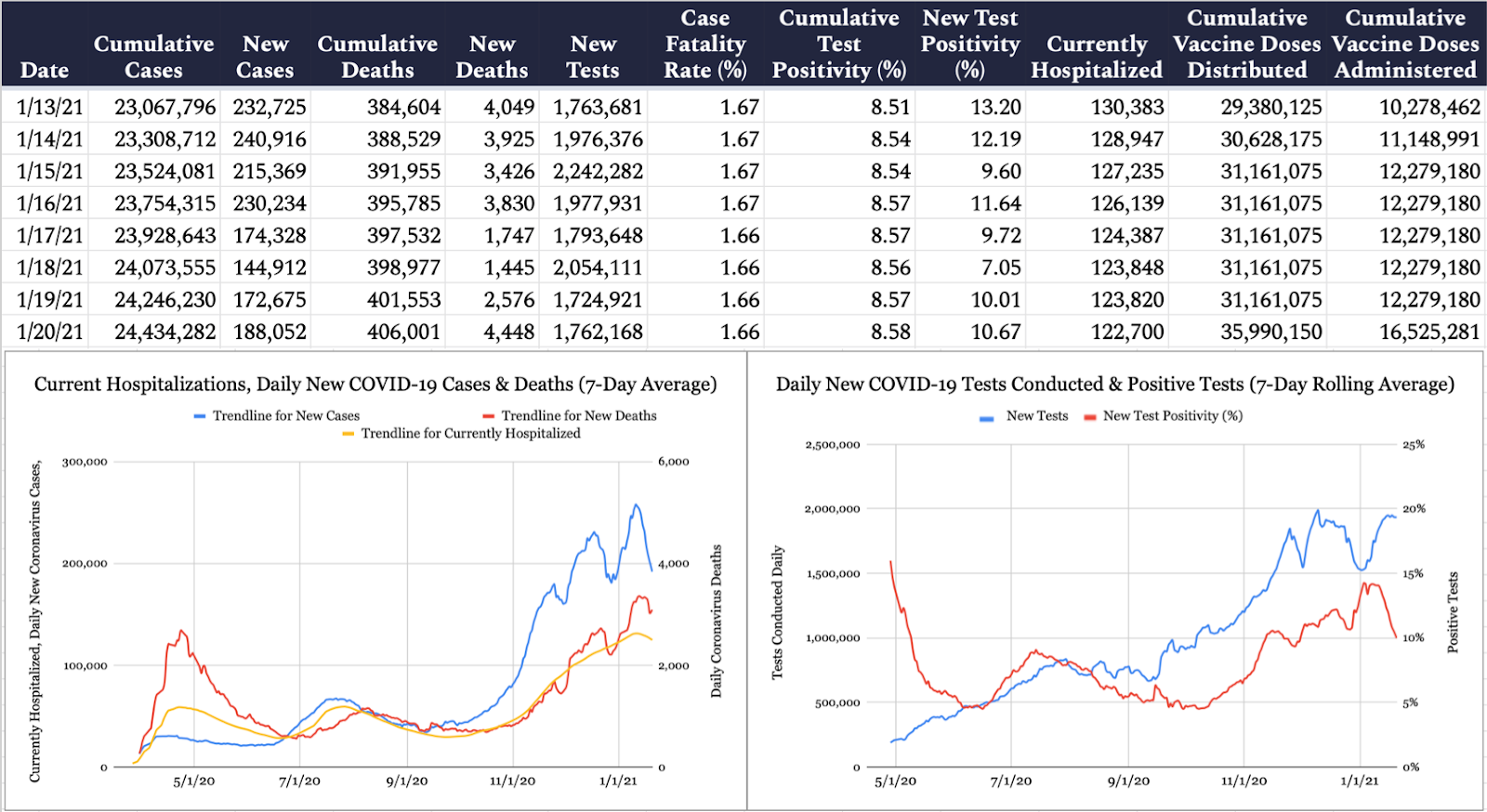
It helps to see exactly where we were on Inauguration Day. The facts are, the virus has passed its apogee and is receding. Vaccine distribution is already on the pace to exceed 100 million doses in his first hundred days. The charts from 1/20 from Johns Hopkins and numbers from the CDC serve as base points.

As you can see, cases, hospitalizations, deaths, and test positivity on Inauguration Day are all heading down. The results were with record-high testing. I think the highs in these areas have passed, and we have seen the worst of the epidemic. It may be the result of mask-wearing and distancing being widespread. Johns Hopkins’ Dr. Marty Makary points to the beginning of herd immunity. Remember, we get this state when a significant percentage of the populace has had the virus, is vaccinated, or some combination of the two. While only 15 million are vaccinated, some have estimated up to a third of us have had the virus. Some people may have T-Cell immunity. The combination makes even this easy spreader’s job harder. The downtrends will only get more pronounced as people are vaccinated.

I predicted by 1/20, 15 million people inoculated. The total doses administered on that day were over one million. As forecasted, this rate meets Biden’s 100 million doses by the end of his first hundred days. With the infrastructure already in place to deliver a million shots a day, our delivery ability will only expand. Every day more inoculation locations are coming online. The only thing that might hold us back from far surpassing this goal is the vaccines’ timely delivery.

People might forget that Operation Warp Speed wasn’t about just the two vaccines we presently have. The Trump administration also invested in others. The AstraZeneca-Oxford vaccine is already vaccinating millions in the U.K. and Europe. Mid-April approval in the U.S.is expected. However, overseas success could speed up the timetable. Because it needs less special handling, it’s easier to distribute.

Continue reading

Il Duce Would Understand

Lucky me, I downloaded Parler to see what it was all about, and it disappeared. It seems they violated the terms of service of the “Big Tech” companies it relied on for its business. Apple, Google, and Amazon claimed Parler allowed violent content on its platform. Without the ability to acquire new users and web services, it was simply out of business.  

On the surface, this seems to be well within private businesses’ right to run their firms as they feel fit. As one with libertarian tendencies, I would generally agree they don’t have to give the free-speech protections of the first amendment to employees or those who do business. Still, it seemed the prohibitions almost always adversely affected those on the right. Similar content on the left never gets the same reaction. The measures inflicted by the Big Tech companies align with the goals of the Democrats. It just doesn’t seem right.  

It turns out all this might not be legal. Vivek Ramaswamy & Jed Rubinfeld, in a recent  Wall Street Journal OP-ED, pointed out, the government can’t induce or conspire with a private entity to do something Constitutionally prohibited from doing itself. I’m not a constitutional lawyer, but reading through the cases they cited, I wouldn’t want to defend big tech in front of a supreme court with six conservatives. Some of those Justices went through various degrees of “cancelling” by the Democrats. They might match Democratic control of the Presidency and both Congress houses with Big Tech’s lopsided actions in their favor. These actions are occurring while leading Democrats are proposing anti-trust measures. This picture looks terrible.

Continue reading

Aftermath

When Donald Trump became President in 2017, I expressed my concern for the Republican Party. On January 30, 2017, in a post, “And then the Republicans,” I questioned whether the Republican leaders in Congress could work with Trump. I asked, “This sets up a clash between Trump and the congressional leaders. Do the conservative leader’s tame Trump, so he obediently signs on to their program, or does he use his followers to bully Congress into submission?” For almost all four years, to my surprise, Trump and the leadership worked relatively well together. The fact the Democrats came down with a severe case of “Trump Derangement Syndrome ruled out any relationship with them. Democratic cries of Russian collusion will lead to impeachment precluded the Democrats and left only the Republicans. The GOP-Trump partnership resulted in a mass of conservative judges, tax reform, a strengthened military, and regulation reduction. The economy did well by a more significant swath of people.

This marriage of convenience was exposed during and after the election. When it looked as if the President would lose, he attacked mail-in voting. He told his supporters to avoid it in favor of in-person voting instead of using the pre-election time to getting their supporters to vote early. This stance hurt Republican early efforts. Even if you plan to vote on election day, something could come up preventing it. This is especially true in this time of COVID-19. In this close election, this proved to be foolish. The President seemed to want an excuse for losing while the party tried to win up and down the ballot. The alliance was fraying.

After he appeared to lose, Trump attacked the outcome. As I’ve written earlier, a close look at an election where widespread first time mail-in voting was done was certainly warranted. We needed to be assured the election results were correct. A wave of recounts and court rulings confirming they were followed. Even Bill Barr, the Attorney General, failed to find fraud that would’ve changed the result. Yet, Trump refused to accept the outcome. Worse, he attacked fellow Republicans. In GOP controlled states of Arizona and, more fatally, Georgia, President viciously attacked the Governor and Secretary of State of his own party. With two crucial Senate seats to decide the Senate’s control on January 5, a total Republican effort was needed to win.

Continue reading

Are We Becoming the USSR?

Artificial Sun" nuclear fusion reactor
Artificial Sun” nuclear fusion reactor

1.5% wind and solar, 2.6% Hydro, and 1.7% nuclear are the amounts of the world’s energy consumption these sources provided in 2019. The other 94% came from fossil fuels. Yet, much of the advanced world is setting limits and goals for certain products and actions for the future. Japan plans to stop the sale of new gasoline-powered cars by 2035. This plan is similar to moves by California and several European nations. By the mid-2030s, if you want a new car, you’ll only be able to buy an electric one.

This program sounds like part of a government 15-year plan. A significant industry will have to revamp its products in a specific time frame or else. Wow, a time-specific government-directed industrial plan. Can we all sing a chorus of “Back in the USSR?” In my series “The Long Journey To More,” I expressed the feeling capitalistic countries would out-perform China or any other totalitarian state. Greater flexibility would fuel a growing efficiency-innovation gap. A totalitarian government would double down on planning until it ended up as a closed society such as North Korea or collapse like the Soviet Union.

This assertion assumed we would avoid top-down planning. The actions we are doing in climate change move us away from a supportive government allowing competing solutions. Ordering us to buy only electric new autos sets up a bias towards existing technologies. The objective is less carbon. Most people agree excess carbon in the atmosphere is contributing to global warming. All things being equal, people choose cleaner carbon-free energy sources. At present, Wind or Solar have it politically over carbon-emitting production. Unfortunately, the wind doesn’t always blow, and the sun doesn’t always shine. Nuclear is reliable but under cost and regulatory constraints. With the new administration, new fossil fuel use will be difficult and discouraged.

Now we are looking forward to millions upon millions of motor vehicles needing a plugin. The additional electricity will have to come from somewhere. Irrational fear raising costs blocks nuclear. Governments are increasingly are limiting or making it difficult to increase fossil fuel use.With realities after 2035, industries have no choice but to make significant capital spending plans utilizing Solar and wind.

Continue reading