It’s An Ill Wind…

Maybe the President will be right, and by the fourth quarter, the economy is humming along. Everyone will be back to work and spending as if nothing ever happened. The 30+ million unemployed were just on an extended paid vacation. That’s one scenario. It’s the one most hope proves to be true. Of course, maybe not so many go back to work. Their old jobs and employers no longer exist. A negative wealth effect rules out discretionary spending. The media highlights continuing deaths among the at-risk. As a result, many are still reluctant to go to a restaurant or get on a plane. It’s hazardous to travel. Children and their parents realize they lost a year of education. They’ll never get it back. Maybe people will be unhappy.

When things aren’t turning out as well as hoped, we ask what went wrong and why? Remember, the Iraq invasion was supported across the political spectrum until it wasn’t. As things went awry, people felt misled. Was it mishandled? They wondered why they wasted so much money and resources? The lives that were lost. There were revisionist answers. Will this be how the Covid-19 epidemic lockdown plays out? Will, the voices of opposition, drowned out during implementation suddenly have a megaphone? Saying “I told you so” is always satisfying to many. If we experience a slow climb out of a steep hole and people realize their pain is the result of a colossal overreaction, they will be looking for someone to blame. Remember, the last two presidents claimed to have opposed the war from the beginning.

As it was in the Iraq War, both our major political parties, with a few individual exceptions, backed the lockdown. Both parties joined in the most massive peacetime spending orgy in history Common cause explains why there is so little criticism from politicians or their media allies. The President makes the unsupported claim he saved millions of lives by his underwriting the lockdown. The only discernible Democratic criticism of his actions is he isn’t maintaining it longer, and he needs to spend more. They agreed on the shut-down and that they would throw money at it.

Continue reading

Was this Trip Necessary?

Sooner or later, the question has to be asked, did we need to shut down most of the country? Did 30 million and counting Americans have to lose their jobs? The supporters of the lockdown uniformly answer, of course, it saved lives. The chorus they sing is you can’t let people die to rescue the economy. Morally we have to put lives over money. But was that the choice? What if we trashed the economy and it turns out that net-net our actions caused more deaths than it saved? What then? I think we are going to find out sooner than later. You might not like the truth.

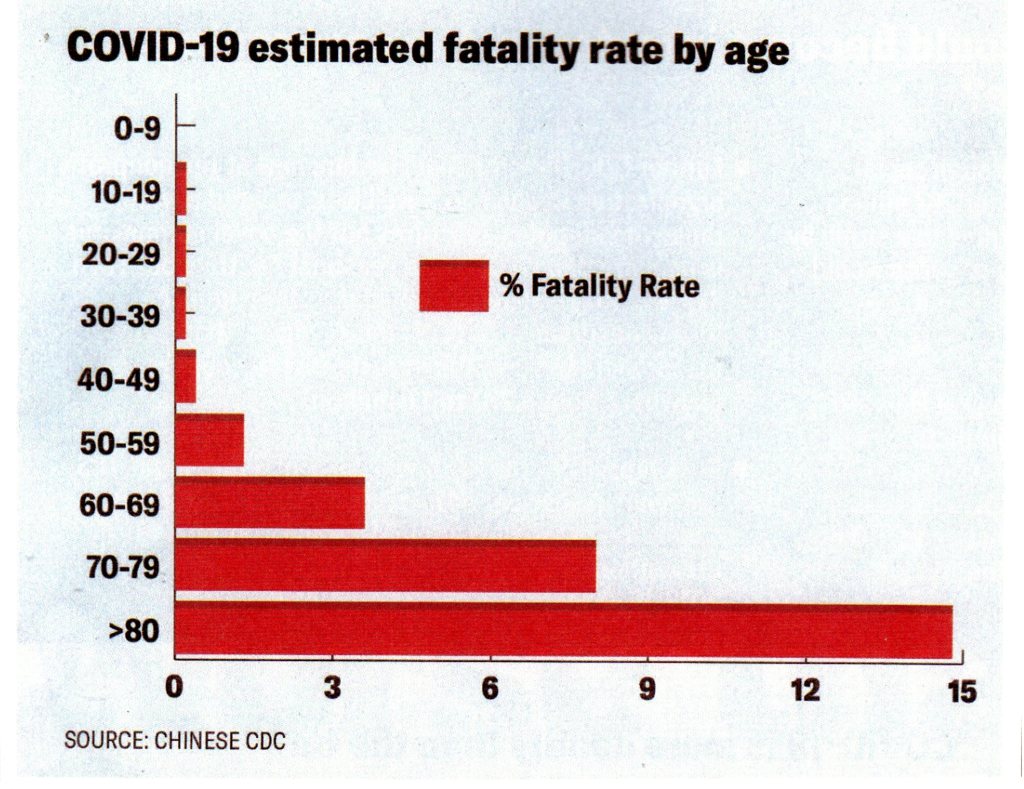
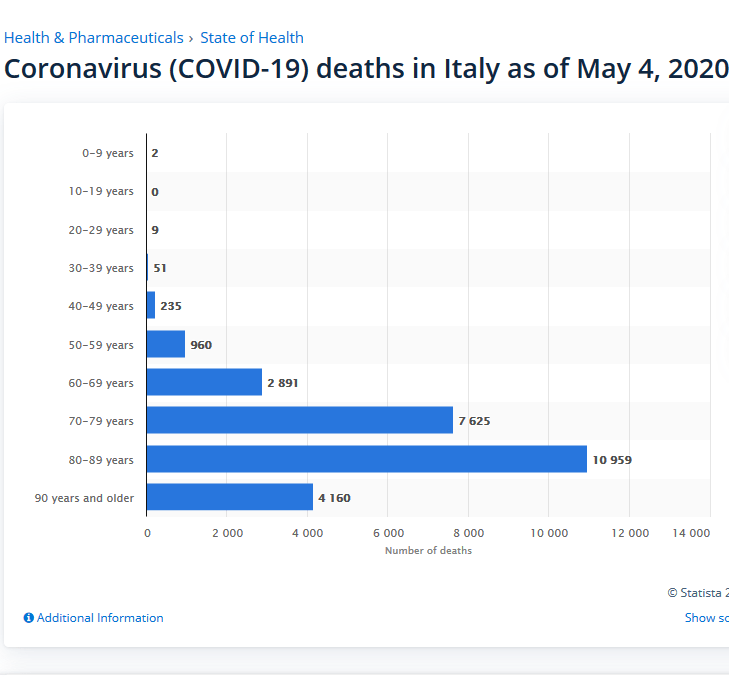
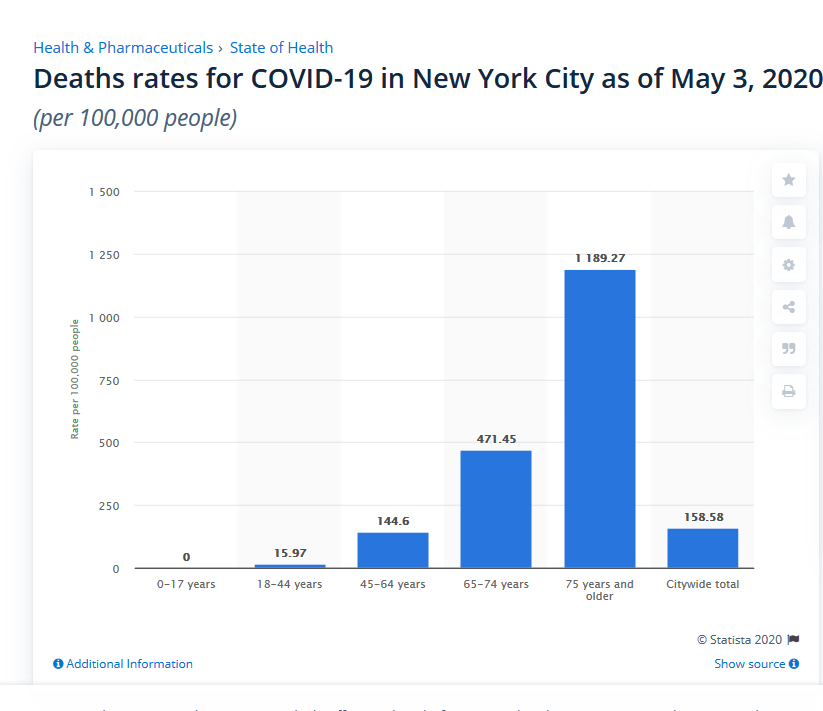
The first thing is the lockdown was never primarily about saving lives. It was just about flattening of the Covid-19 hospital admittance curve. Spreading out the infections would prevent hospitals and our healthcare system from being overwhelmed. The idea was if they have the resources to treat those admitted, the medical community might save them. Doctors in hospitals save lives. How many TV shows make this point? The only problem is Covid-19 was different from the start. Rather than killing both young and old, coronavirus kills primarily the elderly and those with underlying conditions. We have known this since the first data came out of China and the Far East. Statistics out of Italy confirmed this. New York shows the same thing. Three charts illustrate this crucial point:


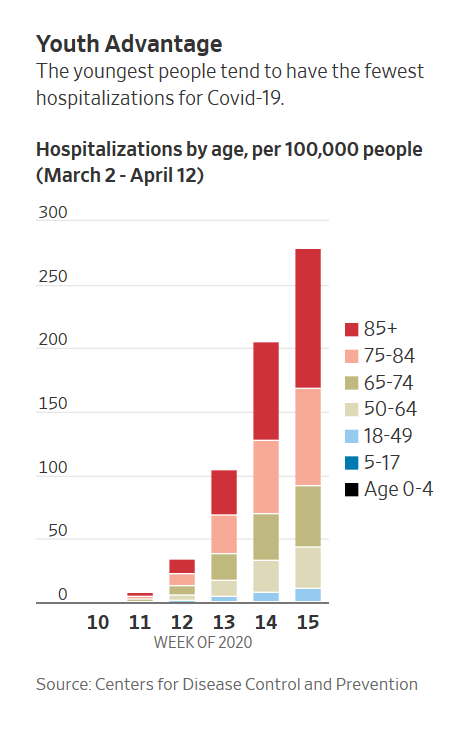
Like a laser, the data pointed out where we had to concentrate our efforts. Additional protection had to be provided for the elderly and compromised. Where are the highest concentrations of the aged? Nursing homes, rehab centers, assisted living, and retirement communities were easy to find. Surely testing, gear, and support had to be rushed to the front lines. This course of action isn’t brain surgery. In any epidemic, these would be at the top of any list of the vulnerable. Plans for this should haw been in place. Others with underlying conditions putting them at high risk needed notification and help. Doctors know who these people are. They write their prescriptions. These groups would be the likely ones to end up in ICU’s in any pandemic. In this case, better than 4 out of five in the ICUs were above 65. If you wanted to keep our medical community from being overwhelmed, you do your best to make sure the elderly don’t get infected in the first place. This chart brings all this home:

How did we and a good part of the world get detoured from a targeted approach? Scenes of Italy’s state-run medical system crushed by sick unattended patients horrified people. Taken by surprise Italy never got ahead of the epidemic. They never had a chance for a targeted approach. At the same time, Neil Ferguson and the Imperial College in the UK announced their model’s findings. If we didn’t take drastic action, Covid-19 would kill 2.2 million in the US and a half million in the UK. If it bleeds, it leads has always ruled the media. Unattended dying patients and the prediction of millions more inspired a media-fueled public panic. Politicians mostly folded. Prime Minister Boris Johnson initially supported a targeted approach in the UK, but promptly did an abrupt about-face. President Trump in the US caved and recommended a full lockdown. Schools and businesses shut down. “Shelter in Place” wasn’t just for those at real risk but for everyone not deemed essential. With millions out of work, governments turned on the printing presses and spent Trillions they didn’t have.

Continue reading

A Word of Explanation

Why an “A Plan to Move Forward-Export Version”? It has to do with the middle of the night realization. The vision of ever more harm done by the continuing lockdown kept me awake. We needed a way out before the injury gains permanence. I had a plan for a proactive approach to determine when most people could go back to their lives. Getting it out to a broader audience isn’t easy for an old blogger. Maybe a major news outlet would help. After going down the list, only The Wall Street Journal (WSJ) showed promise. At least they had entertained the idea we might be running off a cliff. Hence, the more formal “Export Version.”

Alas, the only thing I received from the WSJ was a 4/6/20 email noting they had received the OP-ED. That was it. Rather than tossing this version of the plan, I thought it better to post it here. It just might be more accessible and quicker for people to understand. Since the WSJ submission, others such as Dr. Scott Atlas and Dr. John Ioannidis have made many of the same points. Just not a practical, comprehensive plan for right now. The test of a program is if we had it all over again, would we shut down the world? Would we put 30 million and counting out of work? Wouldn’t a more targeted plan have been vastly better? Remember, on March 20, the day California became the first state to issue a lockdown order; I proposed an alternative route in the “Some Thoughts” post. Ruined lives keep me up at night. Every day the depression gets worse and the road back longer. How can I get the word out? Any Ideas?

A Plan to Move Forward-Export Version

As an octogenarian, I’m well aware of the shortcomings in aiding and securing the at-risk. It’s dismaying how little we do to protect the most vulnerable. However, this realization has led me to ponder how an all-out effort to correct this situation might be a way out of our present untenable position—a proactive three-phase plan to move us from our virtual national lock-down to a reopened nation. We can do this in a time frame we determine by our actions. Action is preferable to watching our economy and lives unravel awaiting a vaccine or an effective therapy.

Phase 1. From the first data we received from Asia, Italy, and our own experience, the findings have been consistent. The vast majority of those requiring intensive care are those with pre-existing conditions and the elderly. Even the lowest figure we’ve seen shows these make up 78 % of ICU admittance. The vast majority of deaths occur in this group. We can refine this even further. Men are three times as likely to die of COVID-19 than women. Italy reports 85% of those dying from COVID-19 are above70. By all indication, the majority of the remaining 15% had underlying conditions. In short, we know who is overwhelming our health services, and it’s not healthy 12 yr olds. It’s the group that cries out to be segregated and protected. 

With the present, almost universal lock-down, one might think the protection of at-risk populations would receive our utmost efforts. The facts say otherwise. We still have coronavirus outbreaks in nursing homes. Seniors stand in dangerous crowds during special grocery store hours only come up empty of essentials. According to the Wall Street Journal, the government is just now issuing guidelines for nursing homes. Nursing homes account for 20% of COVID-19 deaths. We knew the dangers months ago from the Washington States’ Kirkland Life Care Center. I was just listening to a state health official say they need to something about those in assisted living. Of course, they have no masks or anything else available. Ask any of the vulnerable or those who care for them, and you’ll hear a horror story. Every day the at-risk are endangered out of necessity. 

So how do we protect the truly at risk? The government speedily needs to prepare a doctor’s letter and a survey to be conveyed by physicians to every one of their highly at-risk patients. Each dangerous condition has its doctors, and it’s their job to communicate with and help their patients. This letter must be a stern warning that they are in great danger of dying from coronavirus. The message would identify the recipient as at risk. It should contain a supporting barcode. This measure will allow them to get to the head of the line for needed services. If a therapy becomes available, the most endangered would be listed and could receive it as needed. At the same time, the government should duplicate the effort for everyone above 70.

Accompany the letter with a link to a short online survey to identify the person’s circumstances and what they might need for segregation. One would either land in one of three groups. Those needing only priority to get necessities, those requiring some help and those needing significant help or to be moved. This questionnaire would also contain a release so the information could be shared. Email the letter and link to the online survey ASAP—mail backups. Use public service announcements to get the word out as soon and as wide as possible. We can expect robust compliance and cooperation. Imminent death tends to focus minds. A consortium of government agencies and Non-Government Organizations in every area will review the surveys. The NGOs would seem the best bet for quick help. At least a dozen were listed in our local paper as ready and willing to aid the at-risk. They just don’t know where they are. Government agencies could backstop the NGOs while concentrating on clusters of endangered. Nursing homes assisted living, and retirement communities leap to mind. When an area has secured all its at-risks, report it as part of national accounting. We can all see the progress.

While some may only need aid in getting priority in getting delivery or safe pickup of essentials, others will require more extensive help. A support plan put into effect. Move some people under some circumstances. Households with elderly or other people at-risk in some cases will need to be separated. Place elsewhere either the at-risk person or the ones that must go out in the world. Under epidemic circumstances, this isn’t a problem. We have an almost endless number of empty hotels and motels across the nation. The owners would like nothing better than getting some revenue and work for their employees. Quality and location would be the standard for those who have to leave a multi-generational home to do essential work. Use the very best facilities for the at-risk. After all, we’re talking about someone’s loved one. Accommodate caregivers desiring to accompany the vulnerable. Most hotels have kitchen facilities, but where needed, conveniently located restaurants can offer their services. This action sounds expensive but will prove to be a great bargain compared to an endless lock-down. 

Those with fewer means are dying in numbers disproportionately. People of color are prominent in the figures. These are the people likely to operate outside the conventional financial system. A remote operation to receive the delivery or safe pickup of necessities depends on some sort of credit or debit card. The poor are more likely to deal in cash. The high-risk situation is the norm. A large proportion of the at-risk needful receive snap cards (food stamps). Only a few states issue them as prepaid debit cards. Exchanging these for debit cards would allow them to distance themselves from dangerous situations. 

Vitamin D is essential to our immune system, and deficiency is common among people of color. Covid-19 thrives on poor immune function. Most people with underlying conditions get blood tests. The Physicians letter should tell the recipient how much to supplement and how to get this inexpensive vital vitamin.

This plan will require priority for specific resources. Test kits, face masks, and other safety apparel, along with a supporting workforce, will have to be diverted to achieve this great separation. Curbing the supremacy of the medical community may have to happen. They may resist giving up assets. Just giving up some face masks to the at-risk and those serving them may result in howls of danger to health workers. How shortsighted. It would be akin to denying resources to build a dam upriver to use far more fighting a near-endless flood. We must make a cost-benefit analysis to allocate the assets. If people don’t end up in your ICU, you don’t need as many resources. Remember, every one put in the ICU represents a failure to protect. The majority of COVID-19 patients put on a ventilator die. The facts favor the dam.

Continue reading

A Plan To Move Forward II

We thought our plan for moving forward was pretty clear and would be seen as workable. Apparently, we were wrong. We feel the wind generated by east-west and back head movements. The identification and protection of the most vulnerable are seen by some as impossible.
Others contend they’re already hunkered down. Neither of these things is presently valid. As we have pointed out, almost all of the at-risk group is known. The government and/ especially to the medical community know how to contact them. People with preexisting conditions are under medical care. We know this because a doctor has to prescribe their necessary medications. Doctors know how to reach people with diabetes, HIV, cancer, heart disease, and the many other conditions, COVID-19 puts them in grave danger. They can definitely contact their endangered patients. The government sends almost all the elderly social security checks, so they too can surely send them information.

Sheep are highly at risk of being attacked by hungry wolves. Shepherds of old didn’t just tell the sheep of the danger and advise them to lay low. Wolves can be seen as COVID-19 infected. The sheep are vulnerable. The shepherd’s job is to keep wolves and sheep apart. They could hunt the wolves down, but they don’t know where they are, so that takes a lot of work and time. On the other hand, the whereabouts of the sheep are well known so we can gather and protect them. In the best of worlds, we can do both, but which is more easily achieved?

We may think we’re protecting our susceptible, but the facts say otherwise. Over 76% of those needing extreme care are those with preexisting conditions. We can narrow it down even more. According to the Wall Street Journal, “Men are seen as three times more at risk of death in a hospital from COVID-19.” This experience is mirrored in other countries and our experience with other pandemics. We know who is in danger of overloading the system. It’s not healthy 12 yr school kids. Yet, we still have coronavirus outbreaks in nursing homes. Seniors stand in dangerous crowds during special grocery store hours only come up empty of necessities. According to today’s Wall Street Journal, the government is just now issuing guidelines for nursing homes. It just makes sense to build a dam upstream rather than be overwhelmed by the flood.

Continue reading