We always get to see numerous replays of the New Year’s Eve Times Square Ball drop, but this year was different. Instead of the Ball staying grounded, it went right back up, proclaiming the U.S.’s impending 250th birthday, to drop again on July 3. This coming event can’t help but shine a bright light on one of history’s most extraordinary groups-our founding fathers.
Sadly, the people with the loudest megaphones on both the right and the left have chosen to present a distorted view of these remarkable people. The New York Times’ much-debunked 1619 Project portrayed the Founding Fathers as pro-slavery and the Revolution fought to preserve it. While historians and economists pointed out the project’s numerous errors, it lives on in progressive circles along with the nonsensical idea “Slavery is America’s original sin.”
The only thing original about slavery in colonial America was the Quakers, along with their co-religionists in England, calling for the abolition of the eons-old practice. Before Quakers, no religion, not the Catholics, Muslims, Hindus, Buddhists, or any other religion considered slavery a sin. From the Quakers’ shared spaces with other congregationalist Protestants, the idea that slavery is an abomination spread. Slavery was hardly original here, but the abolitionist cause was.
In a world of hereditary caste systems, with people as chattels at the bottom, whether we called them slaves, serfs, coolies, or untouchables, their lives were controlled by those above them. Challenging this system was genuinely original.
It is telling that for all his achievements, Ben Franklin could never sit in the House of Lords. No wonder self-made Americans weren’t keen on the British class system.
It is, therefore, discouraging to see what many consider the beginning of the impending birthday celebration: Ken Burns’ six-part PBS series “The American Revolution” repeats the popular messaging in progressive circles that the founding fathers were pro-slavery.
I’m indebted to Lee Habeeb and Vince Benedetto’s piece in Newsweek, recalling when pro-slavery southerners made the same argument, it was Abraham Lincoln in his 1860 Cooper Union Address in New York City who refuted this slander with facts. Lincoln pointed out that a large majority of the Founding Fathers are on record as opposing slavery in votes on the handling of the Northwest Territory ceded by the British to the United States at the end of the Revolutionary War. The banning of slavery in this vast territory was initially accomplished under the Articles of Confederation and confirmed by the First Congress under the Constitution. Our first president, George Washington, signed the landmark legislation.
No doubt Ken Burns was aware of this address, as he freely quoted Lincoln, but chose to exclude it because it rebutted the prevailing progressive narrative.
The progressive left isnt alone in mischaracterizing the Founding Fathers. How many times have you heard, The U.S. was founded as a Christian nation? You heard it from the late Charlie Kirk. Vice President Vance stated during his closing address at Turning Point USA’s AmericaFest summit in Phoenix, Arizona, on December 21, 2025. “We have been, and by the grace of God we always will be, a Christian nation.” House Speaker Mike Johnson has explicitly proclaimed that America is and was founded as a Christian nation.
Even though a majority of Republicans think along these lines, it isn’t true. Many of the founding fathers were deists or leaned that way. They believed in a supreme being, but one that had created a rules-based universe and left it to run on its own. To know God is to understand these rules. Washington, Jefferson, Madison, Franklin, Hamilton, and Thomas Paine were among those known to hold this view.
This attitude isn’t surprising, given that they were well aware of Sir Isaac Newton’s findings. His laws explained both earthly and celestial movements, unifying physics. Humanity needs to find how God’s Universe works, rather than rely on dogma and the expectation of divine intervention. You don’t interact with God directly.
Contrast this belief among many Christians that God is constantly in their lives. Erika Kirk talks of her conversations with God. Many of the founding fathers would find this quaint.
The founders were also aware of the previous century’s horrible religious wars, where Christians slaughtered each other over dogma. Many of the colonists came to the colonies to avoid religious persecution.
For all these reasons, the First Amendment rules out any state religion. Protecting individual beliefs while prohibiting anyone or the government from forcing any belief on others, and reading the Constitution as anything but a secular document, conflicts with what we know of the Founding Fathers.
Rather than looking back at our founding through a 21st-century prism to conform to a present-day narrative, we’d have a better understanding of the upheaval against a pattern of human civilization that has existed since people first settled down around 10,000 years ago, planting crops and building cities.
Mostly hereditary caste systems ruled civilized societies worldwide. Those at the educated top, 10% at most, made the decisions that primarily benefited them. Patricians, Brahman, or Mandarans, called the shots. Almost everyone else lives at a subsistence level.
Merchants and artisans were exceptions but generally had no political power, and whatever wealth they had was at the mercy of the upper class. Their only option was to move to places that appreciated them—hence, ever-changing trade routes and rising and falling cities.
While British common law and the Magna Carta established property rights and personal protections, the Founders did it better by laying these out in black and white in our Constitution and the Bill of Rights. These ingredients allowed free-market capitalism to bloom, to our great benefit.
The Chinese economist, Weign Zhang, observed in his book “The Logic of Markets,” “The goods an average Briton could consume in 1800 were the same goods an Ancient Roman could enjoy, and the Ancient Roman consumed more of those goods.” Material progress moved at a glacial pace, if at all.
The Authors of a book I’ve heartily recommended, “Super Abundance,” by Marion L. Tupy and Gale L. Pooly, observed that 8 to 9 people out of 10 in 1800 lived in poverty. Today, less than one in ten, even though the world’s population has gone up eight times. The U.S. has been at the forefront of this incredible human advancement:
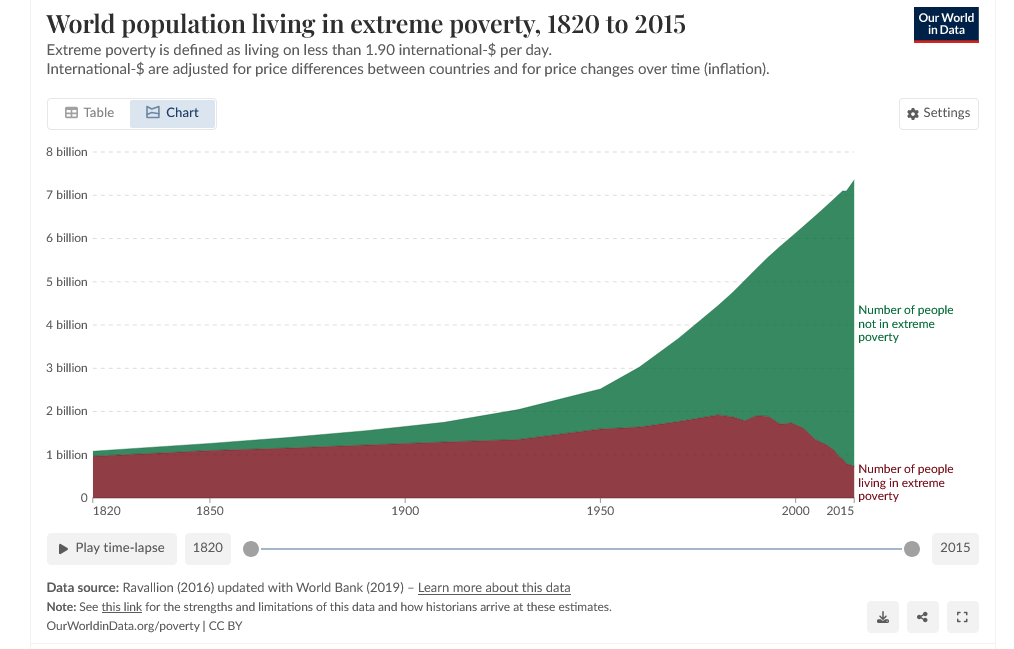
The colonies mirrored the shift to free-market capitalism stirring in Britain that ushered in the Industrial Revolution. Adam Smith published “The Wealth of nationsof Nations the same year as our Declaration of Independence. The founders were well aware of the Scottish Enlightenment.
Without a clear picture of the world at the time of our founding, it’s impossible to conceive of the extent of the changes our founding brought to the world’s power structure. The Declaration of Independence and the Constitution weren’t just an improvement in human organization; they were an earthquake that changed everything.
With colonists already coming from countries such as the Netherlands, Germany, Sweden, Poland, and the British Isles, as well as Africa, we were the first nation based on common principles rather than a common religion or culture. The melting pot was there from the beginning.
I’d add the seed planted by “The Germantown Friends’ First Protest against slavery, 1688” to our great documents. In the century following our founding, the world witnessed the abolition of the thousands-of-years-old practice of treating the lowest castes in society as chattel in a majority of the world.
It isn’t that Burn’s didn’t touch on these things, but a matter of context. Without showing the world as it actually was at the time, his work failed to show the dimensions of the upheaval the Revolution wrought. This lack diminishes what our founding fathers achieved.
Historians, archaeologists, and economists can use this time to fill in the gaps, and the media can then tell the real story. The founders weren’t pro-slavery or Christian zealots. They were people of foresight and understanding who put their lives on the line to open the door to a much better world. On our 250th birthday, we need to know these people and what they actually stood for.
 Detour on the Road