As I alluded to in my last post, I was optimistic a year ago. Wrong on a lot, but I had some idea of how things might go. Right now, I have to admit, I’m clueless. The Ukraine War still rages. We’re bombing boats on the high seas and suspected terrorist sites in Nigeria. Not exactly peace on earth.
Inflation is still uncomfortably high. The national debt gets scarier by the minute. Employment is dicey, and manufacturing jobs are falling. Consumer sentiment is weak:
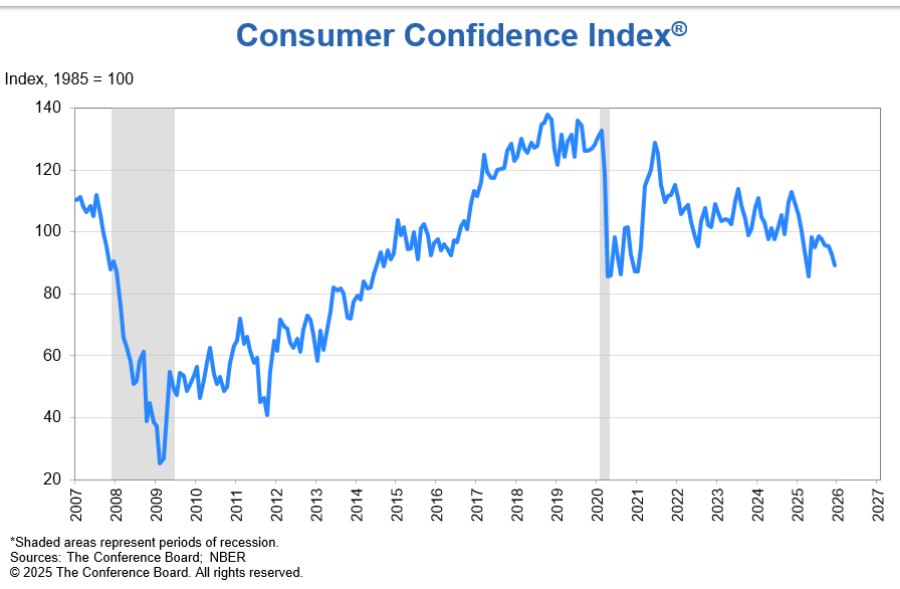
Yet the stock market keeps hitting new highs, and the economy is growing. What gives? Darned if I know, given today’s crosscurrents. I’ll share the clues I’m looking for that clarify the situation.
The first, expected early in 2026, is the Supreme Court’s ruling on the executive branch’s tariff powers. So many of Trump’s second-term actions depend on his ability to slap tariffs on anyone at will; any limits will change the face of his administration. Without knowing what restrictions the court will put on the executive, it’s hard to plan.
If the court narrowly decides that the law underlying the tariffs fails to cover them, but no further, the administration can invoke another law and reimpose the tariffs. Those who are negatively affected will sue again, and we’re back to square one, confused. Previously, I complained that the court was taking way too much time to decide a fundamental constitutional question: Does the first article of the Constitution mean what it clearly states, only Congress has the power to levy tariffs?
However, if the court defines what constitutes a real emergency and, in the event of an actual crisis, how long the tariffs can remain in effect without an act of Congress, we can have the clarity needed to plan and make capital investments confidently.
The expectation of the latter outcome may underpin some of the stock market optimism. If the bulk of the tariffs go bye-bye, better supply lines could lower price pressures. Increased supply could blunt the inflationary effect of the large tax refunds the Trump administration promises. The market may be factoring in a significant Trump loss in court. After all, nothing that’s happened in any court looked favorable to the executive branch. With stability, businesses can invest in expanding supply, a sure way to reduce prices.
Conversely, a muddied decision would leave the situation without a clear path forward. Many tariffs would still be in effect, and threats of more leave the confusion in place as we again wait for the court to act.
If Trump refuses to accept the court ruling, a constitutional crisis would follow. Given the president’s past actions, people here and abroad have to consider the possibility.
Given the wide range of outcomes from the impending high court decision, it’s no wonder the stock market and precious metals are making new highs. Both acting in tandem isn’t normal; there are two scenarios: the tariffs go away, leaving the supply side to stabilize prices, while ushering in growth in the era of AI.
Alternatively, once everyone knows they’ll get no relief from the court, nations might retaliate, feeling they politically have no choice. A Smoot-Hawley-type trade war ensues, inflicting pain on everyone. Adding a constitutional crisis and the dollar’s central role would be in danger. No wonder central banks have added more gold to their reserves. Trust in the dollar could evaporate.
If the tariff decision wasn’t a big enough question mark, Trump has been wielding a sword across the world. An armada lies off Venezuela to what purpose? Trump won’t tellus. We’re bombing alleged terrorists in Nigeria. He’s sending an envoy to Greenland because our national security depends on that island. In each case, we’re not sure what’s going on, but we’ve seen enough consequences of past interventions that they engender unease.
If I can’t give you predictions, at least you have some benchmarks to guide your actions. The makeup of the Supreme Court’s decision on tariffs could provide us with clarity. A deviation from the Stock Market and gold’s joint rise will provide a clue as to whether optimism or fear should rule.
One thing I’ve been looking at lately is the Dow Jones transportation index. It lagged the industrial average most of the year, but is now moving up smartly. Charles Dow, a founder of the Wall Street Journal, developed his market trend theory based on the averages of leading industrials and Transports that moved in step with each other. Both making new highs, bullish, and making new lows, bearish:

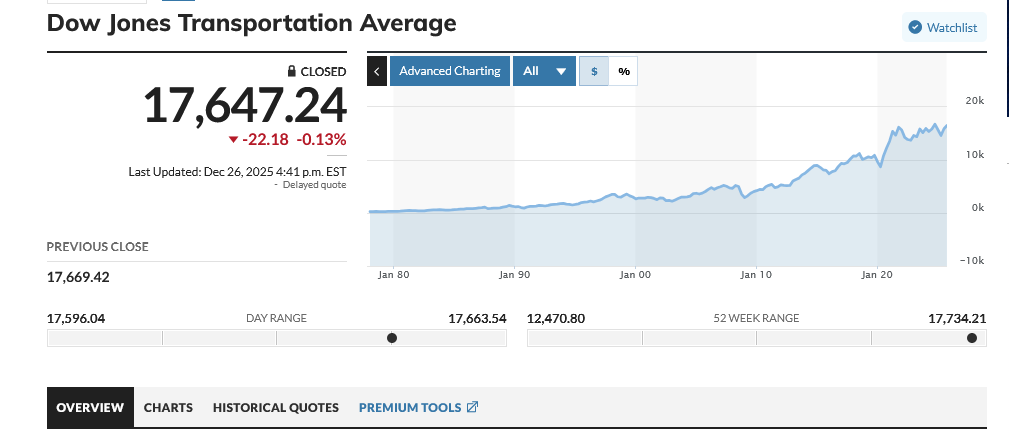
This Theory makes sense. You can’t have an expanding movement of goods and people without general business expansion, and it’s impossible to have widespread business activity without goods and people moving more. The Theory’s signals are sometimes too late for many people, but they may be helpful in this murky situation. Afterall, industrials, transports, and precious metals are unlikely to move together forever.
With the present widening of our economy, possibly signaling that AI is not only sparking growth through massive data centers and energy expansion but also delivering a real boost in productivity, another blast of capitalist innovation is lifting us higher. Once we get the court’s tariff decision, what falls will tell us how the world interprets it.
Ever the optimist, I’m hoping for a positive outcome in the New Year. Let’s get the Court Tariff decision already.
 Detour on the Road