Progressives have the word ‘affordability’ and are going to run with it. Two prominent areas where costs are particularly burdensome for the public are housing and healthcare. Ranting about high prices only gets you so far. At some point, you have to come up with solutions.
Who better to look to for progressive answers than Ezra Klein, the New York Times columnist, turned the left’s Abundance guru due to his co-authored book “Abundance.” For the latest from the left on healthcare, who better than the principal author of the Affordable Care Act, Ezekiel J. Emanuel?
In his book, Klein unearthed the reason for our inability to build anything. We don’t make enough houses because of government restrictions and red tape. Heavens, what else will he find directly under his nose? He provides us with this illuminating chart in a recent article to state the obvious:
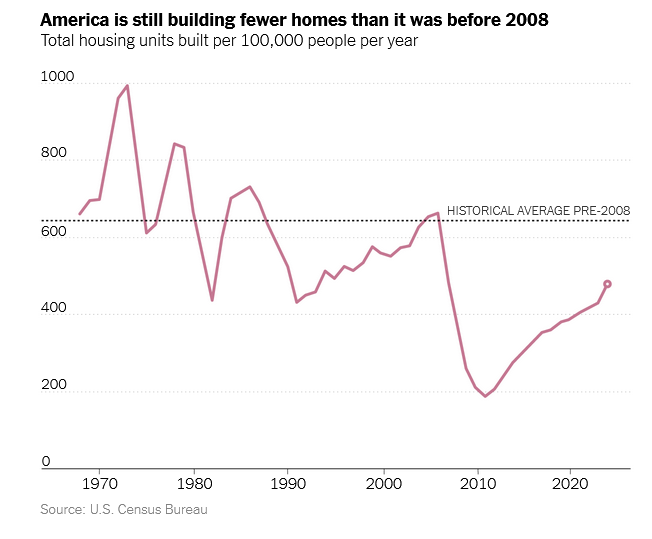
Klein offers insights into progressive solutions. The Center for American Progress and the Searchlight Institute would give some rent subsidies, but, like all subsidies, this would only add to demand, not increase supply, unless you could address the red tape and restrictions.
Many of the restrictions are aimed at preventing the construction of multi-family units in established single-family housing communities. Klein admits this could lower values, so there is no incentive for owners to increase density. People rarely vote against their economic interests.
This situation leaves Klein with one solution that I’ve expounded on in this blog: modular housing. Do the major work in factories rather than on-site. He, again, cites the Center for American Progress. “It wants the federal government to seed a major research program to fund innovation in housing construction.” Backdoor subsidies through military and other government purchases would maintain market continuity and the demand needed to bring in manufacturers.
Klein puts it this way, “One problem the modular housing industry has faced is the absence of steady demand to keep the factories running and work out the kinks of construction.” But then he refers to Sweden, where “more than 40 percent of new homes — and more than 80 percent of single-family homes — are fabricated off-site.” How can a small nation maintain a vibrant modular home industry when we have a market 32 times greater, and we can’t?
The answer is that, instead of getting in the way or offering expensive subsidies, the government should perform simple government functions. Setting standards for modules and their connections extends the principle of weight and measure. Uniform standards for strength and insulation across areas could reduce on-site and planning input to a single final inspection.
Imagine a prospective homeowner who has purchased a lot. The consumer goes to an online provider and puts in the location and description. Enter the desired features, such as style, number of stories, number of bedrooms, number of bathrooms, kitchen, etc. AI returns cost, options, and completion times. Once a final plan is reached, it is forwarded to a lender, if needed, for approval. Money passing and setting an assembly date completes the process.
Because it is so flexible, using this system will lower costs for commercial and large-scale development, as well as for individuals. Module manufacturers across the country will happily integrate their catalogs to serve the widest market, like Amazon or Walmart, for building.
President Trump has proposed using public lands for housing. While public land locations aren’t well distributed nationally, out west, proximity to urban areas is more common. The government could provide large tracts for sale or lease, where, using pre-approved modules, no permits would be needed. A planned community, such as Fountain Hills or Anthem in my home state of Arizona, could accelerate the adoption of modular construction by putting pressure on housing prices in nearby urban areas.
By showing that building great houses without extensive permitting benefits local communities, local communities will see the benefit of doing away with them in favor of modular construction, leading to a nationwide construction trend.
Given the wide variety of possible choices, the developments won’t look anything like the uniform tick-tacky boxes of past developments. By adopting these actions, the government could foster substantially lower building costs without the significant outlays outlined by Ezra Klein and the progressives. Setting standards may cost millions, not billions, and land sales bring in money.
Ezekiel J. Emanuel gives us his five healthcare fixes, starting with capping hospital costs. Why are price controls always part of progressive dogma? They only make matters worse. If Emanuel could give me one example where price controls work, I might give this idea some credence.
The rest of his suggestions are just rearranging the deck chairs on the Titanic. Nowhere does he allow for real market-based solutions. For instance, he identifies administrative costs as a significant ($260 billion annually) issue and proposes only minor changes to the system. Compare this with Dave’s Plan (Available on this site), which eliminates third-party pay and its administrative costs on most medical transactions.
By making the individual medical consumer responsible and able to pay for most medical services directly, providers have no choice but to publish their prices. Because they have to compete, they have every incentive to innovate to lower their prices or go out of business. We perform Cosmetic surgery under this direct-pay system, and the costs have increased at a much lower rate than those under the current third-party pay system.
President Trump broached this idea when he said it would be better to give the Affordable Care Act (ACA) cash directly to individuals. Some Republicans took this to mean funding Health Savings Accounts (HSAs) or similar accounts rather than the ACA. HSAs combine savings and catastrophic insurance in one plan. Trump had previously proposed “Trump Accounts,” seeding newborns’ savings accounts with $1,000 each, adding to the unwieldy number of tax-sheltered savings accounts.
While these are steps in the right direction, Dave’s Plan combines universal health care with universal savings accounts into a single portable account. By virtually eliminating default risk, it allows providers to concentrate on care while lowering costs. Proposed in 2014-15, the plan preceded Trump’s first term. While running in 2016 on repealing the ACA, he never presented an alternative.
While Trump slowly inches toward viable plans, Klein and Emanuel seem allergic to anything resembling free-market solutions. They cling to government-dominated, top-down regulatory, price control, subsidy approaches, even though they never deliver results even close to free-market outcomes. Until they abandon their anti-capitalist ideology and go with what actually works, high costs will remain, while still not providing universal care or affordable housing. Progressive dogma prevents them from moving to practical solutions. If Sweden can produce high-quality, low-cost modular homes, and Singapore can provide high-quality, low-cost healthcare, why can’t we do the same, or better?
 Detour on the Road