Progressives have the word ‘affordability’ and are going to run with it. Two prominent areas where costs are particularly burdensome for the public are housing and healthcare. Ranting about high prices only gets you so far. At some point, you have to come up with solutions.
Who better to look to for progressive answers than Ezra Klein, the New York Times columnist, turned the left’s Abundance guru due to his co-authored book “Abundance.” For the latest from the left on healthcare, who better than the principal author of the Affordable Care Act, Ezekiel J. Emanuel?
In his book, Klein unearthed the reason for our inability to build anything. We don’t make enough houses because of government restrictions and red tape. Heavens, what else will he find directly under his nose? He provides us with this illuminating chart in a recent article to state the obvious:
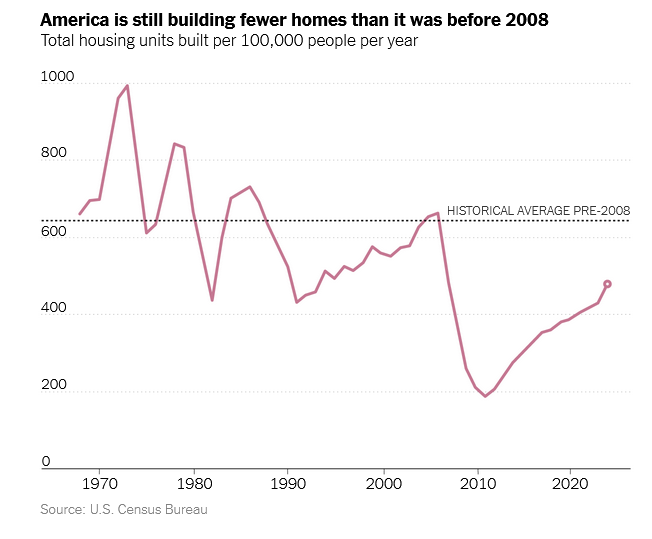
Klein offers insights into progressive solutions. The Center for American Progress and the Searchlight Institute would give some rent subsidies, but, like all subsidies, this would only add to demand, not increase supply, unless you could address the red tape and restrictions.
Many of the restrictions are aimed at preventing the construction of multi-family units in established single-family housing communities. Klein admits this could lower values, so there is no incentive for owners to increase density. People rarely vote against their economic interests.
This situation leaves Klein with one solution that I’ve expounded on in this blog: modular housing. Do the major work in factories rather than on-site. He, again, cites the Center for American Progress. “It wants the federal government to seed a major research program to fund innovation in housing construction.” Backdoor subsidies through military and other government purchases would maintain market continuity and the demand needed to bring in manufacturers.
Klein puts it this way, “One problem the modular housing industry has faced is the absence of steady demand to keep the factories running and work out the kinks of construction.” But then he refers to Sweden, where “more than 40 percent of new homes — and more than 80 percent of single-family homes — are fabricated off-site.” How can a small nation maintain a vibrant modular home industry when we have a market 32 times greater, and we can’t?
Continue reading Detour on the Road