The government shutdown is brought on by Senate Democrats refusing to sign on to a clean continuing resolution because of exploding Obamacare premiums. Without an extension of the COVID-19 era coverage expansion subsidies, many people will see their premiums more than double. The heartless Republicans will consign people to lose their healthcare. Of course, some of those losing their subsidy make 600%0f of the poverty level, but everyone is entitled to healthcare, right?
None of this mess should come as a surprise. When the original Obamacare bill squeaked through, President Obama and the Democrats told us this was a way to get close to universal medical care at a reasonable cost.
Obamacare, at the forefront of the shutdown, brought back the memory of why I started this blog. At the time, I, along with a slew of others, disputed these claims. We said the projected costs would prove much higher and would leave many people uncovered. Of course, we’re correct:

Even with the COVID-19 expansion, 27.2 million Americans, or 8.7%, remained uninsured in 2024. Coupling with this failure are rapidly rising costs. Contributing to these costs is widespread fraud.
After the Affordable Care Act (ACA, Obamacare) narrowly passed and went into effect, I happened to inveigh against it at a family dinner, pointing out its numerous flaws and how to improve healthcare. My stepdaughter challenged me to come up with a better plan. In other words, put up or shut up, though she said more nicely.
This reasonable dare prodded me to start this blog to air my public policy ideas, beginning with healthcare. Dave’s Healthcare Plan went online in 2014. Anyone can read it here.
The difference between my Plan and others, including the ACA, is that it integrates health insurance with savings and portability. This view of a person’s financial picture is standard for a financial advisor assessing a person’s economic needs. Without health insurance, you could wipe out your savings overnight. Your savings could make healthcare more affordable.
Instead of receiving benefits from your employer or the government, you have a personal Benefit Account (PBA), and you have portable benefits you control. No longer losing your health insurance if you change or lose your job. No 401K to transfer somewhere.
The Plan relies on established insurance and investing principles to enable lower-cost solutions. You don’t lose your auto or homeowners insurance just because of an employment change. They’re yours.
Eliminating the bulk of third-party pay and credit risk allows providers to offer lower prices. How is it that cosmetic procedures have fallen in real terms, while insured procedures, private or government, have increased 136% over the last twenty years? The market governs cosmetic procedures, but circumvention of the market is the rule for insured procedures.
One might think the Republicans would entertain alternatives to the ACA, but in all the years since Obamacare’s passage, the GOP has failed to offer an alternative. Many of us remember John McCain casting his decisive vote on the ACA repeal in the Senate during Trump’s first term. While his animus towards Donald Trump might’ve played a part in his thumbs-down no vote, he gave the lack of a replacement as his reason.
So here we are, with the most expensive healthcare in the world, double the average cost of other wealthy nations. Yet, we rank near the bottom in performance. Instead of overhauling the system, we contribute ever more money to failure:
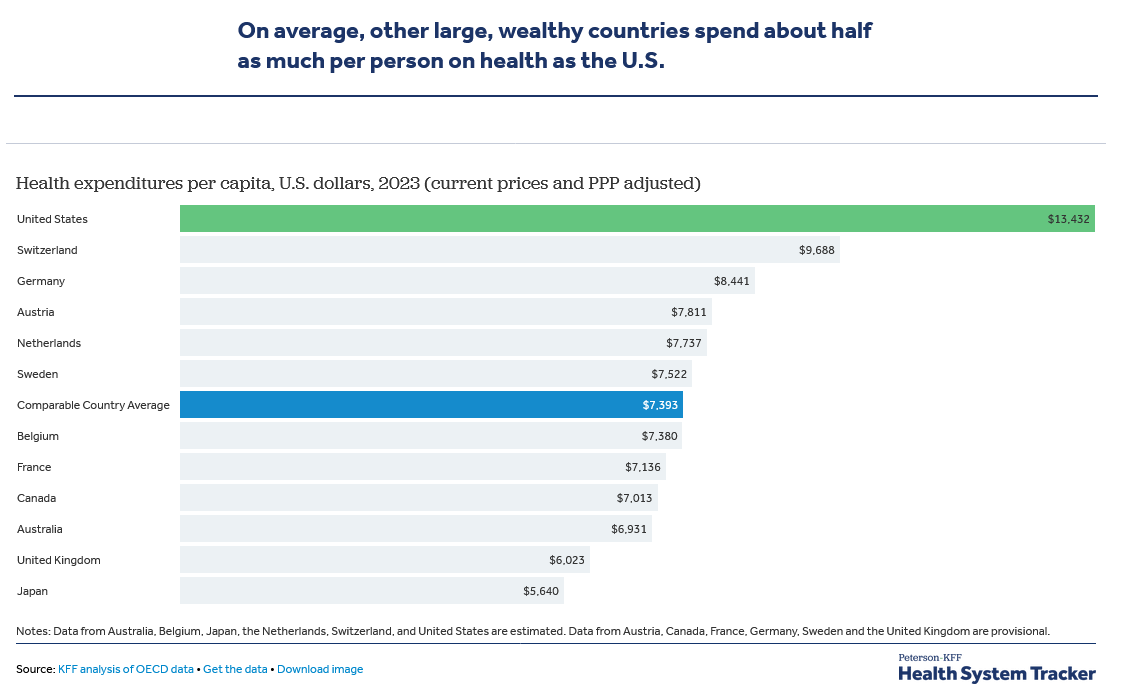
What explains this inertia? In my case, economists didn’t understand how insurance actually works, and health experts didn’t get the connection with savings and credit. All I heard was that the Plan is too complicated, sort of like the tale of the blind men and the elephant. In any case, it would be too difficult to implement.
This reaction seems strange, as Singapore’s similarly top-rated healthcare system has been in place for many years at a fraction of our costs. While Dave’s Plan improves on Singapore’s Plan, both share basic concepts.
So why don’t Republicans offer up something akin to either Plan? I’ve heard healthcare is cheaper in Singapore because it’s a poor country. It’ll probably surprise our politicians that Singaporeans have a higher GDP per Capita than we do.
If there are better ideas out there that show promise of providing universal care at a reasonable cost, why aren’t we discussing them? Ronald Reagan gave us this classic insight: “governments’ programs, once launched, never disappear.”
Once implemented, a program gathers constituents who benefit from it. Even if they opposed it at first, companies and individuals adapt and find ways to profit from the new program. Even oil companies lobby to extend green fuel programs in which they now participate.
For decades, people have pointed out the numerous failures of the Jones Act. It was supposed to maintain a healthy U.S. merchant marine, but under the act, our merchant marine fleet has almost disappeared, while prices for shipments between U.S. ports have gone up. It’s why it’s cheaper for the East Coast to import foreign natural gas than to import it from Texas. Yet, the 1920 Act, with solid stakeholder support, is still with us.
Once somebody gets free or cheap stuff, or rent seekers bank easy money, they become stakeholders willing to fight hard to keep their golden goose.
This scenario explains why, even in the face of default, our big programs roll merrily along towards the rocks. It takes courage and hard work to explain the problem and possible reforms. It also needs a big megaphone. Presidents such as Jimmy Carter and Ronald Reagan were able to put in place significant reforms because they had the fortitude and character to try.
Donald Trump’s pledge not to touch Social Security and Medicare, and never presenting an Obamacare alternative, tells all we need to know about where he stands. However, the reality is that the rocks are in sight. We’re running out of time to make reforms.
Given the current government shutdown, a good place to start is giving reforms like Dave’s Healthcare Plan a good look.
 Detour on the Road