Immigration is a continuing flash point in America, but we rarely look at the facts and data. Emotions have led to deadlock on one of our most important policy questions. Let’s start with what we know:
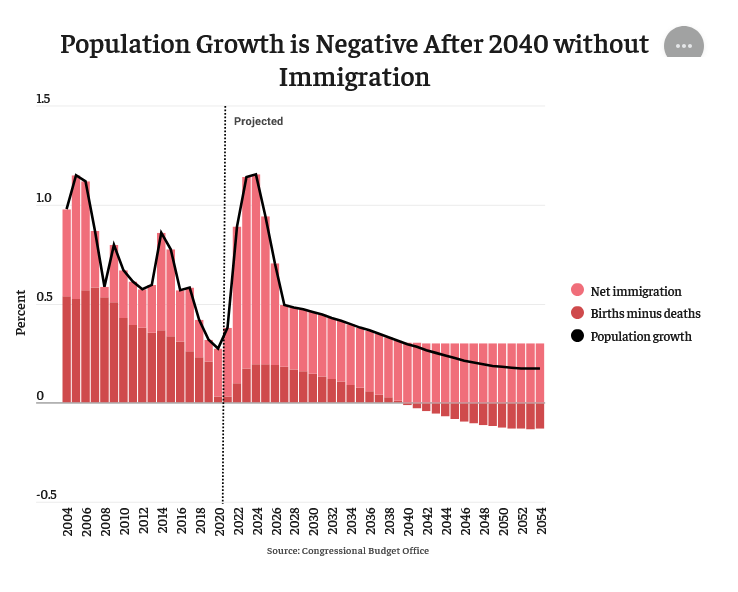
The more we deport migrants, the sooner we will experience negative population growth. A glance at our social programs reveals the disastrous consequences of this path. Social Security will have to cut benefits by 2033 as things presently stand. With even fewer people supporting our retirees, the system collapses. We’ll need more people to fill jobs in an expanding economy.
Once we understand that our future depends on a growing population, the only question is how to achieve it. More births would be beneficial, but no one has yet found a way to increase births in advanced economies. That leaves immigration. However, this conclusion doesn’t mean throwing the borders open and taking in all comers. Done correctly, immigration can be a win-win proposition.
There are approximately 400,000 to 500,000 unfilled manufacturing jobs in the U.S. as of mid-2025. More than 1 million skilled trades jobs are unfilled, a figure expected to continue growing. The cybersecurity sector is projected to have 3.5 million unfilled positions in 2025. The nursing profession faces significant projected shortages, with approximately 1 million openings predicted for the decade of 2022-2032. These figures inform us that we need more skilled workers.
Instead of the confusing and ineffective visa programs for skilled workers we have presently, I propose that anyone with skills worldwide can register for clearance. Once approved, authorized individuals can receive a visa at any time in the future.
People with skills are the best judges of whether leaving home for a future in a distant country is a good idea. In this internet age, locating job openings and applying for them is available worldwide. Channels of communication are in place to connect skilled individuals with U.S. job openings—friends, family, associates, and trade publications quickly alert possible applicants. If there isn’t a place for them, they are unlikely to come.
The result is that almost all those who receive a visa are employed, contributing to the U.S. from day one. Remember, they’re taking unfilled jobs, not those of the presently employed. They will contribute to the U.S. from the very beginning.
The Manhattan Institute estimates that, “Given the education, age, and earnings of H-1B visa recipients, doubling the number of H-1B visas for just one year would reduce the budget deficit by $70 billion over the long run—and by another $70 billion each year thereafter.” Adding their state and local contributions, as well as other economic benefits, each additional skilled immigrant will be a positive by tens of thousands of dollars.
Skilled workers are more likely to speak English already, be law-abiding, and be committed to adapting to their new country. They’re less likely to cause cultural problems.
In the last fiscal year, we admitted 2 million legal immigrants, down from 2.6 million in 2022. At around 2.5 million legal immigrants per year, we maintain positive population growth well above the break-even point of 1 to 1.5 million. There were an estimated additional 1.4 million undocumented migrants. Skilled individuals admitted under various visa programs account for only around 250,000. The rest, documented and undocumented, are likely to be unskilled.
It’s argued that the undocumented migrants consume more in government services than they contribute in taxes, leaving the U.S. in the hole. To be sure, there are those claiming the opposite. The best estimate of the net cost of illegal immigrants I’ve found is from Steven A. Camarota of the Center for Immigration Studies. He estimated, ” that the lifetime fiscal drain (taxes paid minus costs) for each illegal immigrant is about $68,000.” To be sure, there are caveats, but it shows that there is a marginal net cost associated with the unskilled.
Assuming this estimate is a ballpark figure, over a 75-year horizon, the annual individual cost is less than $1,000. The National Academies of Sciences estimates that over the same 75-year horizon, skilled workers each make a net contribution of $237,000. Simply put, one skilled immigrant can support a lot of unskilled individuals without burdening the U.S.
Once we have the actual number of skilled first-year self-limiting visas, we will have a better understanding of the fiscal effects of varying levels of total immigration. Simply put, the larger the number of skilled migrants, the greater the number of less skilled we can admit and still have a net gain.
Under this policy, rather than being a fiscal drain, the problems of taking in large numbers of immigrants are more likely to be the destabilization of specific areas, the overwhelming of culture, and the overburdening of services.
Currently, we are witnessing a drastic decline in illegal immigration. U.S. Customs and Border Protection (CBP) data indicate that migrant encounters at the U.S.-Mexico border have decreased by more than 90% compared to the same period in 2024. Assuming this trend continues, we can gain a better understanding of what unskilled labor is entering and where it’s going, and mitigate any disproportionate local effects.
Allowing the market to determine the number of skilled visas aligns with attracting more business to the U.S. Here in Phoenix, we are well aware of Taiwan’s TSMC struggles in finding qualified hires. The Georgia kerrfufile at a plant South Korean companies were building. Even though they were needed, at least 300 Koreans were forced to return home by ICE.
If we want foreign entities to open operations here, they’ll need people presently unavailable here. With the existing shortages in many skills, we need more right now. Worldwide open hiring can lessen or even eliminate the problem.
We still need people to do more menial jobs. Just ask the farmers or nursing home administrators. With the contributions of the expanded number of skilled workers, we can set the total cap on immigrants high enough to meet their needs, as well as those of refugees, and still be ahead.
If all of this isn’t enough to convince you of the success of this policy, migrants have a higher birth rate, which helps ensure that our population is adequate to meet our needs into the future.
Of course, if we ship out millions of people who originally came here illegally, but are good neighbors, it can offset much of this policy’s gains.
Here in the Southwest, it’s almost impossible not to interact with someone who may be undocumented. Generally, they’re friendly people with clean records who enhance our lives. It just makes economic sense to fine them, but let them stay in place. We have already incurred the costs of educating our dreamers; now let’s reap the benefits. By all means, get rid of the bad people, but don’t throw the baby out with the bathwater.
By allowing the market to determine our immigration needs, we can have a sensible policy to keep our economy humming. In the modern world, a growing population leads to superabundance.
 Detour on the Road