Seven Years ago, I started the series on the “Future Party.” The two-party system had increasingly become captive to its most extreme elements, and the situation becomes more divisive daily. During this time, we’ve experienced a mishandled pandemic, the most significant inflation in four decades, conflicts threatening a new Cold War, if not a hot one, and an upheaval in the world’s trading system.
Both parties contributed to these situations while ignoring the sword of Damocles hanging over the nation, our out-of-control debt problem. At the same time, we’re dividing in ways we haven’t seen before. We receive information from different sources, resulting in an inability to discuss the day’s issues. Each side presents its own “facts.” Where people on the left or the right enjoyed Johnny Carson or Jay Leno, those watching Stephen Colbert would never watch Gutfeld!, and visa versa.
The division has even spread to those we choose to associate with. Some won’t even consider dating anyone with different views. Whatever happened to understanding the other person’s position sufficiently to come to a compromise?
What has caused the widening gulf between Americans? One answer is too much Democracy. By that, I mean too many elections. As I pointed out in the Future Party series, national presidential elections get our attention and participation. Off-year elections and primaries have much lower turnouts. They appeal to partisans and those most directly affected. Government employees will turn out because local elections hit their wallets, but others can’t always devote the time.
If you don’t win in the primary, your greater general election appeal doesn’t matter. You’re out of the race unless you run an independent campaign. Alaska Sen. Lisa Murkowski comes to mind. This outcome is a rare exception rather than a rule because of the difficulties of raising enough money and gaining visibility.
Further complicating the situation is the sorting out of voters’ residences. Red and Blue states have become solid in one way or another. Only seven states are in play in our presidential elections: a couple in the West, two in the South, and three in the old Midwest rustbelt. This situation has led to pandering to local issues in those states rather than a national view.
Nevada has the highest percentage of voters working for tips, so Trump promised “no tax on tips.” The three Midwestern states have more organized labor voters than the rest of the country. These Rust Belt states lost the most manufacturing jobs to automation and offshoring.
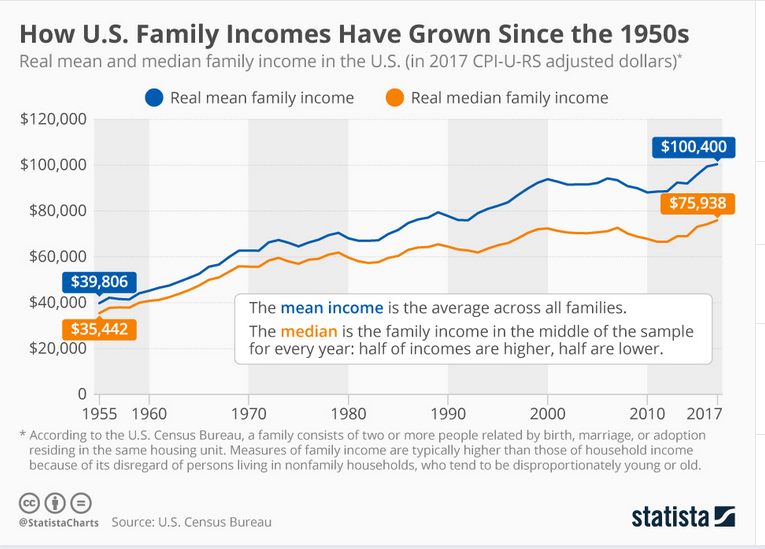
No wonder we must have tariffs to “bring back good-paying manufacturing jobs.” I’ve commented on the myth of a golden age in the 1950s and 60s when everyone had a good-paying union job, allowing them to live better than we do today. If we can keep out the competition, we’ll return to “Happy Days.” That contention is fiction. The truth is quite different:
These quirks in our election system have enhanced populist power over both parties. Populism favors attractive or trendy changes in the present with less regard for future consequences. The French Revolution led to Edmond Burke delineating the differences between conservatives and populists. The former argues against tossing out what works for popular instant gratification.
Conservatives such as Barry Goldwater and Ronald Reagan adhered closely to our founding principles of checks and balances on a small government, free markets, personal and property rights, and an originalist approach to the law. Reagan knew who the nation’s enemies were, the “Axis of Evil,” and used the strengths of our free market economy to bring them down. With the Gipper’s presidential election, the Republican Party became the home for these ideas.
The two Bush presidencies wavered in some ways from conservatism but never repudiated it. Trump’s first term’s major successes were conservative: Lower taxes, reduced regulation, and originalists put on the Supreme Court were his marquee achievements. His tariffs were a contradiction, but limited and loaded with exceptions. He seemed to know who his enemies were. Unlike Obama, he sent lethal weapons to aid Ukraine against Putin. He blocked the Nord Stream 2 pipeline, depriving Russia of revenue.
Conservatives and similarly disposed libertarians could still see the Republican Party as a home compared to the Big Government populist Democrats of Obama and Biden. While many of us thought there were better choices, given the choice between Trump and Kamala Harris, we had to go with Trump. Others joined us in recalling Trump’s first-term conservative successes.
The Biden-Harris administration was the antithesis of Conservative principles. It’s wild spending greatly enlarged the Government’s presence in American life. Widespread executive orders sidestepped Congress, while the government’s power was used to go after political enemies, especially Donald Trump. With the Democrats always more favorable to tariffs, Biden maintained the Trump Tariffs. Biden forgave billions of student debt without any congressional approval. Biden was the progressives’ dream.
The first hundred days of Trump’s second term might cause Conservatives to reconsider. Instead of retreating from Biden’s excesses, Trump seems bent on seeing and raising Biden’s foibles. He set a record for issuing executive orders, many of which stepped on Congress’s and the court’s authority. His massive tariffs threaten the most significant tax increase in history, even though the power of the purse resides only in Congress.
Using the Government’s power to punish perceived enemies isn’t any more attractive to conservatives if Trump does it rather than Biden. Universities and the media may be biased, but we don’t want the Government dictating their policies and views. Petty retribution like removing protection from an Iranian death threat from Trump’s former Secretary of State, Mike Pompeo, for insufficient loyalty is just ugly. Punishing law firms for representing your opponents doesn’t sound like America.
Peace in Ukraine is a laudable end, but so far, Trump has demanded much of that nation, even a large part of its natural resources, and even cut military aid to Ukraine for a period to make his point. As far as anyone can see, he hasn’t asked for anything from Russia or caused it pain. Does he now see Putin as his ally? What would Ronald Reagan think?
Why aren’t the supposedly conservative Republican legislators standing up for congressional prerogatives? The fear of being primaried looms large. Just as A.O.C. frightens Democratic Senate Majority Leader Chuck Schumer with a run at him or Party vice-chairman David Hogg threatens older leaders to push the party in a progressive direction, Trump uses the threat of primaries to keep Republicans on board.
All this leaves traditional conservatives and libertarians feeling as orphaned as we did early in Trump’s first administration. When pleasantly surprised by Trump’s conservative accomplishments, we could tell ourselves that Trump wasn’t who we thought.
Now, after these first hundred days, we find that maybe he is who we thought all along, but was constrained by others in his administration, including his daughter, son-in-law, and Republican leaders in Congress.
Whatever the case, both parties evidence a preference for a big, intrusive government unafraid to use its powers against those who disagree. Even though our limited free-market Government is the world’s envy, those who favor it have lost their political voice. What I feared years ago is coming to pass today: back to the “Future Party” drawing board. In a representative Government, we need representation.
 Detour on the Road