As we enter 2025, some ’24 mysteries remain unresolved. Donald Trump ran his successful campaign with a variety of seemingly contradictory positions. I was reminded of these when the Cafe Hayek blog pointed to economist Mark Perry’s illustration:
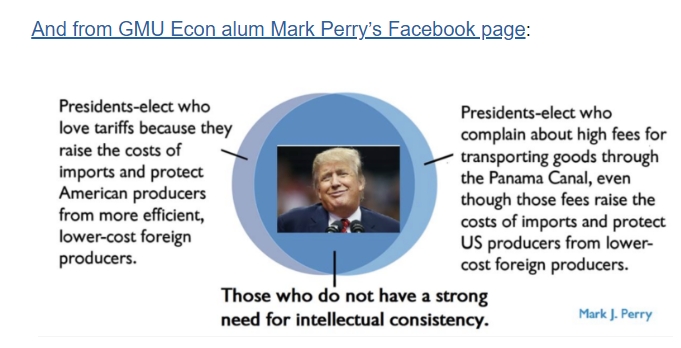
This contradiction made me think of other Trump contradictions. Peace and safety while withdrawing our troops from the Middle East. Without our support, the Kurds overseeing tens of thousands of ISSIS followers may face an attack by Turkish forces, rendering them unable to prevent a resurgence of the deadly group. Remember, Turkish leader Erdogan has territorial ambitions of his own. This possibility doesn’t sound peaceful to me.
We all know that politicians make all sorts of claims that step on each other, but now it’s time to introduce legislation, and conflicts remain unresolved. The idea is to write one or two big reconciliation bills containing the whole Trump program.
Inflation is a paramount issue that accounts for Trump’s victory, yet many of the president-elect’s promises are likely to raise prices. Besides tariffs that, like sales taxes, increase what you’re paying, lower taxes for favored groups, such as those working for tips or retirees, will likely result in higher interest rates or printing money. As I’ve pointed out, either will raise prices.
Unquestionably, the Biden Administration’s wild spending on the Green New Deal, infrastructure, and chips led to the highest inflation in forty years, but will Trump attempt to repeal all of this legislation? Taken together, these acts are an enormous industrial policy. Repeal all since state-directed economies have no record of success.
The question is whether Trump will tackle the problems wholeheartedly or simply piecemeal. The latter will be conflict on conflict. For instance, will Trump’s buddy, Elon Musk, stand still for eliminating his electric vehicle incentives and green tax credit sales? Will members of Congress allow the scrapping of big projects scheduled for their districts? Many businesses have sunk big money based on the Biden-era legislation. Can they continue without the promised subsidies and credits, or must they swallow significant losses on sunk costs? Even major oil companies put big bucks into green projects.
Will Trump rip the bandaid off rapidly or painfully remove it little by little? Much of the Biden legislation had union-friendly provisions. Will Trump’s cozying up to organized labor make him hesitate? What he trumpeted in ’24 makes 2025 a mystery.
Another lingering mystery is how the Democrats, after brilliantly setting up the Republicans to nominate their weakest candidate, turned around and put forth an even weaker candidate. Realizing several Republicans, such as Ron DeSantis or Nikki Haley, likely would trounce Biden, they swamped Trump with weak legal cases making him sympathetic to Republicans while sucking all the air out of rival campaigns.
However, once the Republican convention named Trump, it was time to pull the switcheroo. Somehow, they got Biden to agree to an early debate. It exposed him as the doddering old man he’d been for years. With time for a news-dominating mini-primary, setting up the Democrats to get out from under all the Biden failures with a bright, young, new face, victory was in sight.
So, how did the Democrats come to nominate a candidate less popular than Biden or Trump? A woman so devoid of political talent that when she ran for president in 2020, she had to drop out before the first primary. Yes, she is the vice president, but the position had little to do with talent and everything to do with her color and gender. If she had anything other than those two attributes, forcing out Biden earlier would’ve allowed her to run as the incumbent on her record.
I had hoped that by now, we’d know whether Biden was involved in the plan to switch candidates after Trump became the nominee or if he was in the dark. It’s hard to believe a wave of questionable legal questions arose without some coordination or signaling to entwine Trump. It always seemed there had to be a plan, but maybe it was just a fortuitous coincidence.
Even if that was true, why, when presented with a path to victory after the Biden-Trump debate, did the Democrats fall in line behind their weakest candidate? After a short pause after dropping out, Biden backed Harris, and everyone fell in line. Was Joe unaware of the plan, or did Joe decide to screw the others? The plan was flawed if Joe wasn’t on board with the switch. If Joe was in on it but either changed his mind at the last minute or planned to get the plan authors all along, he is a nastier piece of work than even I thought.
We’re still in the dark about what happened. Someone should’ve spilled the beans by now, but maybe everyone has a book deal.
If anything, it is an example of what Donald Trump hoped to accomplish with high tariffs: Nippon Steel’s offer to acquire the antiquated U.S. Steel and invest billions to bring it up to world standards fills the bill. The updated mills promised to make better products at a lower price. In the campaign, Trump proposed lowering taxes on companies producing here. Others would face high taxes and tariffs.
The Japanese firm was reacting to Trump’s earlier high steel tariffs, which Biden had retained. It would seem that Nippon Steel’s answer to tariffs is what Trump hoped would be emulated by others, and with more production in the U.S. The mystery is why Trump came out against the deal. Many steelworkers favor Nippon.
A Japanese company, Nippon Steel, isn’t a security threat. Japan is our most important ally in facing up to China. Why poke a finger in our friend’s eye?
As one of his last acts, Biden has nixed the deal. The president is as pro-organized labor as they come, and the steelworkers union opposed the agreement. Updating the mills can only be accomplished through automation, but that eliminates some jobs. As seen recently from the dock workers, unions are against automation.
We expected Biden’s veto, but Trump’s opposition contradicts his proposed goals. Why would international companies relocate operations to the U.S. if unions could veto efficient production? As with the President Elect’s support of the dock worker anti-automation stand, it makes no sense. Does anybody know where Trump stands? Does Trump even know where he stands? That’s the mystery.
Maybe we’ll get some answers to these ’24s mysteries in ’25.
 Detour on the Road