Arriving at a Decision

Looking through my morning Washington Post Opinion email, I noticed many of the Op-Ed articles were authored by people once known to be right of center. Max Boot, Joe Scarborough, and George Will were once Republicans but now compete to show how much they loath President Trump. They are joined by a legion of other writers once on the right at the Post and other opinion outlets. In the Sunday New York Times, Frank Bruni crowed the Lincoln Project made up the last Bush administration staffers had raised $18 million to run anti-Trump ads. Apparently, the online journal “the Dispatch” raised its capital to criticize the President. All seem poised to cast their vote for Democrat Joe Biden.

As readers of this blog know, I’m no great fan of our present President. I didn’t vote for him in ’16. Faced with the choice between Trump and Clinton, I opted for the Libertarian Ticket. By voting for two successful governors and a chance to expand our options, this was the best I could do. With Justin Amash’s failure to launch, this time, there is no reasonable alternative to the two major-party candidates. It looks like I’ll have to choose between Biden and Trump. (Still time for Michelle)

To come to a decision, a look at how each stands on the significant issues foreign and domestic is mandatory. Neither is going to fully satisfy me, but on balance, which in my opinion would be better. Let’s look at how each candidate might approach Foreign and domestic issues.

Continue reading
It’s Time to Think About the Children

We are about to make a horrible mistake. In numerous parts of the country, grade-schoolers will be going back to school on a less than regular basis or worse, not at all. We are regularly being lectured by many of our elites; we must follow the science. Yet, some of the same people have willfully ignored it. President Trump is excoriated for merely pointing out our children need to be in school. Already our children have fallen behind by up to a half year. This loss falls most heavily on our most vulnerable. We’ve found the younger the student, the less well distance learning works. The American Academy of Pediatrics has pointed out how important it is for children to be in school. Not only for education but also for social development they want the kids in school. If we don’t get them in school this fall, they may never catch up. This would be a devastating loss for our children and for our country.

The odd thing is we are having this conversation at all. There never was a coherent reason for closing the schools in the first place. Sweden never closed its primary schools. Its neighbors, Denmark and Norway, have been re-opened for months. Norway’s prime minister Erna Solberg has asked, “Was it necessary to close the schools?” She answered her own question, “Perhaps not.” In any case, they all opened without significant problems. A recent study showed schools in Finland closed schools between March 18 and May 13 while Sweden’s schools remained open. Despite that, the authors concluded, “Closing of schools had no measurable effect on the number of cases of COVID-19 among children.” It seems the worldwide consensus is the danger of keeping kids out of school far outweighs the risks of being in school. After all, the data shows children are much less affected by Covid-19 and spread it less.

Given the data, schools across the nation need to be formulating plans to open at least primary schools ASAP. There may be Covid-19 flareups in individual districts, but the goal has to be open all as soon and as much as possible. As in other countries, some employees, from teachers to bus drivers, may have pre-existing conditions that preclude their physical presence. If they can’t contribute remotely, they will need to be replaced. With double-digit unemployment, substitutes should be available. Any problems such as supplies and testing need to be identified so help can be delivered in a timely fashion. The Federal government could anticipate needs and be ready to backstop. The big thing is everyone needs to commit to getting the kids back in school. The assumption has to be we are going to be open in the fall.

Continue reading

Why Not The Best?

Recently one of the architects of the Affordable Care Act (ACA), Ezekiel Emanuel, wrote a Wall Street Journal OP-Ed. In the article, he concedes the ACA has mostly been an expansion of Medicaid.This is a program paying providers so poorly many refuse or severely limit service. In light of this, Emanuel now acknowledges the ACA isn’t working and needs replacement. His recommendation is we look to the health plans of Germany or the Netherlands. He chooses these two, “where citizens choose among competing private health insurers called “sickness funds,” are closest to the U.S. system.”

Why would we want something close to what we have? Our present healthcare system is a costly mess. Just 11 days earlier, George P. Shultz and Vidar Jorgensen had an article on the same Op-Ed page. It pointed to Singapore as providing top-notch healthcare at a low price. By most measures, Singapore is at the top national healthcare heap. Why ignore this success? Why promote the lower performing German and Dutch systems? Maybe Emanuel only writes for the WSJ Op-ed page rather than reading it.

With the possibility of the ACA being declared unconstitutional, real discussion healthcare has to take place. Even if a decision is delayed, it will be a significant topic in the upcoming election. It’s no embarrassment to look to other nations to find what might work better. According to Shultz and Jorgensen, Singapore is the place to start. Some may say Singapore is too small to compare. Yet, many people keep throwing up comparisons to the Scandinavian nations. Only Sweden has a larger population. Singapore also measures up favorably on a per capita wealth basis.

Shultz and Jorgensen mention Scripps College economist Sean Flynn as a statistical source on Singapore. Strangely, this name came up in Steve Forbes’ fact and comment in his magazine’s June/July issue. Forbes lauded Flynn’s book “The Cure That Works.” I found it on Amazon and immediately downloaded the Kindle version.

What I received was a clear and easy to read look at arguably the world’s best healthcare system. The author frames this with an understanding of how we got to our present healthcare system. What’s peculiar is this remarkable book was published over a year ago. Still, Forbes and I are only talking about it now. Regardless of flying under the radar, it is an essential contribution to our healthcare discussion.

Continue reading

Some Observations

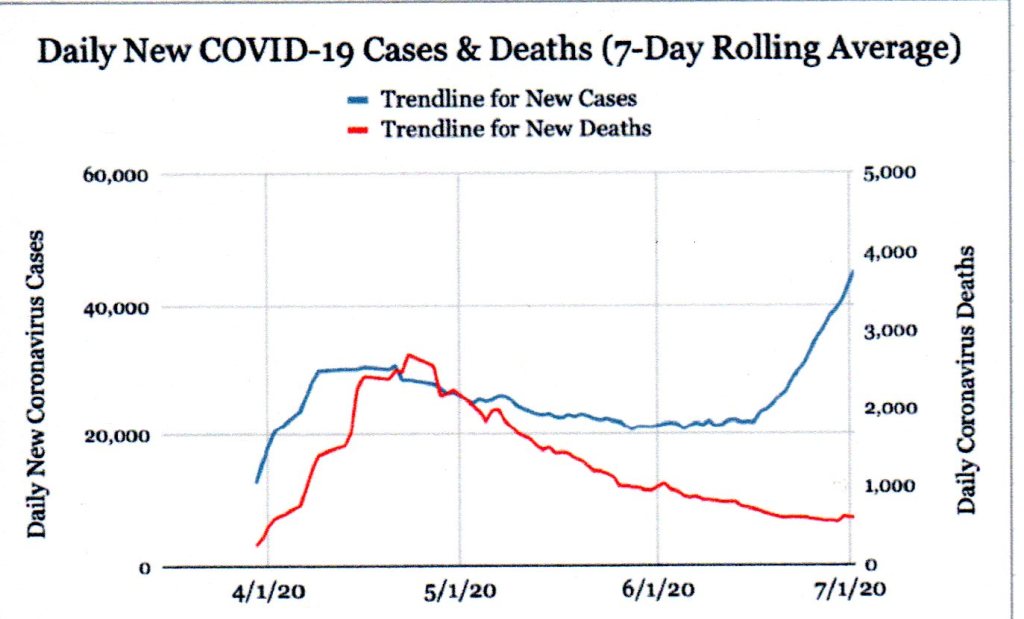
It is interesting to observe some of the things I predicted would happen have taken place. If we did a better job of protecting the elderly and others with underlying conditions, I said we could reopen the country without causing a massive death toll. Younger and healthier people may get the coronavirus in higher numbers, but very few would die. Most of the country has now been opening up. Protecting the vulnerable has been better. Also, people at risk and those close to them are more aware and have taken proper actions. Mask wearing other PPE use around the vulnerable has dramatically expanded. Even Gov. Cuomo now seems to recognize nursing homes must be protected. We still haven’t taken all the measures I proposed, but we have made progress. If better-targeted protections didn’t reduce mortality, then increasing confirmed cases would lead to increased deaths. This chart shows otherwise. Cases have significantly increased, but as I predicted, fatalities haven’t.

Early on, I also wondered why mask-wearing, especially where vulnerable people are present, wasn’t at least encouraged. Even though masks were widely worn in Asia where they had better outcomes, it wasn’t until April 3. The CDC reversed itself and favored masks. There was a shortage of medical gear, but the CDC in April encouraged homemade masks. Peop[e responded. Nothing prevented earlier adoption. This waffling by the authorities has led to needless controversy. Until now, our President seemed to resist wearing a mask. He should’ve set the right example. Can we all agree to wear a mask whenever you might be near an at-risk person? You may save your grandma.

Our failure to do targeted things to protect the at-risk early on has caused needless deaths. Now that more is being done, the results are evident. The better job we do protect the at-risk, the lower the number of deaths. That was always the choice. Not the false one of lives vs. the economy expounded by so many of our leaders.

n my posts at the time of the Ferguson, Mo in 2014 riots after the death of Michael Brown, I warned of the “Ferguson Effect.” If the police were placed in a no-win situation, they would be much less aggressive. This would result in rising crime and murder rates in lower-income areas. The statistics since have borne this out. Rather than recognizing more deprived regions anywhere in the world need more not less police presence, the police are demonized. Instead of striving for a workable community balance to improve the lives in higher crime areas, we have gone in the opposite direction. By disrespecting policing to the point of defunding, the predicable rise in minority deaths is already occurring. This will only get worse. We will see even more Blacks’ lives lost. We are endlessly told “Black Lives Matter,” but do they? To whom?

Continue reading

Wealth And How To Get It

The prevalent idea promoted across much of our media is the vast disparity between white and black wealth is indicative of “systematic racism.” No matter the reason, the gap exists. What is lacking actual proposals to increase black or anyone else’s wealth. What is offered generally involves money transfers or mandated higher wages. This may or may not increase wealth, depending on whether the additional money is saved or consumed. Wealth is just another way to say net worth. We determine our net worth by subtracting what we owe from our assets. What is left is our net worth.

An easy way to understand this is to look at how many people’s two biggest assets would determine one’s net worth. Say you buy a house for $100,000 and auto for $20,000. You were able able to acquire both with 10% down and to borrow the rest. You have $120,000 in assets and debt of $108,000. That leaves a $12,000 net worth. From that point forward, we have to mark the assets to their present market value. Autos are a depreciating asset. They lose value the instant you buy one. Real estate may depreciate or appreciate depending on several factors, the greatest one being location. If the real estate fails to appreciate and the car continues to depreciate, you’ll have a declining net worth. It could even turn negative. Keep this in mind.

Only the portion of one’s income actually saved can add to net worth. Unless it is used to obtain a capital asset, it cannot grow. Putting money in your mattress stays the same. If the assets acquired appreciate it adds to net worth. Maybe the asset gives a return of interest, dividends, or net rent. If those are reinvested, they can also add to wealth. If the value depreciates, your net worth reflects this adversity. This is all basic stuff but is often overlooked.

How do we help those with a net worth deficiency? I submit the “Expanded Dave’s Plan” would be an excellent place to start. Everyone has a Personal Benefits Account (PBA). It consists of two sub accounts at the financial institution of their choice. One combines all tax-favored savings accounts and the other a regular bank account. A catastrophic Health Care plan is associated with the tax-sheltered account. Significant medical bills can wipe out savings, but here we have protected them with a Catastrophic Policy. Employers and governments contribute proper benefits directly into the appropriate account. They’re yours even if you change jobs, locations, or both.

Continue reading