A year ago, I was still befuddled by the Democrats having secured the Republican Presidential nomination for the weakest candidate, Donald Trump, by burying him in bogus lawsuits. That made him a sympathetic figure to many and sucking all the media attention away from his competition. Democrats nominated the only person who could manage to lose big. While pondering this turn of events, I had to come to terms with the fact that Trump was back.
As I pointed out at the time, the outlook could be very positive. After all, Trump’s first term employed supply-side economics to cut taxes on capital and work to reduce onerous regulations. These actions have led to solid pre-COVID growth. Increasing supply is the best way to tackle the high inflation engendered by the Biden administration’s heavy spending. A government-directed economy was shoveling vast sums into the fight against “climate change.” Covid relief swallowed more billions.
Daming the river of wild spending to reduce demand growth, while pumping up supply, worked for Reagan in subduing double-digit inflation and promised to work for Trump. Sure, Trump had added some things to his campaign, such as no tax on tips, overtime, and Social Security, which are not supply-side, but on balance, things looked to be improving on the economic front.
After Trump’s peaceful first term, the war in Ukraine and in the Middle East raged under Biden after his disastrous Afghan withdrawal. In the campaign, Trump promised to bring peace quickly to both areas.
Millions of illegal aliens streamed across our southern border, with the Biden administration just throwing up its hands. Americans know they need immigrants, but not in this way. Trump promised to get control of the border.
The Trump Administration has taken action in all three areas, but it’s unpopular:
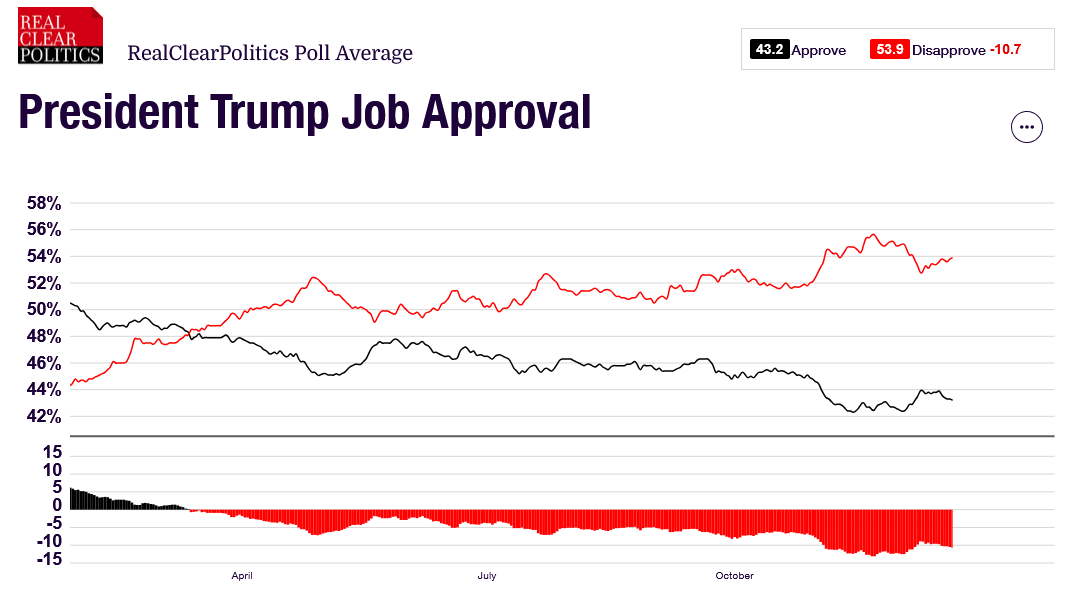
The question is why? While other essential problem areas, such as education and healthcare, exist, these three are most directly under the president’s control. The states dominate education, and neither party has a handle on reasonably priced healthcare.
While Trump, in his first term, imposed tariffs on a few products, such as steel and aluminum, and forced a revision of the NAFTA trade treaty with Canada and Mexico, the administration granted many tariff exemptions, and the new treaty had only minor changes. This time around, Trump has wielded tariffs like a club, hitting everyone in the room.
One thing we know about tariffs is that they don’t lower prices—quite the opposite. Claiming crisis conditions and national security, Trump last spring imposed the highest tariffs on imports since the infamous Smoot-Hawley tariffs—coffee from Brazil and chocolates from Switzerland were deemed existential threats.
Radically adjusting supply chains and coping with ever-changing rates can delay many businesses’ decisions. How does this increase supply?
Adding to its industrial policy by tariff, the administration has chosen to take direct equity positions in certain companies. These actions are picking winners and losers. Who do you think your government will favor: you or the company it partnered with?
The confusion may only grow, with the impending Supreme Court decision on the legality of the bulk of Trump’s tariffs. If, as expected, the court decides Trump overstepped, chaos may reign. Costco, along with many others, has already filed suit for a refund.
The Biden administration’s schizophrenic approach to both the Ukraine and Middle East wars was to provide enough aid to keep the wars going, but not enough to end them favorably. Weapons, if delivered in a timely fashion, might’ve given Ukraine an edge, but were delayed, and even when provided, they came with range restrictions, shielding Russia from pain. In the same fashion, the administration never committed to an Israeli victory.
Given the violent attacks both Ukraine and Israel suffered, and are considered our friends, one might think Trump would favor robust winning strategies for the two victims. In the Middle East, this was undoubtedly the case. Not only was Hamas cornered, and Hezbollah neutered, but the U.S. actually joined in on taking out Iran’s nuclear capabilities. We provided arms to Israel with little or no limitations. So far, we have a favorable outcome.
Strangely, our policy towards Ukraine is the opposite. We only provide arms if Ukraine’s European friends pay for them. Even then, we’ve put on range limitations. At times, we’ve withheld satellite and other intelligence. Applying real pressure on Putin’s Russia seems out of the question.
I wrote that Trump could exact concessions from the Russian dictator by providing Ukraine with weapons that reach Russia’s war machine deep inside Russia. As I’ve pointed out, you can’t win if you can’t shoot back at where the bullets are coming from.
If Trump thinks Russia will suddenly become our ally against China, he’s delusional. As I pointed out, China will never stand for an unfriendly power controlling its northern trade route. In truth, Russia is just a Chinese vassal state. If Russia can’t handle the much smaller Ukraine, it stands no chance in a land war with China, and it knows it.
Just like his tariff policy, Trump leaves Americans and the rest of the world in confusion.
An administration bright spot is the closing of our southern border to illegal immigration. Americans of all backgrounds were appalled by the millions we knew nothing about pouring in. We suspected that some evil people were among them. Trump slammed the door shut and started rounding up bad actors.
We applauded,m but then the government told those who might be here illegally, but making positive contributions, to self-deport so they might come back legally—deportation if caught results in a ban forever. If, in the course of finding bad people, they run across any of these good people, they’re out. Fear grips many communities.
Living in Arizona, I encounter Hispanics and others appearing to have come from elsewhere daily. Yesterday, I was talking with a neighbor who came from Peru twelve years ago. I have no idea whether any of them came legally, but they are all employed and contributing to our society every day.
In a nation facing a falling population without immigrants, there has to be a better way. I’ve suggested reforms that can have positive results. Tossing out productive neighbors isn’t popular with most Americans. How is having a labor shortage in many areas going to lower prices?
Instead of fulfilling our hopes, the Trump administration seems more like an extension of the previous one than a problem solver. Earlier this year, I wondered if it had topped out. The expanded confusion shows I was right:

If only Trump expanded on the supply-side policies that worked so well in his first administration, rather than devolving into “Ancien Regime” mercantilism. Everyone benefited in his earlier term, and even minorities increasingly voted for Trump. Currently, he resembles Louis XIV much more than Reagan.
Now the administration adds Venezuela to these headscratchers. Does anybody have any idea what we’re really doing there?
 Detour on the Road