Republicans For Industrial Policy?

In my last post, the case of Disney, a major corporation attempting to intervene against a duly passed Florida law banning the sexualization of third grades and under and requiring informing parents of a child transitioning, highlights big business going in a new direction.

Among those criticizing Florida Governor Ron DeSantis for standing up to Disney are prominent Republicans, including other presidential candidates. With this in mind, I’ve been pondering Larry Kudlow, Trump’s top economic advisor, claiming the next election will turn on economic policies. Where are the Republicans on this?

In the past, Republicans followed Reagan in relying on capitalism and markets to drive us forward. Industrial policy found favor with democrats. Lately, some prominent Republicans have been echoing the “the Government Knows Best” line. Beyond the sizeable number signing on to the heavy subsidies underlying “The Chips Bill,” Senators Tom Cotton, Marco Rubio, J.D.Vance, and Todd Young recently spoke at an event organized around a policy manifesto called “Rebuilding American Capitalism: A Handbook for Conservative Policymakers.”

Signing on to this manifesto aligns these senators with those claiming capitalism hasn’t produced for America, so the economy needs government direction. The belief outsourcing “good paying manufacturing jobs” in the Rust Belt underlies the decline in the middle class and forms the basis of the manifesto. The idea is to bring these jobs back by giving subsidies, imposing tariffs, and strengthening unions. 

These Republicans have concluded Adam Smith, David Ricardo, and Ronald Reagan have no validity in today’s world and that a form of state corporatism is superior. In my series “The Long Journey To More'” I pointed out the fallacy of this position.

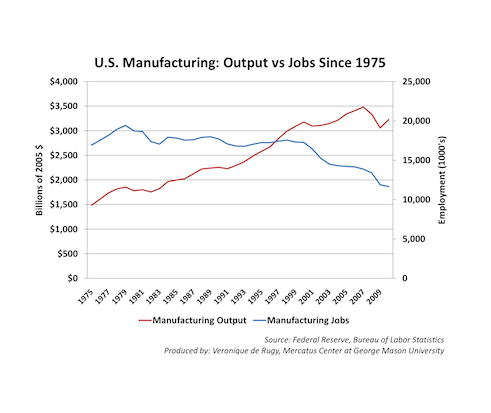
Further, this stance has little factual basis. Automation replaced far more workers than outsourcing. In both cases, high labor costs in the U.S. forced employers to make economic decisions. However, manufacturing continues to grow here even as manufacturing jobs decline.

High Union wages and inflexible work rules led to the migration of manufacturing to right-to-work states, mainly in the South and abroad. Bringing these jobs back to the Rust Belt in any number can only be done at a very high cost, especially if the jobs are unionized. 

While China gained unfairly with subsidies to specific industries such as steel, other friendly nations benefited from globalization as well. Building a fortress America producing everything here is a pipe dream. We can’t make everything and must sell farm goods to others. We have more job openings than people looking for work now. Where would we even get the people to produce everything we need? Higher costs will add to inflation.

While we expect progressives to indulge in fantasies, Republicans should know better. Since the rise of capitalism, no government-directed economy has produced anything close to its results. An elite group of “brilliant” people at the top never matched the mass market’s verdicts. One reason is people will always make mistakes; the market punishes the failure and directs resources in successful directions. Political leaders are loathe to admit defeat. As we’ve seen, stakeholders demand bailouts rather than lose out.

Republicans must be aware of today’s industrial policy. A significant part of which is the Green New Deal. Its present form is simple-produce all our electricity with solar and wind to power everything. Plug in your Industry, your home, and transport. Subsidies, regulations, and protection will make it happen quickly to save the planet. What could go wrong?

Unlike Ford, GM, and others, the #2 auto producer Toyota has resisted the total Electric Vehicle approach. Its lineup in the future includes hybrids and hydrogen-powered vehicles. The company has a long successful history with gas-electric, but why hydrogen? As a significant heavy truck producer, it knows electricity with its heavy batteries isn’t suitable for large loads. Hydrogen makes more sense. That fact will spread hydrogen stations across the world.

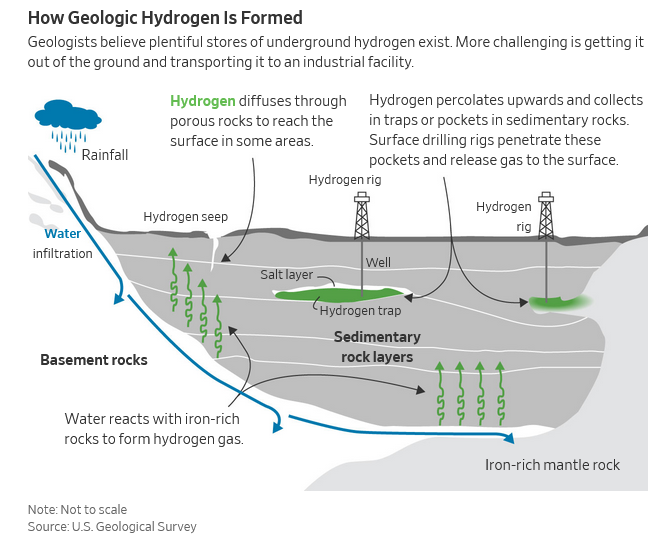
While hydrogen presently requires large amounts of electricity, naturally occurring hydrogen may become available. How ironic is it oil and gas drillers have run across deposits in the past but were not needed then? Using A.I. to go back over their data could be illuminating. The same oil and gas industry may still power the future.

We are still determining if hydrogen or another source will power us. The truth is nobody knows. Rather than betting the house wind and solar to power everything, including autos, the capitalist solution is to let the market sort it out. 

We’ve seen enough results of significant decisions by ruling elites that people wouldn’t do without mandates. China’s one-child policy and the extended covid lockdowns come readily to mind. Those disasters will affect us far into the future.

Republicans have to figure out who they are. Adopting capitalism has bought “More” by far than any other system. Why would you want to copy the top-down Soviet economy that lost the cold war to be another failed industrial policy state?

As China turns away from the free market, maintaining classical liberal policies here will leave it in the dust. It worked before, and there is no reason to think it won’t work again.

Rather than erecting trade barriers, let’s widen trade with our friends. Trump and the Democrats dumped the Trans-Pacific Partnership. We have yet to conclude a liberal trade agreement with the U.K. Rather than trying to do the impossible of producing everything here, let us diversify our supply chains with friends and those obeying the rules.

Most countries know China’s problems and are making market decisions to rely less on that nation. We should join them. As China loses business, it may even change. With a rapidly aging, unbalanced population China might become aware it needs to return to markets and friendly trading partners.

Some Republicans hold up Trump’s anti-trade tirades and tariffs. For all his bluster, his trade deals favored expanded trade, and his tariffs only hurt us. How can you follow a guy who thinks China pays the taxes rather than our importers? We write the checks right here.

Republicans signing on to Industrial Policies need to switch parties or do some summer reading. Adam Smith’s Wealth of Nations, Frederick Hayek’s Road to Serfdom, and the more recent Super Abundance by Marian L. Tupy and Gayle L. Pooley might give them some idea of what works. If you want to win, this is a place to start.
The Truss in the Coal Mine

Ex-Prime Minister Liz Truss has taken it on the chin. Mocked by the U.K. tabloid, the Daily Star newspaper, as unable to outlast lettuce, she proved to be the U.K.’s shortest-serving P.M. The scorn crossed the pond to the New York Times featured columnist Maureen Dowd. She dumped on Truss because “She didn’t understand that you couldn’t simply borrow money from the future.” This a strange observation from someone living in a nation with $31 trillion in debt. I’ve always found Dowd more snark than depth, and she continues to prove me right.

Nevertheless, Dowd is symbolic of the elite class here and abroad, claiming awareness of how debt and interest work but having no clue. I fear they’re going to find what their hubris has wrought.

While so many are having a great time over Liz’s political demise, we need to heed the message it delivers. While Truss’s fiscal plan is radical to some, it mostly follows the route taken by Margaret Thatcher and Ronald Reagan. Reducing stifling taxes and regulations to increase goods and services to offset too much money chasing not enough goods worked for those successful leaders. 

Truss opened the nation to fracking and new leases for offshore exploration to increase domestic oil and gas. She also reduced regulations. The most expensive part was that her proposed subsidies offset the U.K.’s sky-high energy costs. The E.U. will pay a similar fortune to subsidize energy to avoid a crisis. The plan also included some tax cuts. What government could survive its people freezing through the winter? In response, markets reacted harshly to the nation’s bonds and currency. The turmoil forced the Bank of England to intervene.

With only limited political support and an astonishing lack of grit and skill, Truss crumbled. 

Continue reading

Stopping Inflation III

In the previous two posts, I pointed out how we have restricted instead of expanded the supply of crucial commodities leading to higher prices. Higher prices are just another way to say inflation. Another way to raise prices is to add to costs. According to Forbes, the United States is no longer in the top 15 countries to do business. While U.S. News & World Report rates us the 6th best nation overall, it drops us down to #45  in their “open for business” category. Why isn’t the U.S.at the top of the business-friendly? What does it mean for prices now and into the future?

I discussed Ezra Klein’s lament that the Government couldn’t do things reasonably a few posts ago. Government policy determines whether a place is an excellent place to get things done. Comparing a Government-sponsored high-speed rail in California and a private venture in Florida, the latter exists while the other is a rumor. Already owning the right of way, the private railroad didn’t have to deal with governments. Unfortunately, most businesses don’t have that luxury. Hence our poor ratings.

Two things vex people in dealing with governments: who are the responsible person I can deal with, and how much time will it take to get approvals? Faced with these hurdles, it’s no wonder many businesses decide to set up shop elsewhere. Being bounced from one agency to another while being hit with lawsuits from environmentalists, nimbies, native Americans, and preservationists have been the fate of far too many ventures.

For those unable to go elsewhere, costs can be open-ended and only recovered at higher prices—a housing project scheduled for one-year development that takes three results in expensive houses. How we can turn this around while still respecting the concerns of others is the challenge. 

Continue reading

Catching Up With Rapid Change

Has it only been a little over a week? So many solidly held assumptions turned on their heads. The vaunted Russian military would make short work of the corrupt Ukrainians. We gave them some arms showing our compassion. Of course, not nearly what we could’ve, but they’d lose them in a short Russian victory. We could all wring our hands and then go back to our lives. 

The always anti-war left, the never interfere abroad libertarians, and the “America First” conservatives echoed Nevile Chamberlain in their dismay of involvement in a “quarrel in a faraway country between people whom we know nothing.” Chamberlain’s appeasement was over the Sudeten in Checkoslovia. A less than a two-hour flight from his London. The world is much smaller now. 

Supposedly intelligent people believed Ukraine was out to conquer Russia. Many agreed with Fox News’s Tucker Carlson and others it was our fault because we decided to extend NATO to so many ex-Russian-dominated Eastern Europe countries. By desiring to join them, Ukraine threatens Russia’s existence. It seems so quaint now. 

The only one threatened was Putin. A prosperous capitalist Ukraine on Russia’s doorstep would illustrate his failures. The same threat Taiwan presents to China’s Xi. Even with China’s progress, the island’s per capita income is double the mainland.

Continue reading

Job Description

From packages taken from the doorstep to luxury stores hit by gangs, crime is taking on a life of its own. Even the Fox Christmas tree burnt down. Our greatest cities suffering from lawlessness and filth no longer are tourist draws—many experiencing out-migration. The situation only seems to be getting worse.

How did we get to this point? We have to ask how we have departed from civilized norms. To understand the problem, we must revisit what we expect from our elected governments—at a minimum, going about our business without fear for our person or property. Walking down the street or opening for business shouldn’t be an act of foolhardy courage. We pay taxes to enforce the laws allowing civilized society.

In my series “The Long Journey to More,” I observed the only way to get an increase from present circumstances was to take it from someone else, trade for it, or innovate. As we innovate and trade our way to “More,” the idea of taking it from others should become unacceptable. Our military and law enforcement must keep predators from taking what we value.

Limited food, clothing, and shelter meant getting from others before they got from you for most of human history. The strong subjugated those weaker and left most at subsistence. The powerful got “more” and fought to preserve what they had and to extend their sway over others.

The Vikings used their versatile ships to both raid and trade. In an earlier time, they were an example of how things worked. In our era where more people live well above subsistence every day, the tolerance for those preying on others should be diminishing. Instead, we appear heading in the opposite direction.

When we have all sorts of programs to feed, clothe and shelter those in need, what if anything justifies anyone taking from someone else? If government programs weren’t enough, we have a multitude of charities providing aid. One would have to work hard to starve to death. Only exceptional circumstances result in malnourishment. Never in history have we had more support for the unfortunate, yet we find the news now dominated by lawlessness.

Continue reading